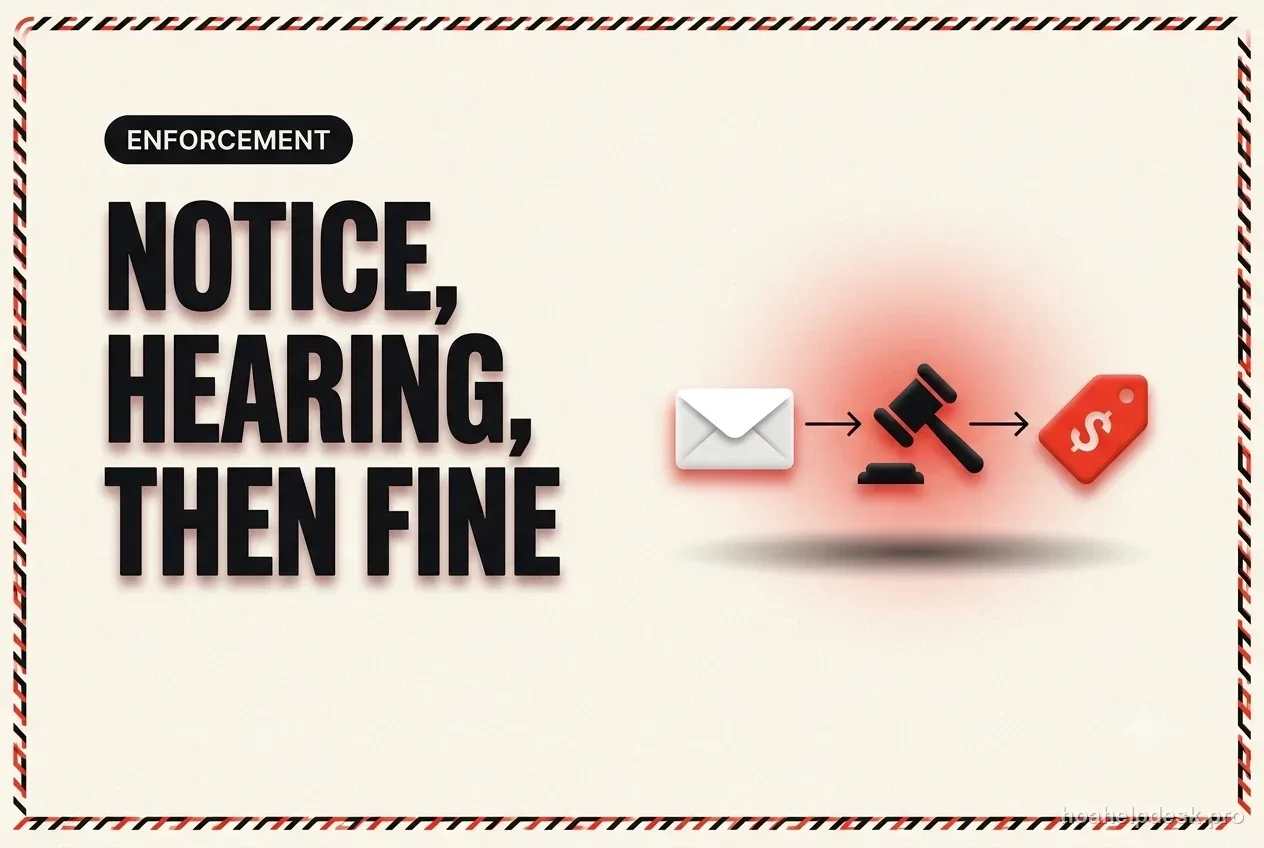
Due process isn't a courtesy — it's what makes the fine collectible
Boards sometimes treat notice and hearing requirements as an optional nicety, something owed to the homeowner as a matter of fairness but not strictly required before a fine can stick. That's backwards: due process is what makes the fine legally enforceable in the first place. A fine imposed without proper notice and a genuine opportunity to be heard is frequently unenforceable outright — meaning the association's own procedural shortcut is the reason a legitimate violation ends up uncollectible.
The two-part pattern many states and governing documents use
Where the applicable law or governing documents impose fine procedure, the requirement commonly has two parts: written notice describing the specific violation and citing the rule allegedly broken, and a genuine opportunity to be heard — in person, in writing, or both — before the board finalizes the fine. Confirm which of these your state and documents actually require, and store each procedural element and its deadline separately: notice content, notice timing, the hearing format, any fine-schedule requirement, any independent committee or appeal step. "Genuine" is doing real work in that sentence: a hearing scheduled with no real chance for the homeowner to attend, or a board that has already decided the outcome, satisfies the letter of the requirement while defeating its purpose.
Notice content matters as much as notice timing
A notice that says only "you are in violation of the rules" without identifying which specific rule, which specific conduct, and what corrective action would resolve it gives the homeowner nothing to actually respond to at a hearing. A defensible notice states the rule by its specific number or section, describes the observed violation with enough detail to identify what happened and when, states the proposed fine amount, and explains how to request a hearing and by what date. Boards using a generic template notice that doesn't get filled in with these specifics are creating a record that looks procedurally compliant on its face but won't hold up if the homeowner challenges the sufficiency of the notice itself.
Confirm your state's specific notice-period and hearing-format requirements → confirm whether an independent committee is required or the board itself can hear it → adopt a pre-set fine schedule the board applies consistently → build a notice template that states the rule, the conduct, the amount, and the hearing process → document every hearing's outcome in the minutes.
The fine schedule has to exist before the violation, not after
Fines applied inconsistently, or set at whatever amount seems appropriate for a given violation in the moment, are a recurring basis for a successful challenge — the standard most states and most CC&Rs expect is a pre-adopted, published fine schedule the board applies the same way to every violation of the same type. A board that decides to fine a first-time trash-can violation $50 for one owner and $200 for another, without a documented reason tied to the schedule, hands the second owner's attorney precisely the comparison they need to argue the enforcement was arbitrary or retaliatory rather than rule-based.
A worked example: the hearing that wasn't one
An association sends a homeowner a fine notice for an unauthorized fence, states a hearing date, and the homeowner shows up — but the board has already discussed the matter and effectively decided the outcome in a prior closed session, with the "hearing" functioning as a formality where the homeowner is informed of the decision rather than given a chance to actually influence it. If the homeowner later challenges the fine, the board's own minutes from the earlier closed-session discussion can become the evidence that undermines the hearing's legitimacy — a genuine hearing has to happen before the decision, not be staged after it's already made. The safer practice is holding the substantive discussion and vote at the hearing itself, with the homeowner present and heard, not beforehand.
What happens when the board skips the sequence anyway
Beyond the immediate fine being unenforceable, a pattern of skipped due process can affect the association's lien and collection rights tied to unpaid fines specifically, since several states treat fines collected without proper hearing differently from properly assessed dues when it comes to lien authority. A board that has been informally skipping hearings for minor violations should audit its recent fine history before relying on any of those fines in a collection action.
Written versus in-person hearings — and why offering both helps
Not every homeowner can attend an in-person hearing on the scheduled date, and a board that only offers that single format risks fining an owner who genuinely wanted to respond but couldn't make the meeting time work. Offering a written-response option alongside an in-person hearing — let the owner submit a written explanation the board considers as part of the same process — closes that gap without adding meaningful burden to the board, and it strengthens the record showing the owner had a real, accessible opportunity to be heard rather than a single rigid format that happened to be inconvenient.
What a complete due-process file should contain
- The state statute's specific notice and hearing requirements.
- The pre-adopted, published fine schedule.
- The notice sent for each fine, stating rule, conduct, amount, and hearing process.
- Minutes documenting the actual hearing and its outcome, held before the fine is finalized.
- A record showing consistent application of the fine schedule across similar violations.
A template alone doesn't guarantee compliance
A well-drafted notice template only helps if it's actually filled in completely every time — a board that has the right form but leaves the specific rule citation or hearing date blank on a rushed notice has undermined the same protection the template was built to provide, so the person sending notices should treat every blank field as a required stop, not an optional detail.
Checking the gap between holding a hearing and holding it too late
An association attorney should review the board's current notice template and hearing process at least once, specifically checking for the gap between "we hold hearings" and "our hearings happen before the decision is effectively made" — this is the single most common defect in an otherwise well-intentioned enforcement process. Where the association is preparing to pursue collection on a fine, counsel should confirm the underlying due process was followed before the fine is added to any lien amount.
How 10 states handle imposing a fine on a memberVerified statute rules · tap to open
Verified against the current statute for each state, last reviewed 2026-09-10. A conditional entry applies only when its statutory gate is met — confirm that first. A research checkpoint, not legal advice.
California
A Davis-Stirling association may impose monetary discipline only within governing-document authority and its distributed penalty schedule. For ordinary violations the monetary penalty may not exceed the lesser of the…
discipline meeting notice: 10 days before board meeting to consider or impose discipline
Florida
A Chapter 720 HOA may levy reasonable fines for governing-document or reasonable-rule violations. The default statutory ceiling is $100 per violation and $1,000 in the aggregate for a continuing violation unless the…
fine/hearing notice: 14 days before hearing
Georgia
A POA Act association may impose and assess fines and temporarily suspend voting and common-area use rights only if and to the extent the recorded instrument so provides; the underlying violation must be of the…
Applies if: The POA Act is opt-in. A Georgia HOA that has not recorded that election is governed only by its declaration and the Georgia Nonprofit Corporation Code (Title…
TexasCondominium
Under Texas Chapter 82, a condominium association may impose reasonable fines if the declaration does not provide otherwise, but before a fine it must give the unit owner written notice describing the violation and…
Applies if: Do not resolve this Chapter 82 workflow from the label “Texas condominium” alone; creation date / opt-in status is a required gate.
owner hearing request: 30 days after written proposed-fine notice
Illinois
For a common interest community covered by the CICA, the board has statutory power to levy and collect reasonable fines for violations of the declaration, bylaws, operating agreement, and rules only after notice and an…
Applies if: Confirm CICA coverage before resolving any numeric rule; small-community exemptions can change the meeting layer.
765 ILCS 160/1-5 · Condo: 765 ILCS 605/18.4(l)
North Carolina
Unless the declaration supplies a specific fine/suspension procedure, a hearing must be held before the executive board or a qualifying adjudicatory panel. The charged owner must receive notice of the charge, an…
Applies if: Do not resolve this cell until Chapter 47F applicability for the association and the specific section is confirmed.
continuing-violation grace period: 5 days after fine decision
N.C. Gen. Stat. § 47F-3-107.1 · Condo: N.C. Gen. Stat. § 47C-3-107.1
Colorado
Colorado requires an association using monetary enforcement to follow a written enforcement policy and a fair, impartial fact-finding process. For a non-public-health-or-safety violation, the owner receives a 30-day…
initial cure period: 30 days after certified-mail notice of a non-public-health-or-safety violation
Washington
For a Washington planned-community association, the current-law source depends on creation date/election into WUCIOA. WUCIOA authorizes reasonable fines only after notice and an opportunity to be heard and according to…
Applies if: The substantive fine standard is similar across WUCIOA and legacy HOA law, but the controlling citation depends on the community’s statutory regime.
Arizona
Arizona permits reasonable monetary penalties for governing-document violations only after notice and an opportunity to be heard. A recipient of a written property-condition violation notice may respond by certified…
Applies if: Confirm statutory planned-community status before resolving the Chapter 33, Article 3 rule.
owner certified-mail response window: 21 days after date of written property-condition violation notice
A.R.S. § 33-1803(B)-(D) · Condo: A.R.S. § 33-1242(A)(11), (B)-(D)
Virginia
For a Virginia property owners' association covered by Chapter 18, monetary charges for violations require express authority in the declaration or duly adopted rules/regulations. Before a charge is imposed, the member…
Applies if: Confirm both statutory POA coverage and express document-based charge authority before showing Virginia fine ceilings.
hearing notice: 14 days before violation hearing
Va. Code § 55.1-1819(B)-(D) · Condo: Va. Code § 55.1-1959(B)-(D)
Need a state that is not listed, or the full condominium detail? Open the State Decision Lookup — it fails closed when the primary law is unclear rather than guessing. Every state also has a full governance guide.
Frequently asked questions
- Can an HOA fine an owner without giving notice of the alleged violation?
- Generally, a fair enforcement process begins with notice identifying the rule or covenant at issue and the conduct alleged. Many states or governing documents also require an opportunity for a hearing before a fine becomes final, so the board should confirm the required notice content and timing.
- Does the hearing have to occur before the board imposes a fine?
- The sequence varies. Some statutes require notice and an opportunity to be heard before a fine is imposed or confirmed, while others use a committee or appeal process after the board proposes the fine. The board should follow the exact procedure in state law and the governing documents.
- Can an HOA fine every day for a continuing violation?
- Some statutes and fine schedules allow per-day penalties for a continuing violation, often subject to notice, aggregate caps, or a single hearing covering the continuing condition. The association should verify both its authority to fine and any state limits before calculating the amount.
These answers describe the general research path. The controlling rule for your association comes from your state statute and recorded governing documents — verify the current primary source and its effective date before the board acts.