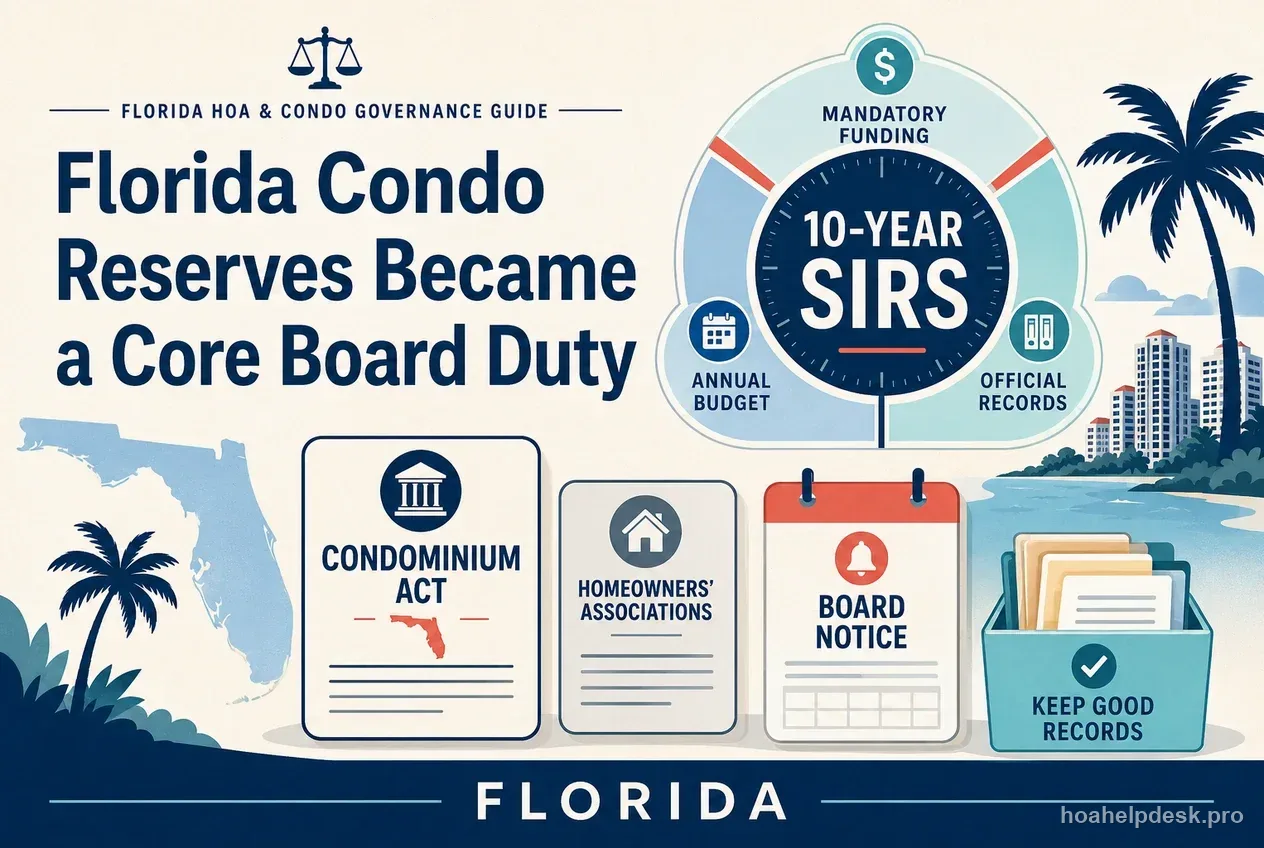
Florida boards must separate Chapter 720 HOAs from Chapter 718 condominiums. HOA board meetings generally need 48-hour posted notice; condominium board meetings generally need 48 continuous hours. Many residential condos three habitable stories or higher need a SIRS at least every 10 years and mandatory reserve funding rules. Both statutes impose records-access deadlines, fidelity coverage, and notice-and-hearing procedures before fines.
Which statute governs your association
Florida is a state where “HOA law” and “condo law” must be separated from the first sentence. A mandatory homeowners’ association is governed principally by Chapter 720, while a condominium association is governed by Chapter 718. Chapter 720 expressly excludes associations regulated under Chapter 718 except where a provision is specifically incorporated. Both types of associations may also be Florida corporations, bringing corporate statutes into director and procedural questions.
The recorded declaration, articles, and bylaws remain essential because the statutes repeatedly defer to governing documents on matters such as allocation, amendment procedures, and additional notice. If the governing documents require a stricter procedure than the statutory minimum and the statute does not prohibit it, the board should follow the stricter rule. Confirm the current statute text and any recent amendment before relying on this guide; Florida community-association legislation changes frequently.
Reserve study and reserve funding
Florida condominium reserve law is now much more prescriptive than HOA reserve law. A residential condominium association generally must complete a structural integrity reserve study at least every 10 years for each association building that is three habitable stories or higher, subject to statutory exclusions. The study addresses specified structural and building-system components, remaining useful life, replacement or deferred-maintenance cost, and a funding schedule.
For budgets adopted on or after December 31, 2024, a unit-owner-controlled condominium required to obtain a SIRS generally may not waive or reduce required reserves for the SIRS items, although the statute now permits specified funding methods and exceptions. That rule should not be copied into a Chapter 720 HOA article: ordinary HOAs do not have the same SIRS mandate. An HOA board should instead follow Chapter 720, its declaration, and any adopted reserve policy.
Insurance and fidelity bond
Florida condominium insurance duties sit primarily in Chapter 718 and include a detailed association master-insurance framework. Separate from property coverage, the association must maintain insurance or a fidelity bond for persons who control or disburse association funds, with coverage tied to the maximum funds in custody at any one time. Chapter 720 also requires insurance or a fidelity bond for persons who control or disburse HOA funds, subject to its statutory waiver mechanism.
Boards should not treat fidelity coverage as a substitute for D&O insurance, property insurance, general liability, flood, or windstorm analysis. Florida’s catastrophe exposure makes deductible and wind coverage decisions especially material to the budget. Ask the broker to show the board how the master insurance policy aligns with the declaration’s maintenance boundaries and what amount could be shifted to owners after a major loss through deductibles or uninsured components.
Open meetings, notice, and agenda
For a Chapter 720 HOA, board-meeting notices generally must identify agenda items and be posted conspicuously in the community at least 48 hours in advance, except in an emergency. Meetings with counsel about proposed or pending litigation and meetings about personnel matters can be closed. Meetings at which special assessments or certain parcel-use rule changes are considered trigger the longer statutory notice procedure.
For a Chapter 718 condominium, adequate board-meeting notice generally means conspicuous posting at least 48 continuous hours before the meeting, with the agenda identified. Annual unit-owner meetings have a separate 14-day notice rule. Owners have statutory rights to attend and speak subject to reasonable rules. The board should preserve the exact notice used, agenda, affidavit or proof of posting where required, meeting minutes, and any statutory basis for closing a session.
Quorum and voting thresholds
Chapter 720 supplies a useful HOA default: unless the bylaws set a lower number, a membership-meeting quorum is 30% of total voting interests. Unless another rule controls, governing documents may generally be amended by two-thirds of association voting interests. Those numbers should not be carried over to a condominium. Under Chapter 718, the default membership quorum is a majority unless the bylaws provide a lower number, and residential proxy rules are more restrictive.
Condominium declaration and bylaw amendments have their own statutory guardrails, and some changes require special consent. Before any election or amendment, write down whether Chapter 718 or 720 applies, the document section being amended, total voting interests, quorum, whether proxies are permitted, and the approval denominator. Florida’s detailed election rules make a generic “majority vote” description especially risky for a board-facing guide.
Records access and retention
Chapter 720 requires HOA official records to be maintained for at least 7 years and generally made available within 10 business days after a written request, within the statutory geographic or electronic-access framework. Chapter 718 likewise gives condominium owners access to official records and generally requires availability within 10 working days after the board or its designee receives a written request. Both statutes identify records that may be withheld.
Boards should run records access as a documented workflow: date-stamp the request, identify whether Chapter 718 or 720 applies, collect responsive records, remove only categories the statute permits the association to withhold, and document the production date. Do not require an owner to explain a purpose where the governing statute prohibits that requirement. Keep a records-retention schedule that separately tracks permanent governing documents, minutes, accounting records, contracts, ballots, insurance, and capital-project records.
Budget and assessment disclosure
Florida budgeting differs sharply between HOAs and condominiums. A condominium budget must be detailed and must address statutory reserve items and, where applicable, SIRS funding. Chapter 718 also contains owner procedures related to budgets that exceed specified prior-year assessment levels; those procedures are not a simple universal fee cap. Chapter 720 has its own budget, financial-reporting, and assessment provisions and should be read independently.
The board packet should separate regular operating assessment, reserve contribution, insurance, debt service, and any special assessment. For a condominium subject to SIRS, show how the adopted funding method aligns with the most recent study; the statute now permits specified combinations of regular assessments, special assessments, lines of credit, and loans. For an HOA, do not imply the condominium SIRS funding rule applies merely because the community has expensive common property.
Limits on assessment and fee increases
Florida does not use one statewide percentage cap that applies identically to every HOA and condominium annual assessment. Chapter 718 has a 115%-of-prior-assessments budget procedure in specified circumstances, with exclusions such as required reserves and insurance; it is not a blanket prohibition on any assessment above 115%. Chapter 720 relies on its own budget, assessment, notice, and governing-document framework rather than that condominium mechanism.
When a special assessment is proposed, the board should identify the project, statutory authority, declaration allocation, notice requirement, voting requirement if any, reserve availability, and financing alternatives. For Chapter 720 boards, meetings considering special assessments require the enhanced notice described by the statute. For a condominium subject to SIRS, the board also needs to confirm whether the funding method requires a majority of total voting interests under the current reserve provisions.
Fines and enforcement due process
Florida is explicit that a fine is not simply a board ledger entry. Under Chapter 720, a proposed fine or suspension requires at least 14 days’ written notice of the owner’s right to a hearing before an independent committee, and the current statute specifies timing and written findings around that process. Under Chapter 718, a condominium fine or suspension likewise requires at least 14 days’ written notice and an opportunity for a committee hearing.
Keep the violation evidence, governing-document authority, first notice, hearing notice, committee membership, hearing record, committee decision, cure information, and final ledger entry together. The board should also distinguish a fine from an unpaid assessment because lien and collection consequences can differ. Florida’s statutes change often enough that the association should verify the current fine amount limits, collection consequences, and notice mechanics before using an old enforcement form.
Sources
- Florida Statutes — Chapter 718, CondominiumsOfficial Florida Legislature chapter; includes current 2026-amended text as posted.
- Florida Statutes — Chapter 720, Homeowners’ AssociationsOfficial Florida Legislature HOA chapter; current page includes 2026 amendment history.
- Florida DBPR — Division of Condominiums, Timeshares and Mobile HomesOfficial regulator and education portal, including SIRS reporting resources.
- Florida DBPR — SIRS guidance and reportingOfficial SIRS reporting resource; useful for current implementation details.
Compare nearby state rules
Check one decision against the statute
For a single board decision — a fine, a special assessment, a records request, an election, a CC&R amendment — the State Decision Lookup resolves the verified statutory rule for Florida and a growing set of other states, and the Board Decision Router lays out the research sequence. Both fail closed when the primary law is unclear rather than guessing.