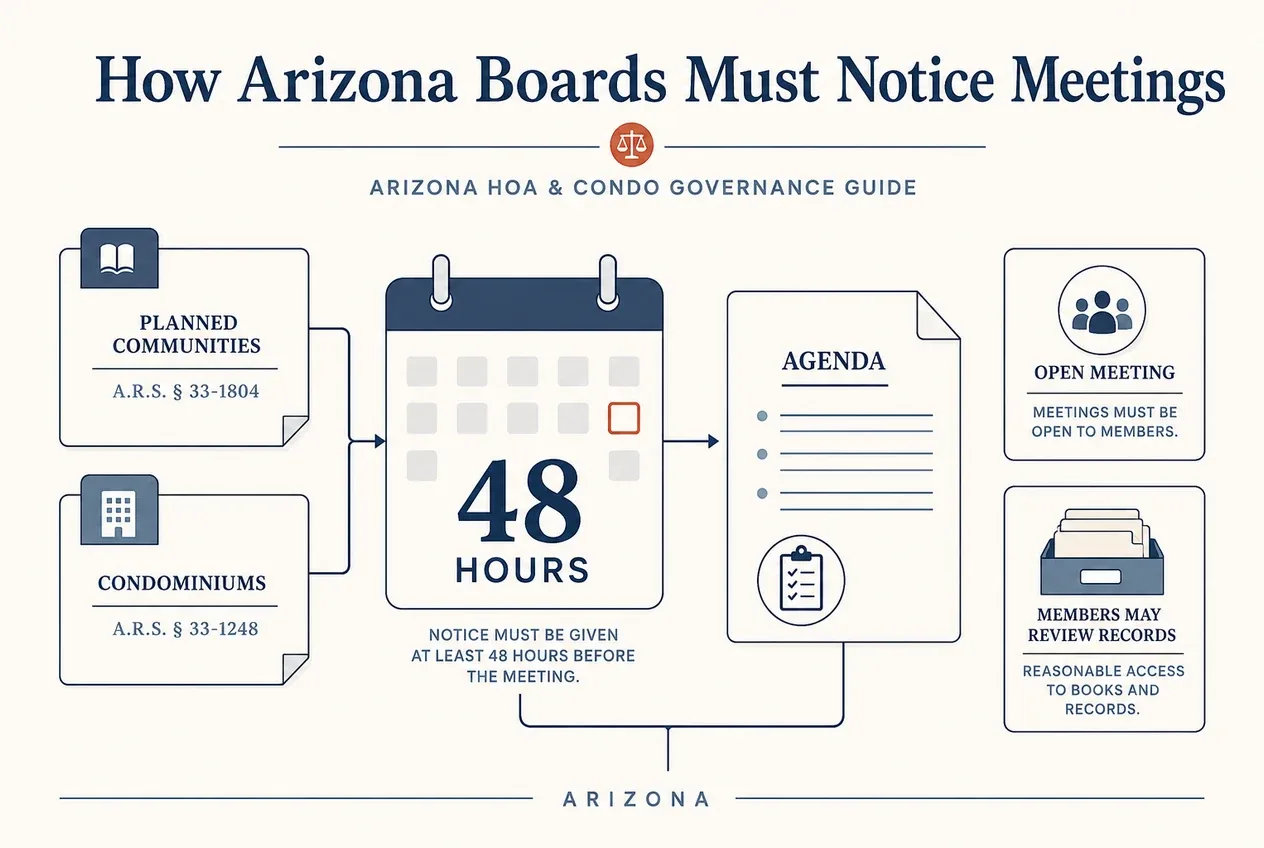
Arizona has separate condominium and planned-community statutes but parallel rules on many board issues. Post-declarant-control board meetings generally need at least 48 hours’ notice, owners may record open meetings, and association records requests generally must be fulfilled within 10 business days. Planned communities currently have a statutory regular-assessment increase limit, while 2026 legislation also creates changes with later effective dates that boards must check before relying on older code compilations.
Which statute governs your association
Arizona uses two primary property statutes. Condominiums are governed by the Arizona Condominium Act in Title 33, Chapter 9, while most subdivision-style HOAs are governed by the planned-community statutes in Chapter 16. The two chapters often contain parallel provisions — open meetings, records, violations, liens, resale disclosures — but section numbers and some substantive rules differ. A board should identify whether the property is legally a condominium or a planned community before citing a section, even when the practical issue sounds identical.
Arizona also layers nonprofit-corporation law and the recorded declaration, articles, bylaws, and rules onto the statutory framework. Some statutes expressly override contrary governing-document language; elsewhere the documents can impose stricter procedures. Do not assume a declaration can waive a mandatory open-meeting or records rule merely because owners agreed to it years ago. Conversely, if the declaration or bylaws require longer notice, a lower assessment cap, or a higher approval threshold, the stricter internal rule may control. Confirm the current statute text and any recent amendment before relying on this guide, especially because the Legislature enacted HOA changes in 2026.
Reserve study and reserve funding
Arizona statutes authorize condominium and planned-community associations to adopt budgets that include reserves, but Arizona does not impose one general recurring reserve-study cycle on all HOAs and condos. A board should therefore avoid saying state law “requires a reserve study every X years” unless a separate project-specific law, governing document, lender condition, or contract creates that requirement. Reserve adequacy remains a practical governance issue because the board must maintain common property and adopt a budget capable of paying anticipated obligations.
For condos, annual assessments are based on an annually adopted budget under A.R.S. § 33-1255. Planned communities use their own assessment provisions. A reserve study remains a useful planning tool even where the statute does not mandate the study itself, because it gives the board a defensible basis for roof, paving, mechanical, pool, or other long-lived component contributions. If the declaration requires a study, a reserve percentage, or a member vote for reserve borrowing, that stricter governing-document rule should be followed.
Insurance and fidelity bond
Arizona’s Condominium Act contains a specific insurance section at A.R.S. § 33-1253, while planned-community insurance obligations are more dependent on the declaration and the association’s property responsibilities. Condo boards should verify the current master-policy requirements, deductibles, and scope of common-element coverage before renewal. Both property forms may also rely on D&O, crime, fidelity, cyber, and umbrella policies because statutory minimums are not a complete risk-management program.
Arizona does not impose a California-style statewide fidelity-bond formula equal to reserves plus three months of assessments for every association. If a declaration, lender, management agreement, or insurer requires fidelity or crime coverage, that requirement should be mapped separately from the property and general-liability policy. A treasurer should also verify who is an insured, whether the management company’s dishonest acts are covered, and whether electronic funds-transfer fraud is included. Treat the master insurance policy and fidelity bond as different controls serving different loss scenarios.
Sources: [1]
Open meetings, notice, and agenda
Arizona has one of the more detailed statutory open-meeting systems for community associations. Under A.R.S. §§ 33-1248 and 33-1804, association and board meetings are generally open to members, subject to listed closed-session topics such as legal advice, litigation, certain personal or employee matters, and violation appeals. Members or their written representatives are allowed to attend and speak at the prescribed point in the meeting, and attendees may audio- or video-record open portions subject to reasonable rules that cannot eliminate the statutory right.
After declarant control ends, board-meeting notice and the agenda generally must be provided at least 48 hours in advance; emergency meetings are treated differently. The notice must state date, time, and place, and informal gatherings of a board quorum to discuss association business can still trigger the open-meeting rule. Arizona’s 2025 amendments also address association recordings and retention. Boards should build agendas before deliberation, identify the statutory basis before entering a closed session, and avoid using email chains or “workshops” as substitutes for properly noticed board action.
Quorum and voting thresholds
Arizona’s condominium and planned-community statutes contain separate voting provisions, so boards should use the section for the correct property form. Proxy, absentee-ballot, and election rules are not identical to a generic corporate election. Declaration amendments can also carry their own statutory or document thresholds. The denominator matters: “members voting,” “members present at a quorum,” and “all allocated votes in the association” can produce very different results. Election materials should state the threshold being applied before ballots are counted.
Because the Legislature considered and enacted multiple HOA bills in 2026, boards should verify the effective date of any new voting or election language rather than relying on an old management handout. If a governing document requires a larger majority than the statute’s default, the stricter threshold generally remains important unless a statute expressly overrides it. Keep proxies, absentee ballots, inspector or tabulation records, and the minutes together so the association can later demonstrate how quorum and approval were calculated.
Sources: [1]
Records access and retention
Arizona gives owners a strong statutory records right. Under A.R.S. §§ 33-1258 and 33-1805, financial and other association records must generally be made reasonably available for examination. The association has 10 business days to fulfill a proper request for examination and 10 business days to provide requested copies. Inspection itself cannot carry a review fee, and copy charges are capped at 15 cents per page under the cited sections. The statutes also identify categories that may be withheld, including privileged attorney communications, pending litigation, closed-session material, and certain personal or employee records.
Retention is a separate question. The open-meeting statutes now require an association that records an open meeting to keep the recording for at least six months and make the unedited recording available on request. Other record categories may need longer retention under the governing documents, tax rules, contracts, or litigation holds. A board should therefore maintain a written retention schedule rather than treating the 10-business-day production deadline as a retention period. Preserve approved minutes, governing documents, financial statements, owner ledgers, and election records in a form that survives management-company turnover.
Budget and assessment disclosure
For condominiums, A.R.S. § 33-1255 states that assessments are made at least annually based on a budget adopted at least annually by the association. Planned communities have their own statutory framework, and the declaration may add budget mailing, hearing, or member-approval procedures. A defensible budget file should show operating expenses, reserve contribution, contracted increases, insurance renewals, and the allocation basis used to turn the budget into unit or lot assessments.
Arizona also requires annual financial oversight for planned communities under A.R.S. § 33-1810: unless the community documents require a CPA audit, the board must provide for an annual audit, review, or compilation, completed no later than 180 days after fiscal year end and made available to members on request within 30 days after completion. That is not the same as an owner vote on the budget. Boards should keep the budget adoption record and the later financial-review record as distinct compliance steps.
Limits on assessment and fee increases
Arizona is one of the states where boards must check an actual statutory assessment limit rather than assume the declaration is the only ceiling. For planned communities, the currently compiled A.R.S. § 33-1803 provides that a regular assessment more than 20% above the immediately preceding fiscal year’s assessment requires approval of a majority of association members, unless the community documents impose a lower limit. The same section contains separate late-charge limits and notice requirements. Do not apply that planned-community percentage automatically to condominiums.
The 2026 Legislature considered changes to assessment rules, and some 2026 HOA legislation becomes effective after this guide’s September 1 update date. Arizona’s own online code compilation warns that it had not yet incorporated the 57th Legislature, 2nd Regular Session when checked. For that reason, a board planning an increase after the 2026 general effective date should check the chaptered session law and then the updated A.R.S. text. Governing documents can still impose a lower cap or a higher member-approval threshold.
Fines and enforcement due process
Both property regimes require process before monetary penalties. The condominium association’s powers under A.R.S. § 33-1242 and the planned-community provision in § 33-1803 require notice and an opportunity to be heard before reasonable monetary penalties are imposed. Arizona also provides a structured written exchange after a violation notice: an owner can respond, and the association must provide specified information about the alleged violation and contest process within the statutory timeline. Boards should use the correct section for the property form and preserve the notice, response, hearing record, and decision.
Arizona also offers an administrative-hearing route through the Department of Real Estate for certain disputes under A.R.S. § 32-2199.01. That does not turn the Department into a general HOA regulator or eliminate court remedies. From an operations standpoint, the board should separate rule enforcement from assessment collection: a violation penalty, late charge, regular assessment, special assessment, and lien can have different statutory prerequisites. Consistent due process is easier to defend than ad hoc enforcement, particularly when a member later challenges the charge in an administrative or judicial forum.
Sources
- Arizona Revised Statutes, Title 33 — official Legislature portalPrimary official index for the Condominium Act and Planned Communities statutes; compilation timing warning is important in 2026.
- A.R.S. § 33-1248 — condominium open meetingsOfficial open-meeting, owner-speaking, recording, notice, and agenda provisions for condos.
- A.R.S. § 33-1804 — planned-community open meetingsOfficial parallel open-meeting rule for planned communities.
- A.R.S. § 33-1258 / § 33-1805 — association recordsOfficial condo records page; planned-community parallel is § 33-1805.
- A.R.S. § 33-1803 — planned-community assessment limitationCurrent compiled 20% regular-assessment rule; recheck after 2026 general effective date.
- 2026 Session summary — HOA legislation and effective datesOfficial House summary; includes chaptered 2026 HOA measures and effective-date information.
Compare nearby state rules
Check one decision against the statute
For a single board decision — a fine, a special assessment, a records request, an election, a CC&R amendment — the State Decision Lookup resolves the verified statutory rule for Arizona and a growing set of other states, and the Board Decision Router lays out the research sequence. Both fail closed when the primary law is unclear rather than guessing.