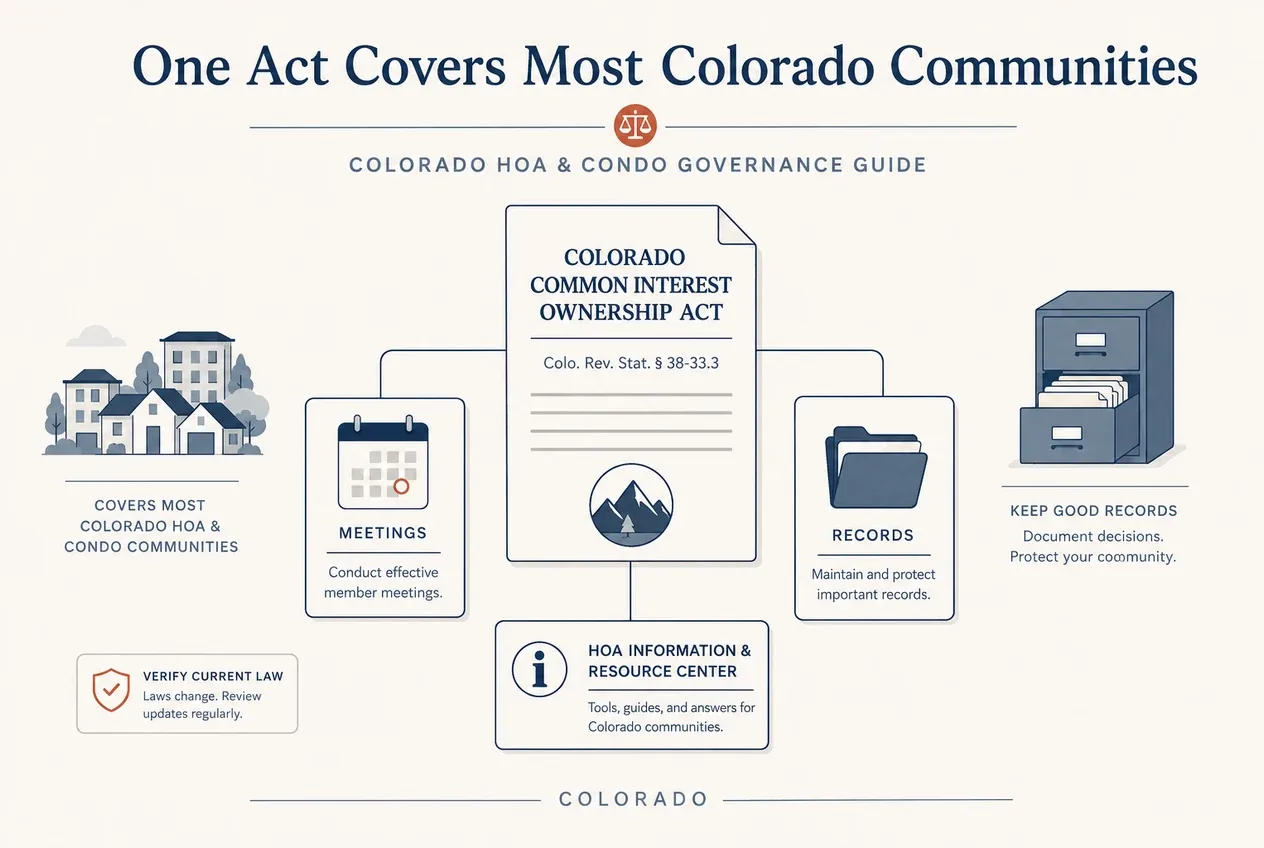
Colorado uses CCIOA for most condominium and planned-community governance. Owner meetings generally require 10 to 50 days of notice, board meetings are ordinarily open, and declaration amendments default to 67% unless the declaration lawfully changes the threshold. A 2026 law adds a 30-year reserve study at developer turnover, but it is not a blanket recurring-study mandate for every owner-controlled association.
Which statute governs your association
Colorado boards should begin with CCIOA, not with a generic “HOA law” checklist. Article 33.3 governs most modern condominiums and planned communities, while Article 33 contains the older Condominium Ownership Act. CCIOA’s applicability provisions matter for communities created before July 1, 1992 because some provisions apply to older communities and others do not. The association’s nonprofit-corporation law also supplies general director standards when the association is incorporated as a nonprofit.
A board should therefore identify the community’s creation date, recorded declaration, organizational form, and any later opt-in or amendment before applying a rule. If the declaration, CC&Rs, or bylaws impose a stricter procedural requirement than the statutory floor, the board should follow the stricter governing-document rule unless the statute makes its rule nonwaivable. Confirm the current statute text and any recent amendment before relying on this guide.
Reserve study and reserve funding
Colorado’s 2026 legislation added a targeted reserve-study duty at developer turnover. Before transferring control of a planned community or condominium, the declarant must commission and pay for a reserve study addressing association-maintained components and projecting costs over a 30-year period. That is a meaningful new handoff protection, but it should not be rewritten as a statewide requirement that every owner-controlled HOA commission a new reserve study on a fixed recurring cycle.
For an established owner-controlled association, the practical board question remains whether the declaration, budget policy, lender requirements, or the association’s own reserve policy requires a study or funding target. CCIOA also regulates reserve funds and board financial duties, but Colorado does not impose a Florida-style mandatory reserve-funding schedule on every association. Keep the reserve study, component inventory, funding assumptions, and board decisions together so a later board can see why contributions changed.
Insurance and fidelity bond
CCIOA requires association property insurance, to the extent reasonably available, at not less than full insurable replacement cost after applicable deductibles for covered association property, together with liability coverage. The statute also has a fidelity-insurance rule for associations with 30 or more units when a unit owner or employee controls or disburses community funds. Boards should verify the current subsection and policy limits against the current budget before renewal rather than carrying forward last year’s certificate without review.
A master insurance policy is only one layer of the risk program. The declaration may allocate responsibility for unit improvements, deductibles, or losses differently, and a lender may impose additional requirements. D&O insurance is a separate board-risk question and should not be confused with property or fidelity coverage. Ask the broker to map each policy to the declaration’s insurance provisions and to identify any exclusions that would shift an unexpected loss back to owners.
Sources: [1]
Open meetings, notice, and agenda
Colorado treats transparency as a core board-governance rule. Unit-owner meetings generally require notice 10 to 50 days before the meeting. Board meetings are ordinarily open to owners, and agendas must be made reasonably available. An executive session is permitted only for specified subjects, so a board should identify the statutory basis before closing the room and should avoid using a closed session merely because a topic is uncomfortable or controversial.
For a practical meeting file, preserve the notice, agenda, proof of posting or delivery, owner materials, and meeting minutes together. If the bylaws require longer notice or a particular delivery method, use that stricter procedure. Emergency action should be treated as the exception rather than a routine way to bypass an open meeting. When the board returns from executive session, the minutes should accurately reflect the action actually taken in open session.
Sources: [1]
Quorum and voting thresholds
CCIOA supplies important defaults but does not replace the declaration. For a declaration amendment, the general statutory default is approval by owners holding at least 67% of the association votes unless the declaration lawfully requires a larger percentage or another permitted threshold. That percentage is based on allocated association votes, not merely the owners who happen to attend a meeting, so the board should calculate the denominator before announcing that an amendment passed.
Quorum, proxies, ballots, and election procedures also need to be checked against CCIOA and the bylaws. Do not assume the same threshold applies to an election, budget decision, declaration amendment, or termination. The safest board packet states the authority for the vote, the total eligible voting interests, the required threshold, how proxies or electronic votes are treated, and the final tally before the secretary certifies the result.
Sources: [1]
Records access and retention
Colorado gives owners a statutory right to inspect association records subject to stated procedures and exclusions. The current statute allows the association to require a written request and to organize access through reasonable rules. Sensitive categories such as privileged legal material, some personnel information, and other protected records may be withheld. A board should use a written records-retention schedule so the response is based on a maintained file system rather than whatever happens to remain in a manager’s inbox.
Records requests are also a governance test. Route each request to one responsible person, log the date received, identify the requested categories, separate producible material from exclusions, and document any lawful copying charge. If management companies change, the board should inventory records and credentials at transition. Colorado’s 2026 legislation also addresses transfer of association property and records when a management relationship ends, making transition planning more than an administrative courtesy.
Budget and assessment disclosure
Colorado associations adopt assessments through the annual budget framework in CCIOA, and the association must make assessments at least annually based on the adopted budget. The board should connect the budget to the maintenance obligations in the declaration, insurance renewal, reserve assumptions, contracts, delinquencies, and known capital work. A budget number that cannot be traced to a board obligation is difficult to defend and difficult for owners to understand.
Budget procedures can also include owner ratification requirements under CCIOA. Before sending a budget package, verify the current statutory ratification procedure and the declaration’s notice rules. A useful budget disclosure separates operating expenses, reserve contributions, debt service, insurance, and any special assessment rather than hiding a capital problem inside a single assessment figure. Governing documents that require extra notice, hearings, or owner approval should be treated as binding procedural guardrails.
Sources: [1]
Limits on assessment and fee increases
Colorado does not impose a simple statewide percentage cap on ordinary annual HOA assessment increases comparable to California’s 20% rule. The lawful amount instead depends on the adopted budget, CCIOA procedures, and the declaration’s allocation and approval provisions. A board should therefore avoid telling owners that “state law allows any increase”; the better statement is that no general percentage cap substitutes for the association’s budget process and governing-document limits.
For a special assessment, identify the capital need, the declaration authority, the allocation formula, notice requirements, and any owner vote that the documents or statute require. The board should also show whether reserve funds, borrowing, insurance proceeds, or phased work were considered. That record helps distinguish a necessary special assessment from an arbitrary fee increase and gives future boards a usable history of the decision.
Sources: [1]
Fines and enforcement due process
Colorado’s enforcement statute now places meaningful limits on fines and collection practices. The association must use its written enforcement policy and provide notice and an opportunity to cure. Current law includes different cure mechanics for ordinary violations and safety-related violations, and it limits the total amount of fines for a single violation. A board should verify the current subsection before issuing a fine letter because recent amendments have changed this area.
Enforcement should be separated into violation evidence, notice, cure opportunity, hearing or internal review, board decision, and collection. Do not convert a disputed rule violation into a lien or foreclosure strategy without confirming the current statutory limits, because Colorado restricts the use of foreclosure for amounts that are fines rather than assessments. Consistent treatment of similar violations is also important; selective enforcement can create a separate dispute even where the underlying rule is valid.
Sources: [1]
Sources
- Colorado Revised Statutes 2026 — Title 38, PropertyOfficial OLLS compilation; CCIOA is Article 33.3. Verify live PDF path during assembly.
- Colorado HB 26-1099 — Protect Financial Condition of HOAsOfficial 2026 legislation adding declarant reserve-study and transition duties.
- Colorado HOA Information & Resource CenterDivision of Real Estate education and HOA registration resource.
- Colorado Revised Statutes 2026 — Title 7, Corporations and AssociationsOfficial nonprofit-corporation provisions relevant to director standards; verify live PDF path.
Compare nearby state rules
Check one decision against the statute
For a single board decision — a fine, a special assessment, a records request, an election, a CC&R amendment — the State Decision Lookup resolves the verified statutory rule for Colorado and a growing set of other states, and the Board Decision Router lays out the research sequence. Both fail closed when the primary law is unclear rather than guessing.