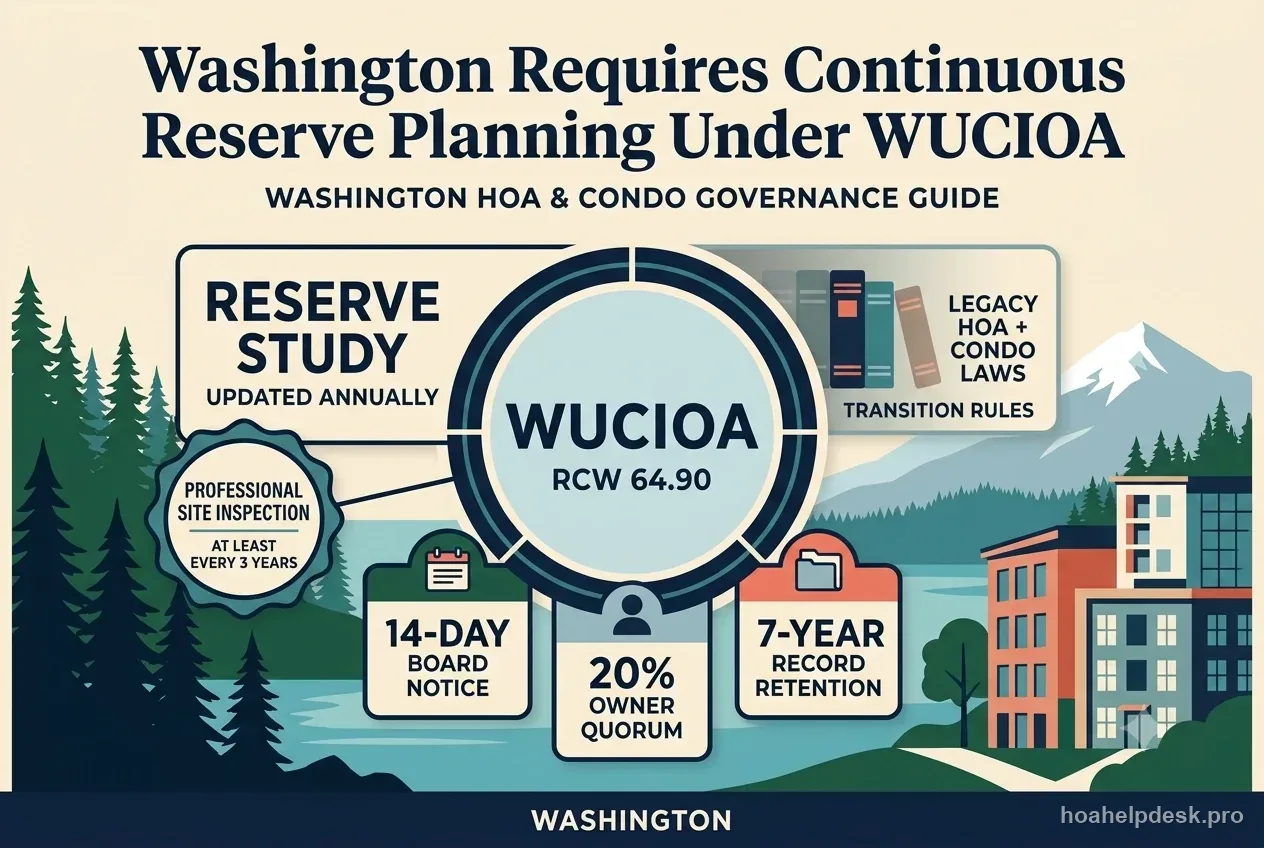
Washington now has one of the more detailed common-interest governance frameworks. WUCIOA requires open board meetings, 14-day notice for most unscheduled board meetings, a 20% default owner quorum, seven-year retention for many records, and reserve studies updated annually with a professional site-inspection update at least every three years. Legacy HOA and condominium chapters remain relevant during the transition to broader WUCIOA coverage.
Which statute governs your association
Washington’s central statute is the Washington Uniform Common Interest Ownership Act, or WUCIOA, in RCW 64.90. It covers condominiums, cooperatives, and planned communities within its applicability rules and has been expanded through later legislation. Older communities may still encounter the Homeowners’ Associations Act in RCW 64.38 or the Condominium Act in RCW 64.34 during the transition period, so boards must determine which WUCIOA provisions apply to their creation date and community type.
This transition is particularly important in 2026 because statutory amendments continue to modify WUCIOA before broader 2028 changes take effect. Governing documents may impose stricter lawful requirements, and the statute itself preserves certain legacy-document rules. A board should therefore map each major decision to the current RCW section, the declaration, and the organizational documents. Confirm the current statute text and any recent amendment before relying on this guide.
Sources: [1]
Reserve study and reserve funding
Current RCW 64.90.545 requires an association that is not exempt to prepare and update a reserve study. The study must be updated annually, and at least every third year the update must be prepared by a reserve study professional and based on a visual site inspection. The 2026 amendment also refines exemptions, including communities with only nominal reserve costs and certain middle-housing communities without qualifying on-site reserve components.
The reserve study must disclose components, useful lives, replacement costs, the reserve balance, percent funded, planned special assessments, inflation assumptions, and 30-year funding projections. WUCIOA does not simply command every association to be 100% funded immediately. Instead, the study presents full-funding and baseline plans and the budget discloses how current contributions compare with the study. Governing documents can impose greater requirements than the statutory floor.
Insurance and fidelity bond
WUCIOA contains association insurance requirements in RCW 64.90.470 and distinguishes attached-unit communities from other common-interest structures. Boards should verify property, liability, fidelity or crime, and deductible provisions against the current section and the declaration, because responsibility can turn on the physical configuration of units and common elements. Insurance decisions should also be coordinated with the association’s maintenance obligations and reserve study.
A treasurer should treat fidelity coverage as part of the association’s financial-control system rather than a checkbox. The board should document who can initiate and approve transfers, how reserve withdrawals are authorized, whether the manager is covered, and how electronic-payment fraud is handled. Any numerical insurance or fidelity formula should be confirmed against the current WUCIOA text and policy requirements immediately before renewal.
Sources: [1]
Open meetings, notice, and agenda
WUCIOA requires owner meetings at least annually and generally requires 14 to 50 days’ notice for annual and special owner meetings. Board and qualifying committee meetings must be open to unit owners except for permitted executive sessions, and final action cannot be taken in executive session. Owners must receive a reasonable opportunity to comment, including at least 15 minutes at the beginning of a board meeting for agenda-item comments before the board votes.
Unless a board meeting is already included in a schedule given to owners, notice generally must be provided at least 14 days before the meeting and state the time, date, place, and agenda. For an unforeseeable event where ordinary notice is impracticable, the statute allows a shorter seven-day electronic notice path. Boards should not use social gatherings or informal discussions to evade the open meeting requirements.
Quorum and voting thresholds
Under WUCIOA’s default rule, an owner-meeting quorum exists when persons entitled to cast 20% of the association votes participate through an allowed method, unless the organizational documents provide otherwise. A board quorum generally requires directors entitled to cast a majority of board votes. If a board quorum is present, action normally requires the affirmative vote of a majority of board members present unless a greater threshold applies.
Washington allows multiple participation and voting methods, but the board should distinguish attendance for quorum from the separate approval percentage for an amendment, removal, budget rejection, or other protected action. Special owner meetings can generally be demanded by owners holding at least 20% of the votes unless the organizational documents specify a lower percentage. Board members themselves may not vote by proxy or absentee ballot.
Records access and retention
Washington’s records statute is unusually detailed. RCW 64.90.495 requires retention of the current budget, detailed accounting records, financial statements, tax returns, contracts, certain architectural and enforcement materials, insurance policies, meeting minutes, governing documents, notices, voting records, and other items. Many categories have a seven-year retention period, while ballots, proxies, and related voting records generally have a one-year period after the relevant vote.
Required records must generally be made available for examination and copying by owners, mortgage holders, and authorized agents subject to statutory conditions and exclusions. Boards should build the retention schedule around the actual RCW categories rather than a generic “seven years for everything” rule. Sensitive personnel, privileged, owner-specific, or enforcement material should be screened before production, and the management contract should obligate the manager to preserve association records.
Budget and assessment disclosure
Within 30 days after adopting a proposed budget, the Washington board must provide the budget to owners and schedule a ratification meeting not less than 14 nor more than 50 days after the budget is provided. Unless owners holding a majority of all association votes, or a larger percentage specified in the declaration, reject the proposal at that meeting, the budget is ratified even if a quorum is not present.
The budget itself must disclose projected income and expenses, assessments per unit, reserve contributions, whether the association has a compliant reserve study, the extent of any deviation from reserve-study recommendations, and reserve deficiency or surplus information. A special assessment generally follows the same ratification process. This makes Washington budget procedure more owner-facing than a simple board adoption followed by a notice letter.
Limits on assessment and fee increases
Washington does not impose a single annual percentage cap comparable to a universal dues ceiling. Instead, WUCIOA regulates how budgets and special assessments are proposed and ratified, while the declaration may impose additional limits. A board should therefore analyze the expense authority, reserve plan, budget-ratification procedure, and any document-specific voting threshold rather than searching for one statewide percentage applicable to every community.
If the board needs a large increase because reserves are weak, the reserve study should explain the component need and the budget should disclose the current deficiency or surplus. Owners then receive the statutory ratification process. Governing documents can be more restrictive than the statutory default. Boards should also separate ordinary assessments from fines, collection fees, capital contributions, and other charges because different authority and procedures may apply.
Fines and enforcement due process
WUCIOA gives associations rulemaking and enforcement powers but couples them with notice and procedural requirements. Before imposing a fine or other sanction, the board should identify the rule, confirm it was validly adopted and distributed, give the owner the process required by RCW 64.90 and the governing documents, and create a record showing the violation and decision. Executive-session privacy does not permit the board to take final action secretly.
Washington boards should also preserve enforcement materials because RCW 64.90.495 specifically addresses retention of materials relied on for decisions to enforce governing documents. Consistent treatment matters: an enforcement program that cannot show the evidence, rule, notice, hearing opportunity, and final board action is vulnerable even when the underlying conduct appears to violate the documents. Confirm any monetary fine limitation in the current statute and documents before assessment.
Sources
- Chapter 64.90 RCW — Washington Uniform Common Interest Ownership ActPrimary official current WUCIOA portal.
- RCW 64.90.545 — reserve studyOfficial text including 2026 c.96 amendment.
- RCW 64.90.550 — reserve study contentsOfficial contents and 30-year funding-plan disclosures.
- RCW 64.90.445 — meetingsOfficial owner/board meeting, notice, comment, and executive-session rules.
- RCW 64.90.495 — association recordsOfficial records and retention requirements.
- RCW 64.90.525 — budgets and assessmentsOfficial budget ratification and special-assessment procedure.
Compare nearby state rules
Check one decision against the statute
For a single board decision — a fine, a special assessment, a records request, an election, a CC&R amendment — the State Decision Lookup resolves the verified statutory rule for Washington and a growing set of other states, and the Board Decision Router lays out the research sequence. Both fail closed when the primary law is unclear rather than guessing.