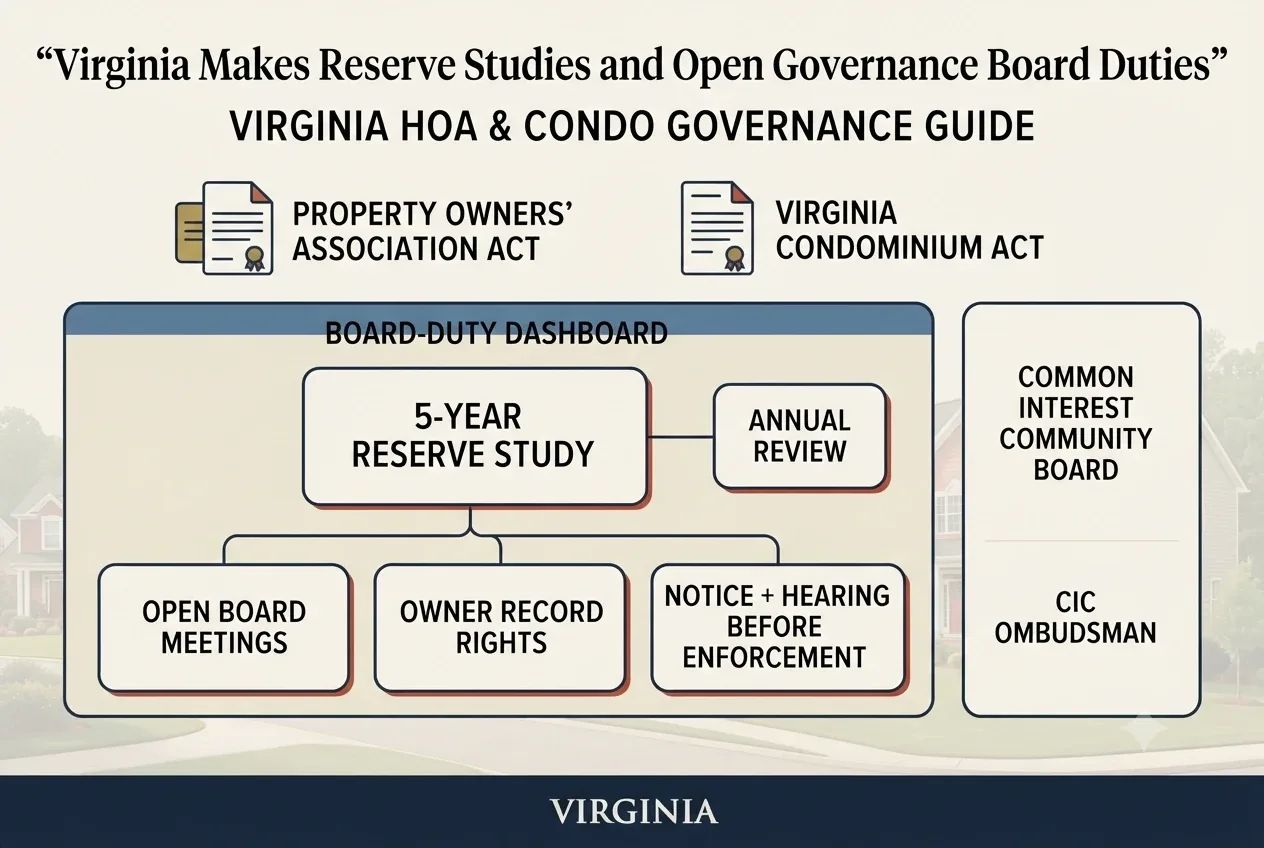
Virginia gives both HOA and condominium boards detailed governance rules. Reserve studies are generally required at least every five years with annual review, board meetings are open to owners subject to executive-session limits, records rights are statutory, and enforcement requires notice and a hearing. The HOA and condominium statutes are separate, so boards should not transfer a rule from one chapter to the other.
Which statute governs your association
Virginia separates planned-community HOAs from condominiums. Most non-condominium communities organized around recorded declarations are governed by the Property Owners’ Association Act in Title 55.1, Chapter 18, while condominiums use the Condominium Act in Chapter 19. Corporate duties may also arise under Virginia nonstock-corporation law. A board should identify the correct chapter before using any notice, voting, records, or enforcement rule because similar topics are not always worded identically across the two acts.
Governing documents still matter. If the declaration, bylaws, or rules impose a stricter procedural requirement than the statutory floor and that requirement is lawful, the board should follow the stricter document rule. Virginia also has a Common Interest Community Board and ombudsman framework, but those offices do not replace the board’s duty to read the controlling statute and recorded instruments. Confirm the current statute text and any recent amendment before relying on this guide.
Reserve study and reserve funding
Virginia is not a “study only and forget it” state. Under the HOA statute, the board must conduct a reserve study at least once every five years, review the study at least annually, and make adjustments it considers necessary to maintain appropriate reserves. If the study shows a need for reserve funding, the annual budget must disclose component costs, reserve balances, expected contributions, the estimation method, and the amount recommended by the study.
The Condominium Act contains a parallel five-year reserve-study and annual-review framework. It also permits the executive board to address repair and replacement needs through reserves, additional assessments, or borrowing. This is not the same as a universal statutory percentage-funded mandate. Boards should distinguish the duty to study, review, budget, and disclose from any separate funding level required by the declaration, lender standards, or the association’s adopted reserve plan.
Insurance and fidelity bond
Virginia condominium insurance is partly document-driven. The Condominium Act authorizes condominium instruments to require a master casualty policy tied to full replacement value, a master liability policy, and other appropriate coverage. HOA boards should separately inspect their declaration, lender requirements, contracts, and the Property Owners’ Association Act rather than assuming the condominium insurance section applies to a planned community.
Fidelity or crime coverage should be checked against the current statute, governing documents, management contract, and any lender or secondary-market requirements that apply to the community. A treasurer should document who handles association funds, account limits, dual-control procedures, and cyber-payment exposure. The practical governance rule is to align the master insurance policy and fidelity bond with the association’s actual assets and authority rather than copying another community’s limits.
Sources: [2]
Open meetings, notice, and agenda
Virginia HOA board meetings where association business is discussed or transacted are generally open to members, and boards may not use work sessions or informal gatherings to evade that rule. Minutes must be recorded. The statute permits executive-session treatment for limited subjects, but final action should occur in the open meeting as required by law. Boards should build the agenda so owners can see what is being considered and the minutes can show what was actually decided.
Condominium owners have a statutory right to notice of executive-board meetings and to participate as provided by the Condominium Act. For unit-owner meetings, annual or regularly scheduled meetings generally require at least 21 days’ notice, while other meetings generally require at least seven days. Those timelines belong to the condominium chapter; HOA boards must use the notice provisions in the Property Owners’ Association Act and their own documents.
Quorum and voting thresholds
Virginia does not give every association one universal quorum or amendment percentage. The declaration and bylaws remain central, while statutory provisions control particular actions and establish mandatory procedures. Boards should separate three questions before a vote: what constitutes a quorum, whether the threshold is measured against all allocated votes or only votes cast, and whether the statute reserves the action to owners instead of the board.
Proxy voting, electronic participation, director elections, recalls, and amendments should be checked against the act that governs the community and the recorded instruments. Do not describe a declaration amendment as approved merely because a majority of people at a meeting voted yes. Many common-interest mistakes come from confusing a meeting quorum with the percentage of the entire ownership needed to amend the declaration or approve another protected action.
Records access and retention
Virginia HOA law requires detailed financial records and makes association books and records available for examination and copying by qualifying members, subject to statutory exclusions and conditions. The Condominium Act provides a parallel owner-access framework. Boards should keep a written records-retention schedule covering financial statements, contracts, minutes, ballots, owner ledgers, insurance policies, reserve materials, enforcement records, and privileged communications.
An owner request should be logged on receipt and reviewed against the statute before staff or a management company responds. Personal, privileged, personnel, and enforcement information may require redaction or withholding, while ordinary association records should not be withheld merely because they are inconvenient. A board that outsources recordkeeping remains responsible for ensuring the manager can locate and produce records within the legal process.
Budget and assessment disclosure
Before the fiscal year begins, Virginia HOA and condominium boards generally must make the annual budget or a summary available to owners. Reserve disclosures belong in that budget when the reserve study indicates a need to budget for capital components. Boards should show operating expenses and reserve contributions separately so owners can understand whether a dues change reflects routine operations, deferred maintenance, or a capital-replacement plan.
Virginia law does not turn the annual budget into a generic owner veto in every association. The declaration, bylaws, and applicable statute determine whether and when membership approval is required for a particular assessment or budget action. Minutes should identify the authority used, the amount approved, the effective date, and any notice delivered to owners. This creates a defensible record when owners later ask why assessments changed.
Limits on assessment and fee increases
Virginia does not impose a simple statewide percentage cap that can be quoted for every HOA and condominium annual assessment increase. The board’s authority comes from the correct common-interest statute and the recorded instruments, with additional statutory procedures for particular charges. Therefore a board should not assume that a neighboring association’s percentage limit or owner-vote practice applies to its community.
Before adopting a special assessment or substantial dues increase, review the declaration’s assessment power, any owner-vote threshold, reserve-study recommendations, notice rules, and budget provisions. If the documents are more restrictive than the statutory default, the stricter lawful document requirement controls. Boards should also distinguish an assessment used for common expenses from a fine or enforcement charge, which follows a separate due-process pathway.
Fines and enforcement due process
Virginia HOA enforcement has unusually concrete due-process steps. Before charges are imposed, the member must receive written notice and a reasonable opportunity to correct the alleged violation. If it remains uncorrected, the member must receive an opportunity to be heard and represented by counsel. Hearing notice must generally be delivered at least 14 days beforehand, and the result must be delivered within seven days after the hearing.
For HOAs, statutory charges are capped at $50 for a single offense or $10 per day for a continuing offense under the current section, subject to the statute’s conditions. Condominium enforcement follows its own chapter and should be checked separately. Boards should never skip the hearing process because a violation seems obvious; the enforceability of the charge depends as much on procedure as on the underlying rule.
Sources
- Virginia Property Owners’ Association Act — official Code of VirginiaPrimary official HOA statute portal; current text should be checked at publication.
- Virginia Condominium Act — official Code of VirginiaPrimary official condominium statute portal.
- Virginia DPOR — Common Interest Community Board / OmbudsmanAgency/ombudsman resource; URL should be HTTP-checked during assembly.
- Va. Code § 55.1-1826 — HOA annual budget and reserve studyOfficial five-year reserve-study and annual-review text.
- Va. Code § 55.1-1819 — HOA rules and enforcementOfficial hearing procedure and charge limits.
Compare nearby state rules
Check one decision against the statute
For a single board decision — a fine, a special assessment, a records request, an election, a CC&R amendment — the State Decision Lookup resolves the verified statutory rule for Virginia and a growing set of other states, and the Board Decision Router lays out the research sequence. Both fail closed when the primary law is unclear rather than guessing.