
How to Set Up an HOA Reserve Study and Funding Plan
What a reserve study measures, which states require one, and how to turn the results into a defensible funding plan.
Read guide →
D&O Insurance for HOA Boards: What It Covers and Why You Need It
The difference between D&O and general liability, what Side A/B/C means, and what to check before renewing.
Read guide →
How to Properly Notice and Run an HOA Annual Meeting
Notice timing, quorum thresholds, proxy handling, and what to do when the meeting doesn't reach quorum.
Read guide →
Fidelity Bond Coverage for HOA Treasurers: What It Requires
Which states mandate a bond, how the required amount is calculated, and who it actually protects.
Read guide →
How to Hire (and Fire) an HOA Management Company
What to check in the contract before signing, and the notice and vote requirements before ending the relationship.
Read guide →
HOA Board Fiduciary Duty: What the Law Actually Requires
The duty of care, duty of loyalty, and business judgment rule explained for board members who want real protection.
Read guide →
How to Properly Approve and Notice a Special Assessment
The board-vote threshold, the membership-vote trigger, ballot requirements, and notice content that survives a challenge.
Read guide →
Delinquent Assessment Collection: A Board's Step-by-Step Process
The escalation sequence from grace period to lien, and where a single skipped step can void the file.
Read guide →
Records Retention Requirements for HOA Boards
Which records stay permanent, and why a retention schedule is built category by category from statute, tax rules, and claim periods.
Read guide →
Transitioning From Developer Control to a Homeowner-Run Board
What triggers turnover, what the developer must hand over, and how to prepare a year in advance.
Read guide →
HOA Master Insurance Policy: What Boards Must Buy
What the master policy is expected to cover, the 100% replacement-cost benchmark, and where it stops.
Read guide →
How to Run a Compliant HOA Board Election
Nomination methods, secret-ballot requirements, independent inspectors, and certification steps that hold up.
Read guide →
HOA Vendor Contract Checklist Before Signing
Insurance certificates, additional-insured status, and indemnification language to read line by line.
Read guide →
Executive Session Rules: What Boards Can Discuss Privately
The specific categories that qualify for closed session, and what still must go in the open minutes.
Read guide →
HOA Board Member Resignation and Removal Process
How a resignation is handled, what a recall petition requires, and how a vacant seat gets filled correctly.
Read guide →
HOA Board Officer Duties: President, VP, Secretary, Treasurer
What each office is actually responsible for under most bylaws, and where duties overlap dangerously on a small board.
Read guide →
HOA Board Indemnification: Are You Personally Protected?
How indemnification clauses work, what business-judgment protection covers, and where D&O insurance fills the gap.
Read guide →
Who Maintains What: Common Elements vs. Owner Responsibility
How to read the maintenance matrix in your CC&Rs, and why limited common elements are the recurring dispute.
Read guide →
Emergency HOA Assessments: When the Board Can Skip the Vote
What qualifies as an emergency, and the notice steps that keep an emergency assessment defensible.
Read guide →
HOA Late Fee and Interest Caps: What Your State Actually Allows
Why the CC&Rs aren't the last word on late charges, and how state caps override a higher contractual rate.
Read guide →
When an HOA Board Should Refer a Delinquent Account Out
The difference between a collection agency and a collection attorney, and the board vote that should precede either.
Read guide →
What the Annual Budget Disclosure Must Actually Include
What most states require the board to disclose before the fiscal year starts, and the deadlines that carry real consequences.
Read guide →
Does Your HOA Actually Need an Audit? Reading the Threshold
How revenue and unit-count thresholds trigger a mandatory audit or review, and what happens below the threshold.
Read guide →
HOA Proxy Voting: What a Proxy Can and Can't Actually Do
Why a proxy isn't a blank check, and where it can't override a secret-ballot requirement.
Read guide →
HOA Meeting Minutes: What Must Be In Them and How Long to Keep Them
What minutes legally need to capture, how retention differs by state, and where owner access stops at executive session.
Read guide →
HOA Board Conflict of Interest: Disclose First, Then Decide
The disclosure-and-recusal sequence a board should follow, and when a conflicted member can still vote.
Read guide →
HOA Architectural Review Timelines: What Happens If the Board Is Late
How the ARC clock starts, and what a deemed-approved rule actually does if the board misses its window.
Read guide →
HOA Fines Need Due Process: Notice, Hearing, Then the Fine
Why a fine issued without the right notice and hearing sequence is the most common reason enforcement gets thrown out.
Read guide →
How Often to Update the Reserve Study: Full vs. Update-Only
The difference between a full site-visit study and a financial-only update, and building a schedule that doesn't go stale.
Read guide →
Who Should Actually Be a Signer on the HOA Bank Account
How many signers an association needs, and why dual approval on large withdrawals matters.
Read guide →
Amending the CC&Rs: Why the Threshold Is Higher Than Boards Expect
Why CC&R amendments need a share of the total membership, not just those who vote.
Read guide →
Board-Adopted Rules Can't Outrank the CC&Rs — Even Reasonable Ones
What a board can adopt by simple resolution versus what actually needs a CC&R amendment.
Read guide →
HOA Agenda Requirements: Open Meeting Notice and What Can Be Discussed
How far in advance notice must go out, and why the agenda limits what the board can actually discuss.
Read guide →
Borrowing From HOA Reserves: What's Actually Allowed, and Repaying It
How a board can legally use reserve funds for short-term cash flow, and what disclosure that requires.
Read guide →
HOA Recall Petitions: Counting the Signature Threshold Correctly
How the petition threshold is actually counted, and why co-owned units create a common counting mistake.
Read guide →
How Much Does an HOA Management Company Actually Cost?
Why there is no reliable national per-unit figure, how the percentage-of-dues model compares, and the add-on fees that change the real total.
Read guide →
Self-Managed HOA vs. Professional Management Company
What a self-managed board takes on, where professional management earns its fee, and the capacity-and-complexity read that decides it.
Read guide →
HOA Management Software: A Board's Evaluation Framework
An evaluation framework for fund accounting, homeowner-side experience, and data portability — run it against any platform.
Read guide →
HOA Reserve Fund "Percent Funded": How to Actually Calculate It
The fully-funded-balance formula, the 30/70 health bands, and why the same dollar balance can mean two very different things.
Read guide →
How to Calculate a Special Assessment Per Unit
The equal-share formula versus the square-footage formula, and why the CC&Rs — not the board — pick the method.
Read guide →
How Much Can an HOA Raise Fees? What the State Caps Actually Say
How to classify a state's assessment-increase rule — percentage cap, budget ratification, owner-vote trigger, or document-driven.
Read guide →
Condo Association vs. HOA: Key Governance Differences a Board Should Know
What each owner actually owns, why condos and HOAs run under different statutes, and where voting thresholds diverge.
Read guide →
Condo Reserve Fund Requirements by State: What Changed in 2026
Florida's post-SIRS mandatory structural funding, Michigan's 10% floor, and the new Fannie Mae/Freddie Mac 15% rule taking effect in 2027.
Read guide →
California HOA Board Meeting Notice Requirements (Civil Code §4920)
The four-day notice rule, what the notice must contain, and the emergency and executive-session exceptions.
Read guide →
Florida HOA Board Member Liability Protection (Chapter 720)
What the business judgment rule actually protects, and the specific conduct that pierces it under §720.303.
Read guide →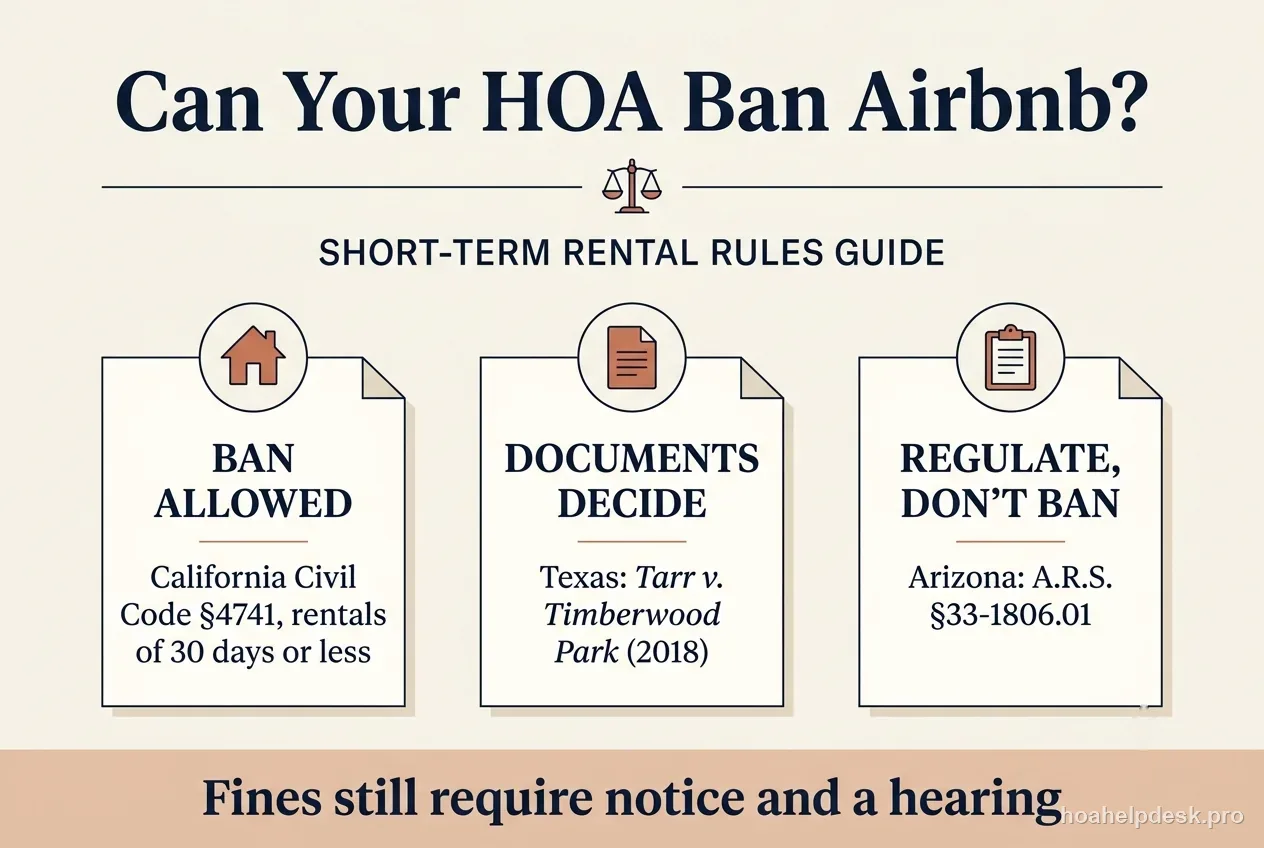
Can an HOA Ban Airbnb? Short-Term Rental Rules Boards Can Enforce
Which states let a board prohibit short-term rentals outright, which only allow regulation, and how to adopt a rule that survives a challenge.
Read guide →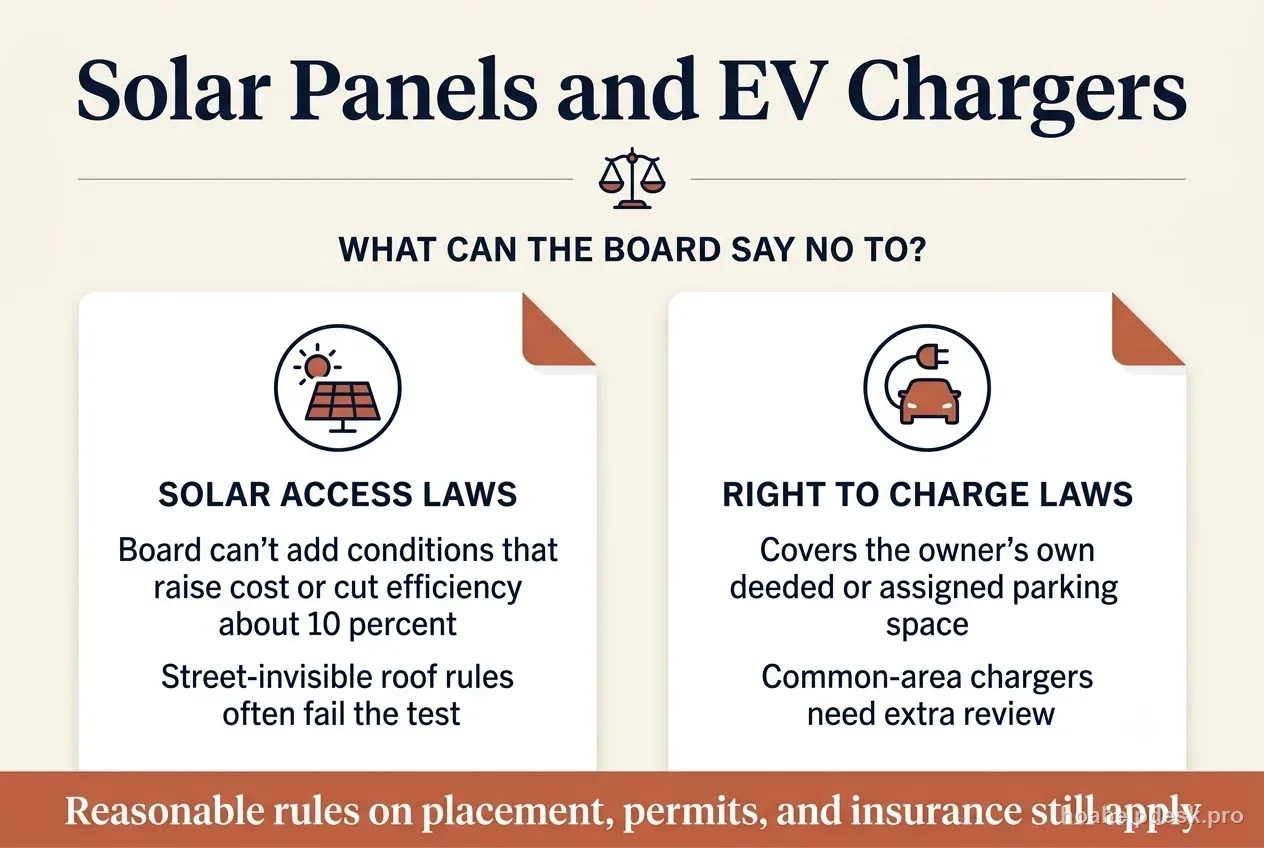
Solar Panels and EV Chargers: What an HOA Can and Can't Restrict
Solar-access and right-to-charge laws limit how far architectural review can go, and what boards can still regulate.
Read guide →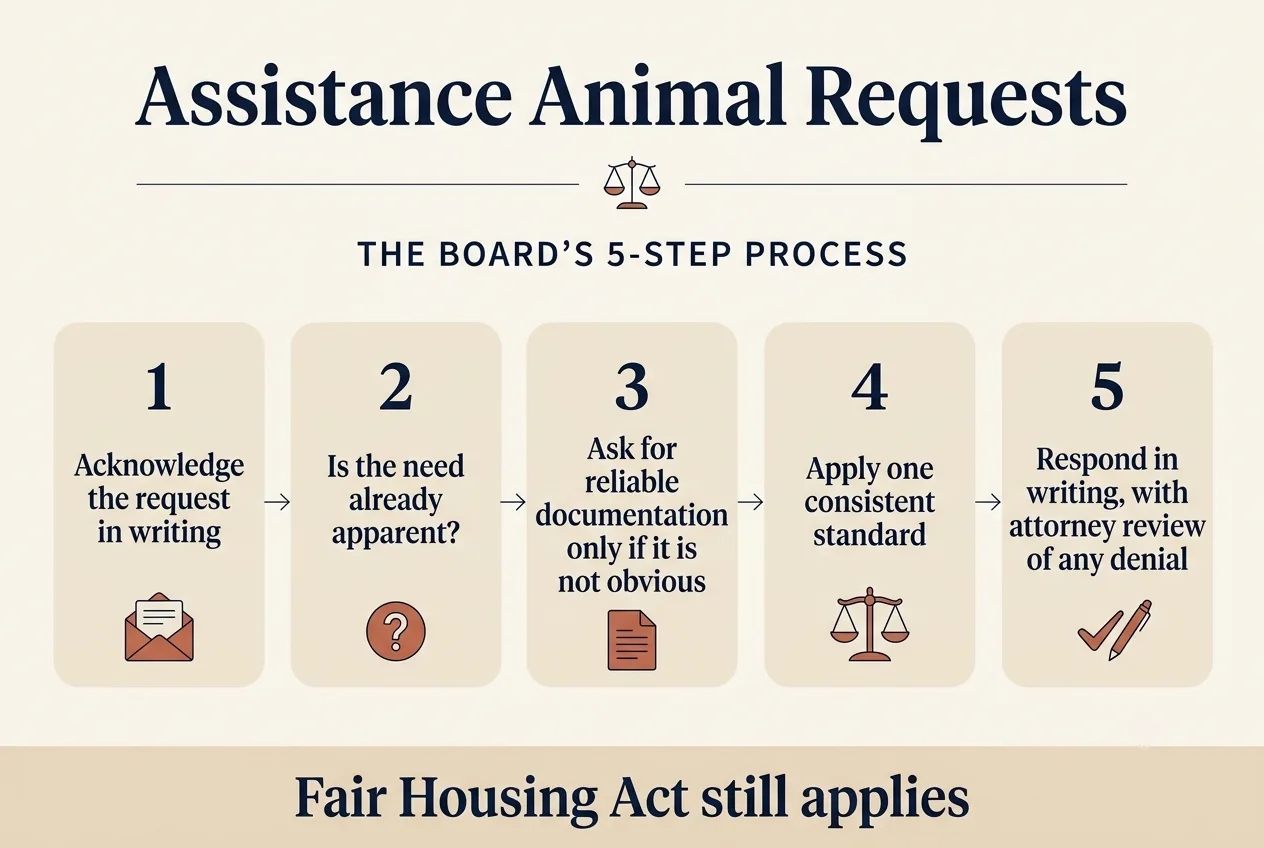
Emotional Support and Service Animal Requests: What a Board Can Ask
HUD's 2026 rescission of its ESA guidance changed the enforcement backdrop, but the Fair Housing Act didn't move.
Read guide →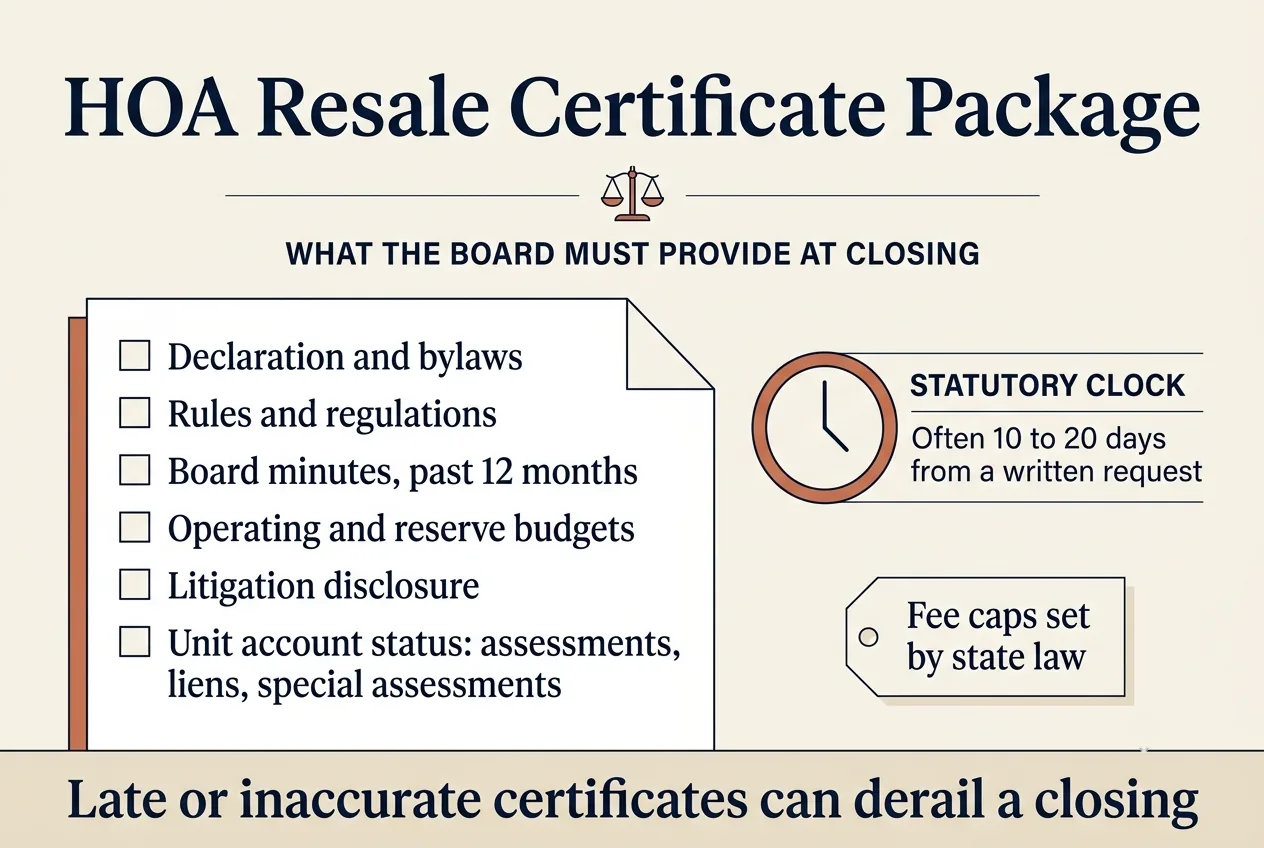
HOA Resale Certificates and Transfer Fees: What Boards Must Provide
What has to be in the package, the statutory deadline to produce it, typical fee caps, and why a stale certificate can delay a sale.
Read guide →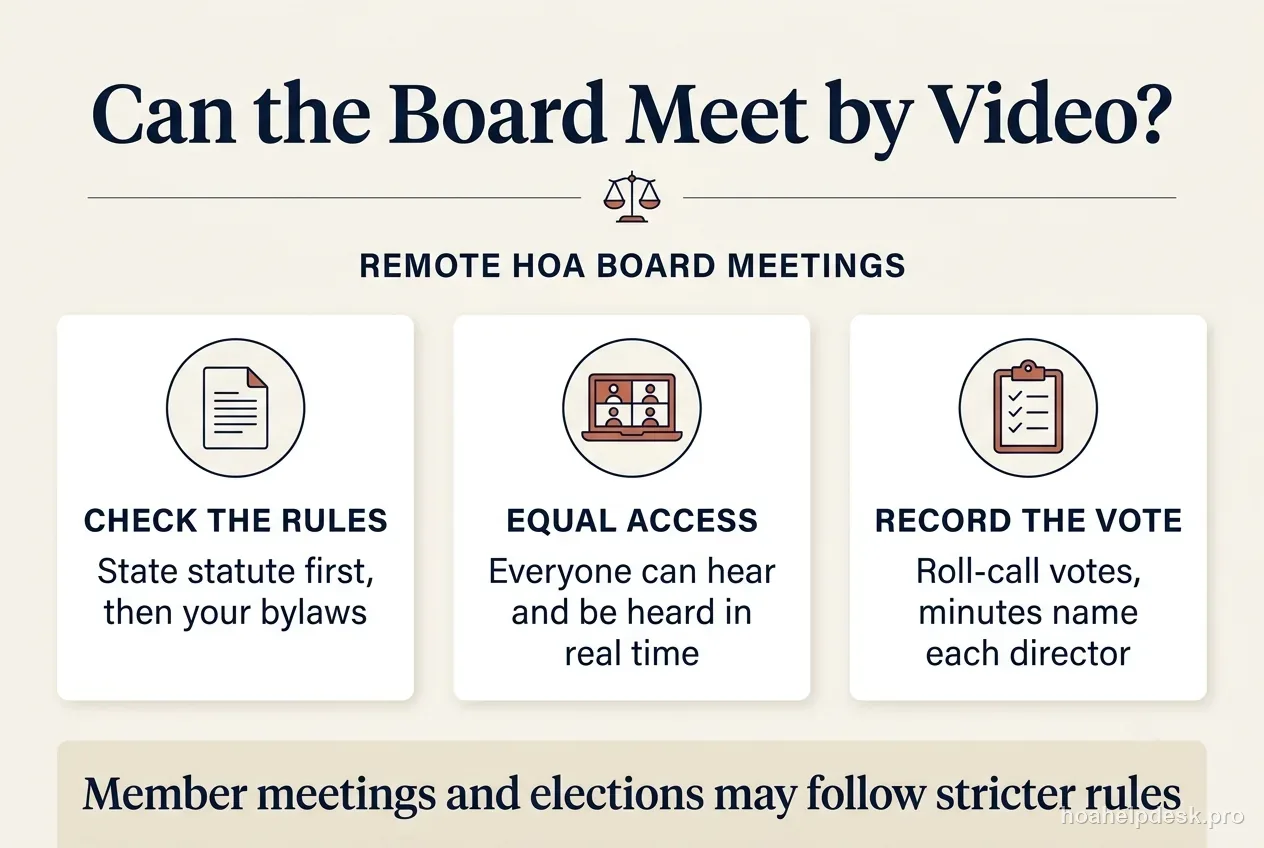
Can an HOA Board Meet by Video or Phone? Virtual Meeting Rules
Which states have codified a right to hold board meetings remotely, and what "equal access" actually requires.
Read guide →How the desk researches a governance question
The working sequence is intentionally boring: identify the entity type, collect the actual reserve study, policy, or contract, locate the governing documents, then match the question to the current state statute and official guidance. The goal is to reduce guesswork before a board decides whether it needs a broker, CPA, or attorney.
Core record set
For most governance decisions, the useful file starts with the reserve study, the insurance declarations, the vendor contract, board minutes tied to the decision, and the governing documents provision that applies. What the board must document — and when — depends on state law and the association type.