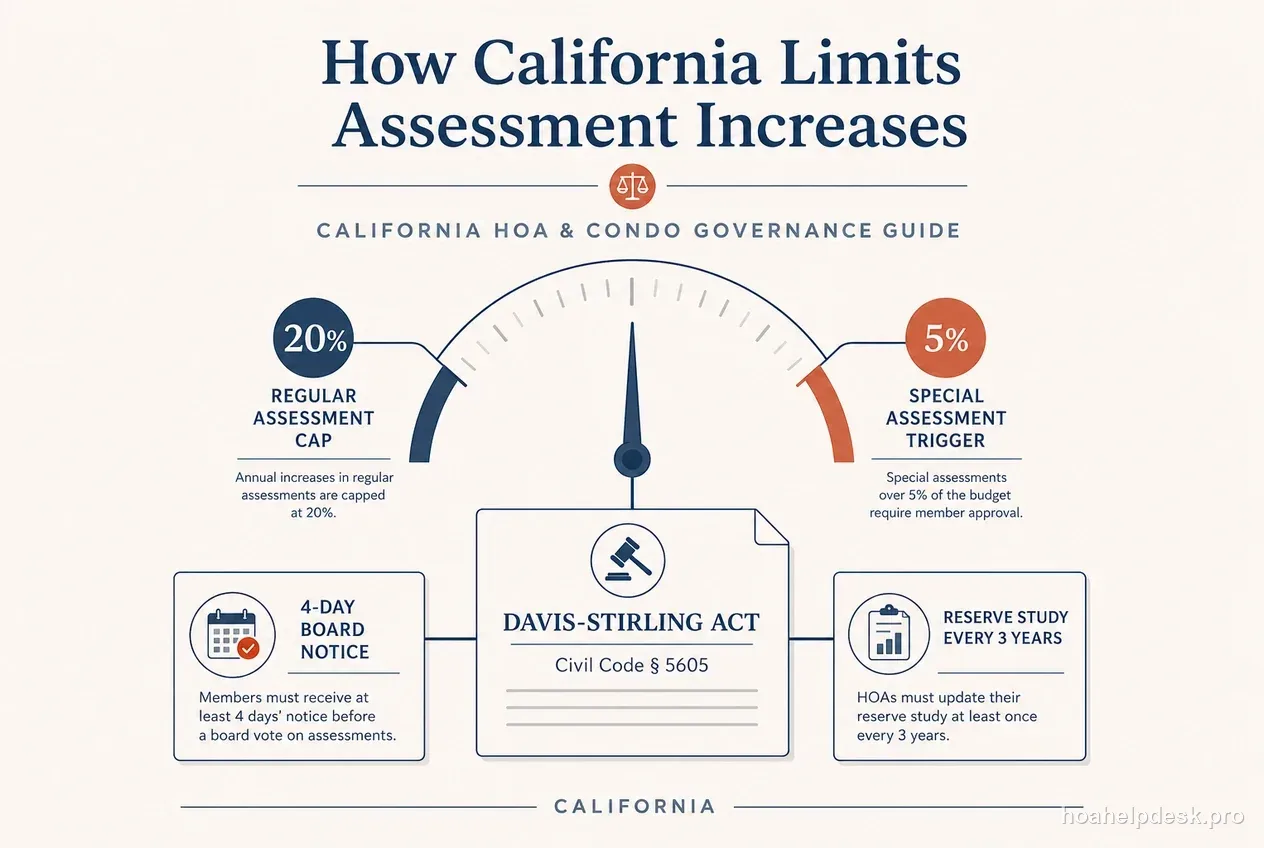
California’s Davis-Stirling Act applies across qualifying common-interest developments and sets unusually detailed board procedures. Reserve studies require a visual inspection at least every three years with annual review; most board meetings need four days’ notice and an agenda; annual regular-assessment increases above 20% and aggregate special assessments above 5% of budgeted gross expenses generally require member approval; crime/fidelity coverage must equal at least reserves plus three months of assessments.
Which statute governs your association
California does not use one HOA act for subdivisions and a separate condominium governance act. Qualifying common-interest developments — including condominium projects, planned developments, stock cooperatives, and community apartment projects — are governed principally by the Davis-Stirling Common Interest Development Act in Civil Code §§ 4000–6150. Corporate law still matters for incorporated associations, but Davis-Stirling contains the specialized rules a volunteer board encounters most often: board meetings, elections, records, annual disclosures, reserves, assessments, discipline, and dispute resolution.
The governing documents remain important, but they cannot waive mandatory statutory protections. In some sections the statute expressly tells the board to follow a longer notice period or greater coverage amount required by the governing documents. That is the correct way to apply the “stricter documents control” principle: use the statute as the floor, then check the declaration, bylaws, and operating rules for additional restrictions that are lawful. Do not enforce a governing-document clause that conflicts with mandatory Davis-Stirling language. Confirm the current statute text and any recent amendment before relying on this guide.
Sources: [1]
Reserve study and reserve funding
California has a real statutory reserve-study cycle. Civil Code § 5550 requires the board, at least once every three years, to cause a reasonably competent and diligent visual inspection of accessible major components the association is obligated to repair, replace, restore, or maintain when the statutory replacement-value threshold is met. The board must review the study annually and consider necessary adjustments. The study identifies major components with remaining useful life under 30 years, remaining life, estimated repair or replacement cost, annual contribution, and a reserve funding plan.
A reserve funding plan is required, but California does not simply command every association to be “100% funded.” The board’s job is to disclose the reserve position, adopt a funding plan, and explain how anticipated component obligations will be financed. The annual budget report must include a reserve summary and funding-plan information. Treat the reserve study as a living board document: update cost assumptions, reconcile deferred projects, and record why contributions changed. If the governing documents require more frequent study or stronger funding, use that stricter internal standard.
Sources: [2]
Insurance and fidelity bond
California separates several insurance concepts. Civil Code § 5805 provides tort-liability protection for owners based on specified general-liability coverage levels: at least $2 million for a development with 100 or fewer separate interests and at least $3 million when there are more than 100. Those limits are tied to the statutory liability protection and should not be confused with a complete master property-policy requirement. The annual budget report also requires a summary of property, general liability, earthquake, flood, and fidelity insurance policies.
Civil Code § 5806 creates a specific crime/fidelity floor. Unless the governing documents require more, the association must maintain crime insurance, employee dishonesty coverage, fidelity bond coverage, or equivalent protection for directors, officers, and employees equal to at least the combined amount of reserves plus three months of total assessments. Equal protection against computer fraud and funds-transfer fraud is also required, and management-company dishonest acts must be covered when a manager is used. This is a statutory formula a treasurer can directly test at renewal.
Sources: [4]
Open meetings, notice, and agenda
Civil Code § 4920 generally requires at least four days’ notice of the time and place of a board meeting, delivered by the general-notice methods in § 4045, and the notice must contain the agenda. A nonemergency board meeting held solely in executive session generally requires at least two days’ notice, while a statutory emergency meeting does not require advance notice. If the governing documents require a longer notice period, the board must follow the longer period in the circumstances described by the statute.
Agenda discipline matters because Davis-Stirling limits board action on items not placed on the agenda, subject to statutory exceptions. Executive session is not a general-purpose privacy tool; it is reserved for matters the statute permits to be closed. Boards should publish the agenda before discussion, identify executive-session topics appropriately, and keep minutes that show the action taken without exposing privileged content. Remote and electronic participation must also be handled under current meeting statutes rather than by informal text-message or email voting.
Sources: [3]
Quorum and voting thresholds
California member elections are unusually procedural. Civil Code § 5100 requires secret-ballot procedures for director elections and removals, assessments that legally require a member vote, amendments to governing documents, and specified exclusive-use common-area grants. Board seats must be submitted to the statutory election process when terms expire and at least once every four years unless a narrow exception applies. The election rules work together with inspector-of-election, nomination, ballot-delivery, counting, and notice sections; a board should not treat the secret ballot as the only compliance step.
Vote thresholds depend on the action. Assessment approvals under § 5605 use a majority of a quorum as defined by statute, while declaration amendments may be governed by a different Civil Code provision and the declaration. Civil Code § 5120 requires public counting and prompt reporting, with general notice of tabulated results within 15 days. Before any vote, identify the statutory voting article, the governing-document threshold, quorum, ballot method, and denominator. A stricter lawful governing-document threshold should be applied when the statute permits it.
Records access and retention
California’s records statute is specific about both inspectability and timing. Under Civil Code §§ 5205 and 5210, association records for the current fiscal year and the prior two fiscal years are generally subject to member inspection, while member and board meeting minutes remain subject to inspection permanently. When a proper request concerns current-year records, access generally must be granted within 10 business days; for records from the prior two fiscal years, the statute generally provides 30 calendar days. Other categories have their own timeframes.
That is not permission to destroy everything after two years. Minutes have permanent inspection status, election and reserve-inspection materials have separate rules, and tax, contract, insurance, litigation, and corporate needs can demand longer retention. Boards should maintain a written records retention schedule and a repeatable request workflow. Privacy and privilege rules still matter, so the association should redact or withhold only as authorized rather than refusing an entire request. Recordkeeping should also support the annual disclosures and reserve documentation the board is separately required to produce.
Sources: [3]
Budget and assessment disclosure
Civil Code § 5300 requires the association to distribute an annual budget report 30 to 90 days before the end of the fiscal year. The report includes a pro forma operating budget, reserve summary, reserve funding-plan summary, information about deferred major-component work, anticipated special assessments for major components, the mechanism for funding reserves, loan disclosures, and an insurance summary. This is not merely a courtesy budget letter; it is a statutory disclosure package linked to the board’s assessment authority.
The timing matters because § 5605 conditions certain regular-assessment increases on compliance with specified annual-budget-report requirements unless the association obtains the required member approval. A board should calendar the report backward from fiscal year end, verify that the reserve and insurance sections are complete, and keep proof of delivery. If the governing documents require an earlier mailing or additional financial information, comply with the stricter requirement. Budget adoption, owner disclosure, and assessment notice should be documented as separate steps.
Sources: [2]
Limits on assessment and fee increases
California has a statutory board-authority ceiling that boards should calculate before adopting dues. Under Civil Code § 5605, the board generally may not impose a regular assessment more than 20% above the preceding fiscal year’s regular assessment or special assessments that in the aggregate exceed 5% of the budgeted gross expenses for that fiscal year without approval of a majority of a quorum of members. The statute also contains special rules for certain deed-restricted affordable housing units in newer associations.
These percentages are not a statement that every increase below them is automatically proper. The board still needs a compliant budget, lawful allocation, and observance of any governing-document restrictions that operate consistently with the statute. Nor should the 5% special-assessment threshold be described as a ban: above the threshold, member approval is generally the issue. Before levying a special assessment, calculate the aggregate special assessments for the fiscal year and confirm whether an emergency-assessment exception or another statutory provision applies.
Sources: [2]
Fines and enforcement due process
California’s discipline process became more protective in 2025. Civil Code § 5855 requires written notice at least 10 days before the board meeting at which discipline or certain reimbursement charges will be considered. The notice must state the date, time, place, nature of the alleged violation or damage, and the member’s right to attend and address the board. The member has an opportunity to cure before the meeting, and the board must meet in executive session if the member requests it.
If the board imposes discipline, it must provide written notice of the decision within 14 days after the action, and the discipline is not effective unless the statutory requirements are satisfied. If the parties remain in disagreement, the member has an opportunity to request internal dispute resolution. Boards should therefore avoid “automatic fine” workflows that skip the hearing. Keep the violation evidence, hearing notice, proof of delivery, cure status, minutes, decision, and any IDR request together so the association can demonstrate due process.
Sources: [5]
Sources
- Davis-Stirling Common Interest Development Act — Cal. Civ. Code § 4000Official California Legislature entry identifying Part 5 as the Davis-Stirling Common Interest Development Act.
- California finance and assessment rules — Cal. Civ. Code §§ 5300, 5550, 5605Official § 5550 reserve-study rule; this source group also cites official §§ 5300 (annual budget report) and 5605 (assessment thresholds), which must be HTTP-checked during assembly.
- California governance, election, and records rules — Cal. Civ. Code §§ 4920, 5100, 5120, 5210Official § 4920 meeting rule; grouped with official §§ 5100/5120 election rules and § 5210 records timing for sourceRefs.
- California liability and fidelity/crime coverage — Cal. Civ. Code §§ 5805, 5806Official reserves-plus-three-months fidelity/crime formula; § 5805 contains general-liability thresholds.
- California discipline hearing — Cal. Civ. Code § 5855Official pre-hearing notice, cure opportunity, decision notice, and IDR provisions.
Compare nearby state rules
Check one decision against the statute
For a single board decision — a fine, a special assessment, a records request, an election, a CC&R amendment — the State Decision Lookup resolves the verified statutory rule for California and a growing set of other states, and the Board Decision Router lays out the research sequence. Both fail closed when the primary law is unclear rather than guessing.