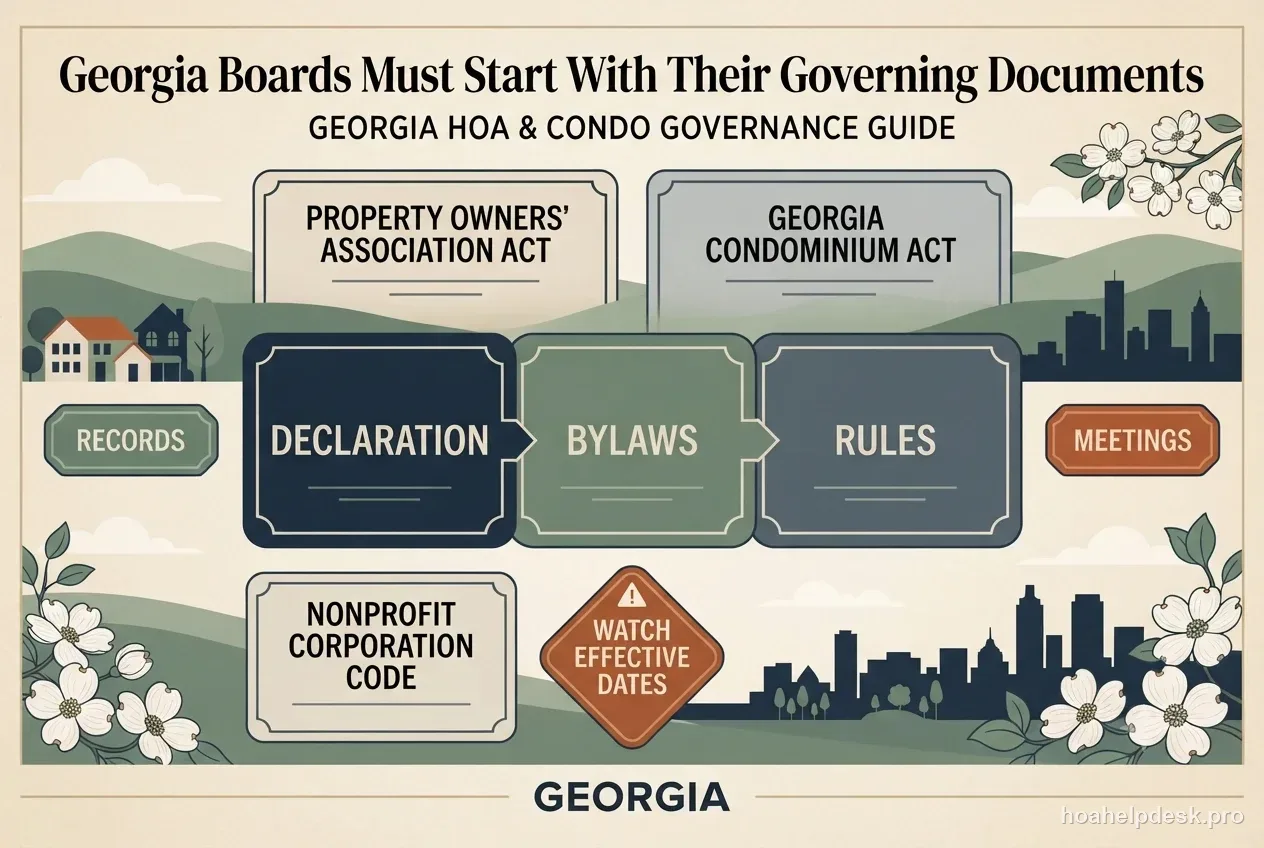
Georgia separates the Property Owners’ Association Act from the Condominium Act and leaves many day-to-day governance details to recorded instruments and corporate bylaws. Both modern acts use a two-thirds default for many amendments. The Condominium Act has specific master-insurance requirements, while neither act creates a general recurring reserve-study mandate. SB 406 was signed in 2026, but its principal HOA changes begin January 1, 2027.
Which statute governs your association
Georgia boards first need to determine whether the community is a condominium under the Georgia Condominium Act or a subdivision that has submitted to the Property Owners’ Association Act. Those are separate statutory regimes. A subdivision can also have recorded covenants without being subject to the POAA, so the board should not infer POAA status merely from the existence of an HOA name, assessment obligation, or architectural committee.
Corporate law and the recorded declaration, instrument, articles, and bylaws fill many procedural gaps. That makes Georgia more document-driven than states such as Delaware or Florida. If the governing documents lawfully require stricter meeting, notice, quorum, or enforcement procedures than the statute, the board should follow them. Confirm the current statute text and any recent amendment before relying on this guide, especially because 2026 legislation changes the POAA framework beginning in 2027.
Reserve study and reserve funding
Neither the current Georgia POAA nor the Condominium Act imposes a general statewide recurring reserve-study cycle comparable to Florida’s SIRS law or Delaware’s five-year reserve-study definition. Condominium instruments may authorize or require reserves, and a prudent board should budget for predictable replacement obligations, but it should not tell owners that Georgia law mandates a study every fixed number of years when the current statutes do not.
For a condominium, begin with the declaration’s common-element maintenance responsibilities and any reserve provisions in the condominium instruments. For a POAA community, review the instrument, annual budget process, and common-property obligations. A board-created reserve study can still be valuable evidence of reasonable planning. Keep the component list, cost assumptions, bids, reserve balance, contribution decision, and any special assessment resolution together so later directors can reconstruct the financial rationale.
Sources: [1]
Insurance and fidelity bond
The Georgia Condominium Act is specific about association insurance. Section 44-3-107 requires property coverage consistent with full insurable replacement cost, less deductibles, for the condominium property described by the statute and requires commercial general liability coverage with stated minimum limits. The current condominium statute does not create a universal fidelity-bond formula comparable to Florida’s “maximum funds in custody” rule.
The POAA is less prescriptive about association-wide insurance, so the instrument and corporate risk program become more important. A board should separately evaluate the master insurance policy, general liability, fidelity or crime coverage, D&O insurance, deductibles, and any owner-insurance requirements. Do not assume the condominium insurance statute applies to a subdivision HOA merely because both associations collect assessments and maintain common property.
Open meetings, notice, and agenda
Georgia’s current POAA and Condominium Act do not create the same detailed statewide board-meeting notice system found in Florida or Connecticut. Meeting mechanics are therefore often controlled by the association’s declaration or instrument, articles, bylaws, and applicable nonprofit-corporation provisions. The board should identify those sources before announcing that state law requires a particular number of days for every board meeting.
Even where a statute does not impose a detailed open-meeting rule, disciplined notice is good governance. Use a consistent calendar, publish agendas as the bylaws require, preserve proof of delivery, and keep meeting minutes that show motions and votes. If a matter is handled privately because of attorney-client privilege, personnel issues, or another sensitive reason, document the authority for confidentiality rather than inventing a broad “executive session” power not found in the governing framework.
Sources: [1]
Quorum and voting thresholds
Georgia supplies a concrete amendment rule in both regimes. Under the current POAA, an association instrument generally may be amended by owners holding two-thirds of association votes unless the instrument lawfully requires a larger majority, subject to statutory exceptions. The Condominium Act likewise generally uses a two-thirds owner-vote threshold for condominium-instrument amendments, with special rules and protections for certain fundamental changes.
Those amendment percentages do not automatically set quorum for every member meeting or establish the election method. The bylaws and corporate statute may control those questions. Before a vote, the board should identify total eligible votes, quorum, whether proxy voting is permitted, the exact approval denominator, mortgagee consent if applicable, and the recording requirement. An amendment is not operational merely because a show of hands at a meeting looked decisive.
Records access and retention
As of September 1, 2026, Georgia’s current POAA does not yet contain the broad new owner-records framework that SB 406 will introduce principally on January 1, 2027. Current records rights therefore require careful attention to the governing documents, corporate law, condominium provisions where applicable, and the type of record requested. Boards should not publish the 2027 procedure as if it were already effective.
Adopt a records-retention schedule now anyway. Keep governing documents, amendments, owner and voting records, minutes, financial statements, tax returns, contracts, insurance, bank records, capital-project files, and enforcement records in organized categories. Separate privileged counsel communications and sensitive personnel information. A good 2026 records system will also make compliance easier when Georgia’s new POAA registration and owner-rights framework takes effect in 2027.
Budget and assessment disclosure
Georgia’s current statutes do not use a Connecticut-style statewide budget-ratification vote or a California-style annual assessment-increase cap. For a POAA association, assessment authority and allocation begin with the recorded instrument and POAA provisions. For a condominium, common-expense liability and the condominium instruments govern. The board should build the annual assessment from documented obligations rather than treating the prior year’s fee as an automatic baseline.
A useful budget package shows operating expenses, insurance, reserve contribution, contracts, delinquency assumptions, known repair work, and the per-lot or per-unit allocation. If a special assessment is needed, cite the instrument provision authorizing it and any owner vote or notice requirement. Because Georgia is document-driven, owners should be able to see both the financial reason for the assessment and the recorded authority that allows the board to levy it.
Sources: [1]
Limits on assessment and fee increases
Georgia currently has no simple statewide percentage ceiling on ordinary annual HOA or condominium assessment increases. That does not mean a board can charge any amount for any purpose. The recorded instrument or declaration controls what common expenses may be assessed, how they are allocated, and whether owner approval is required. The governing documents may therefore be more restrictive than state statute in a particular community.
Be careful with SB 406 when discussing fees and liens. The act was signed in 2026, but—with a limited unrelated exception—its property-owners’ association registration, complaint, records, fine, fee, and lien changes take effect January 1, 2027. A September 2026 guide should flag the transition for planning without presenting the future Secretary of State framework or future lien thresholds as current law.
Fines and enforcement due process
Current Georgia HOA enforcement is strongly document-dependent. The POAA authorizes assessment and lien remedies, but the board should identify the specific covenant or rule, the instrument’s fine authority, required notice, and any hearing or appeal procedure before adding a charge to an owner’s account. Condominium boards should perform the same exercise under the condominium instruments and the applicable Condominium Act provisions.
SB 406 will materially change the POAA environment beginning January 1, 2027, including registration and complaint mechanisms and new restrictions tied to fines, fees, and liens. Until that effective date, boards should not use those future provisions as present enforcement authority. They should, however, review forms and collections workflows during late 2026 so the association can transition without continuing a procedure that becomes noncompliant on the effective date.
Sources
- Official Code of Georgia Annotated — state-provided LexisNexis portalGeorgia state agencies direct users here for the current O.C.G.A.; cross-check 2026 session changes against signed acts because recently enacted legislation may not yet be incorporated.
- Georgia General Assembly — General Statutes / annual statutory materialsOfficial General Assembly portal for statutory materials and annual updates.
- O.C.G.A. § 44-3-107 — condominium insurance (secondary mirror)Secondary mirror used only as a navigation aid; confirm against the official O.C.G.A. portal before publication.
- O.C.G.A. § 44-3-226 — POAA amendments (secondary mirror)Secondary mirror shows the version in force before the January 1, 2027 changes; confirm against official current code.
- Georgia SB 406 (2026) — signed actOfficial signed legislation; principal HOA-governance changes take effect January 1, 2027, while specified provisions have earlier effective dates.
- Georgia General Assembly — 2026 Session SummaryOfficial session summary used to cross-check the scope and timing of 2026 HOA legislation.
Compare nearby state rules
Check one decision against the statute
For a single board decision — a fine, a special assessment, a records request, an election, a CC&R amendment — the State Decision Lookup resolves the verified statutory rule for Georgia and a growing set of other states, and the Board Decision Router lays out the research sequence. Both fail closed when the primary law is unclear rather than guessing.