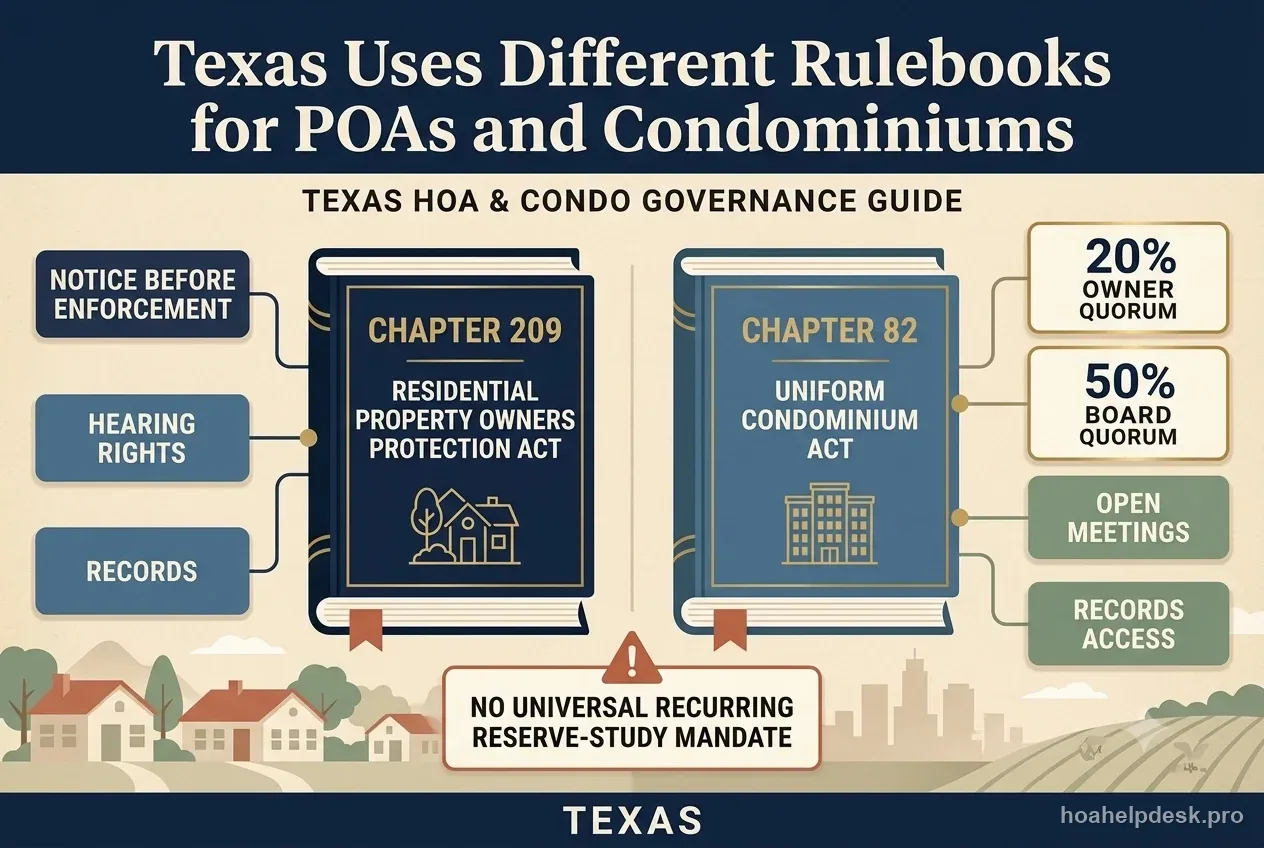
Texas uses different statutes for subdivision POAs and condominiums: Property Code Chapters 209 and 82. Texas does not impose a general recurring reserve-study mandate on all associations. Condo quorum defaults to 20% for owners and 50% for the board. Chapter 209 gives HOA owners detailed notice and hearing rights before many enforcement actions, while Chapter 82 has its own open-meeting, records-access, voting, and amendment rules.
Which statute governs your association
Texas boards must first determine whether the property is a subdivision governed by Chapter 209 or a condominium governed by Chapter 82 of the Property Code. The Texas Residential Property Owners Protection Act regulates many residential property owners associations, while the Uniform Condominium Act provides a separate association framework for condominiums. The two chapters overlap in themes but not in every procedure, deadline, voting rule, or enforcement safeguard.
Older condominiums need another check because Chapter 82 became the modern regime for declarations recorded on or after January 1, 1994, while older projects remain substantially tied to Chapter 81 subject to Chapter 82’s applicability provisions. A board should never lift a Chapter 209 HOA rule into a condo without checking Chapter 82. If governing documents impose a stricter valid requirement, follow it. Confirm the current statute text and any recent amendment before relying on this guide.
Reserve study and reserve funding
Texas does not impose a statewide recurring reserve study cycle or mandatory percent-funded reserve floor on every Chapter 209 HOA or Chapter 82 condominium. Reserve obligations are therefore commonly driven by the declaration, annual budget, lender expectations, insurance planning, and the board’s maintenance responsibilities. A Texas board may still commission a reserve study as a prudent capital-planning tool, but it should not describe the study as a universal statutory interval.
This distinction matters when owners debate a special assessment. The board should connect the proposed funding to a maintenance obligation, an adopted budget, or authority in the governing documents rather than claiming Texas law requires a particular reserve balance. Condominiums should also review Chapter 82’s common-element repair and budget powers. If the declaration contains a reserve contribution formula, a board-created policy cannot simply disregard that document requirement because state law lacks a general reserve percentage.
Insurance and fidelity bond
Chapter 82 contains condominium association insurance requirements that should be read together with the declaration and the unit/common-element boundary. The association’s property and liability coverage duties can depend on what the condominium regime defines as association-insured property, available coverage, and deductible allocation. A board should confirm the current text of Section 82.111 before stating a replacement-cost or deductible rule to owners.
Chapter 209 does not impose one universal fidelity bond formula or master insurance policy percentage on every Texas subdivision HOA. The declaration, lender requirements, management contract, and board-risk policies often control crime coverage and D&O insurance decisions. Boards should avoid importing the condominium insurance rule into a non-condominium POA. The correct question is which statute and governing document allocates the risk for this particular association and this particular common asset.
Open meetings, notice, and agenda
Texas has detailed open meeting rules, but the HOA and condominium statutes should be read separately. Chapter 209 regulates property owners association board meetings and requires owner notice before specified board action; current statutory text should be checked for the exact method and timing because the Legislature has amended this section. Chapter 82 separately provides that association and board meetings are open to unit owners subject to specified executive-session topics.
For condominiums, executive session may cover matters such as personnel, pending or threatened litigation, contract negotiations, enforcement actions, and confidential or private information, but final association action should be handled under the statute’s meeting rules. For Chapter 209 HOAs, boards should put budget, assessment, fine, and rule actions on a properly noticed agenda when required. Do not rely on an old 72-hour summary: Texas changed the HOA notice framework in 2021.
Quorum and voting thresholds
Texas condominium quorum is unusually easy to state because Chapter 82 supplies defaults. Unless bylaws provide otherwise, an owner meeting has quorum when persons entitled to cast at least 20% of the votes for director elections are present in person or by proxy at the start; bylaws may not reduce that below 10%. Unless bylaws require more, a board meeting has quorum with 50% of board votes represented at the start.
Declaration amendment is a separate question. Section 82.067 generally uses at least 67% of votes in the association unless the declaration specifies a larger majority, with special protections for changes that alter boundaries, allocated interests, or certain uses. Chapter 209 subdivisions follow their own dedicatory-instrument rules. Before asking owners to amend the CC&Rs, state the denominator on the ballot and do not substitute the condominium 67% rule for an HOA declaration that lawfully requires something else.
Sources: [2]
Records access and retention
Chapter 82 gives condominium owners a structured records-access process. A written certified-mail request can trigger production or inspection within 10 business days, subject to a statutory extension process that requires timely notice and a later production date. For associations with at least eight units, Section 82.1141 also specifies retention periods for categories such as governing documents, financial records, owner account records, contracts, minutes, and tax or audit materials.
Chapter 209 has its own HOA records statute, Section 209.005, with request, production, copying-cost, and retention requirements that should be used for subdivision associations rather than the condo section. A board’s records retention schedule should identify which chapter applies before assigning deadlines. Attorney-client communications and other protected information require separate treatment; an owner’s inspection right does not mean every file held by counsel or every private owner record becomes freely distributable.
Budget and assessment disclosure
Texas does not use one statewide owner budget-ratification system for both POAs and condominiums. Chapter 209 regulates significant HOA board actions through its open-meeting framework, while the dedicatory instruments often determine assessment calculation and budget authority. Chapter 82 grants condominium associations powers to adopt budgets and levy common-expense assessments under its own structure. Boards should identify whether owner approval is required by statute, declaration, or bylaws before publishing a budget calendar.
A clear budget disclosure should separate ordinary assessments, reserve contributions, and a special assessment, because the authority and collection consequences may differ. For condominiums, retain the adopted budget and supporting financial records with the records required by Chapter 82. For HOAs, verify Chapter 209’s notice and meeting requirements before a board votes on material budget or assessment action, especially if an older board policy still assumes pre-2021 notice rules.
Limits on assessment and fee increases
Texas does not impose a single statewide percentage cap on ordinary annual assessment increases for every Chapter 209 HOA and Chapter 82 condominium. The declaration, dedicatory instruments, and adopted budget authority often provide the relevant ceiling or owner-approval threshold. A board therefore should not advertise “no cap” as unlimited power; the board remains constrained by recorded covenants, statutory meeting procedures, allocation rules, and the purpose for which an assessment is imposed.
Special assessment authority also depends on the correct regime. An HOA may need member approval if the declaration says so even though Chapter 209 contains no universal percentage limit. A condo board must use Chapter 82 and its declaration rather than Chapter 209. Before voting, write down the legal basis, amount, allocation method, due dates, and any owner approval. That simple step helps prevent a budget decision from accidentally becoming an unauthorized CC&R amendment.
Fines and enforcement due process
Texas Chapter 209 has detailed due process before many HOA enforcement actions. Section 209.006 requires written notice before specified actions such as suspending common-area rights, charging property damage, or levying a fine. For a curable violation the notice must provide a reasonable cure period, and the owner may request a hearing on or before the 30th day after the notice is mailed, subject to statutory exceptions.
Section 209.007 adds hearing mechanics: after a timely request, the association generally must hold the hearing within 30 days and provide at least 10 days’ hearing notice; the statute also addresses evidence packets and postponements. These numbers are HOA-specific and should not be pasted into a Chapter 82 condo policy without checking the condo documents and statutes. Boards should preserve the notice, delivery proof, evidence, hearing record, and final decision for every contested fine.
Sources: [1]
Sources
- Texas Legislature — Property Code Chapter 209Official current statute PDF for the Texas Residential Property Owners Protection Act; publication version is current through the 2025 legislative sessions shown by the state portal.
- Texas Legislature — Property Code Chapter 82Official Texas Constitution and Statutes portal for the Uniform Condominium Act; use section navigation to verify current Chapter 82 text.
- Texas Legislature — Property Code § 209.006Official source for notice required before specified HOA enforcement actions.
- Texas Legislature — Property Code § 209.007 board hearingsOfficial source for board-hearing timing, notice, evidence packet, and related HOA enforcement procedure.
- Texas Legislature — Property Code § 82.109 condominium quorumOfficial source for condominium quorum, voting, records, and related governance sections; verify section anchors during assembly.
Compare nearby state rules
Check one decision against the statute
For a single board decision — a fine, a special assessment, a records request, an election, a CC&R amendment — the State Decision Lookup resolves the verified statutory rule for Texas and a growing set of other states, and the Board Decision Router lays out the research sequence. Both fail closed when the primary law is unclear rather than guessing.