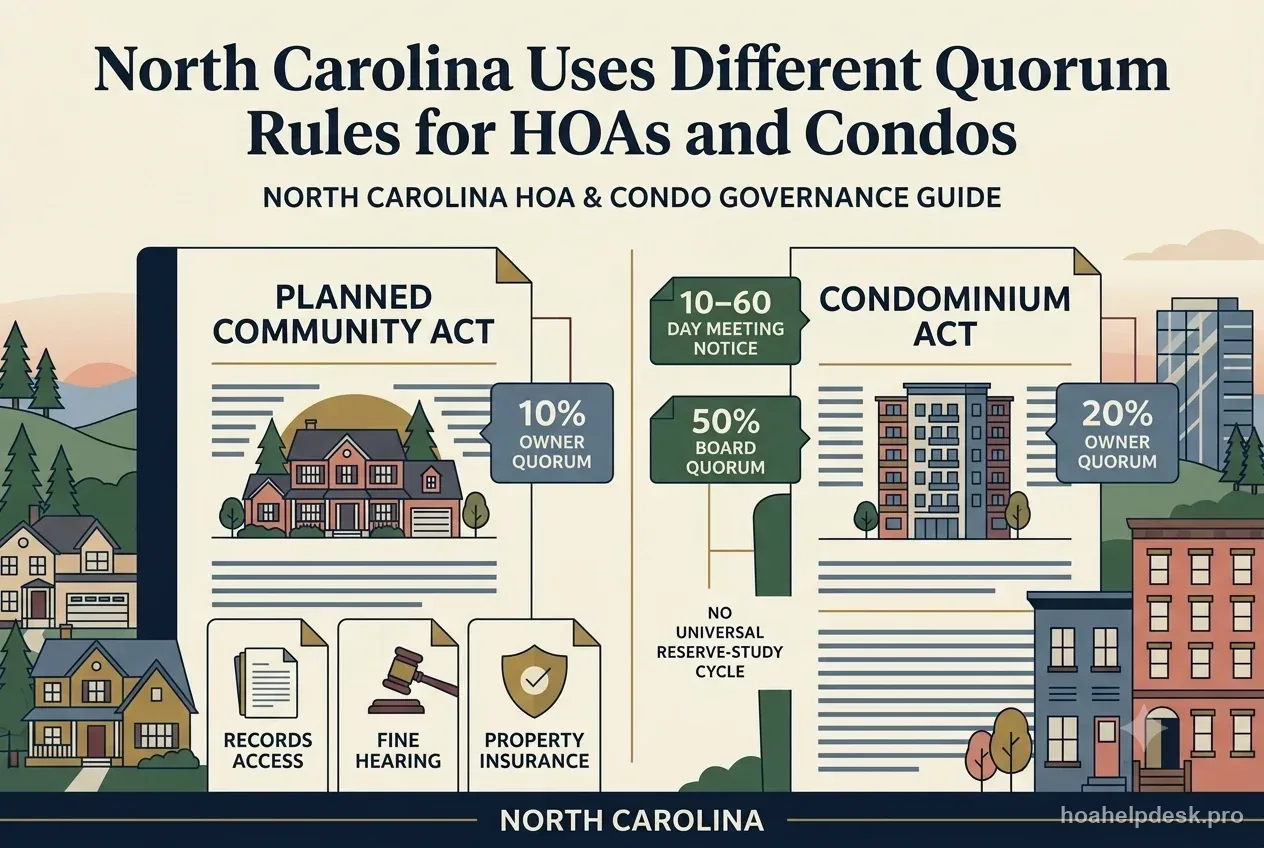
North Carolina separates planned communities under Chapter 47F from condominiums under Chapter 47C. Owner meetings generally require 10–60 days’ notice. Default owner quorum is 10% for HOAs and 20% for condos; board quorum is 50%. Both regimes provide owner access to records, statutory fine hearings, and common-property insurance rules, but neither imposes a general statewide reserve-study cycle or dues-increase cap.
Which statute governs your association
North Carolina has two mature common-interest statutes. Planned communities are governed by Chapter 47F, while condominiums use Chapter 47C. A condominium created after October 1, 1986 is squarely within the Condominium Act. Older condominiums may remain subject to the Unit Ownership Act in Chapter 47A for many matters, although Chapter 47C expressly applies a long list of modern governance provisions to later events in those older projects.
Chapter 47F applies in full to planned communities created in North Carolina on or after January 1, 1999, with two carve-outs: a community with 20 or fewer lots, and a community whose lots are all restricted to nonresidential use, are outside the Act unless the declaration opts in. Communities created before January 1, 1999 are not covered by the whole Act, but N.C. Gen. Stat. § 47F-1-102 still extends a defined set of 47F provisions to them — including parts of the meeting, quorum, board-power, lien, and records rules. Check your recorded creation date and whether the declaration has been amended to adopt 47F.
Planned communities created under Chapter 47F have their own meeting, quorum, proxy, insurance, records, assessment, and enforcement rules. Directors should not copy a condo threshold into an HOA resolution or vice versa. The declaration and bylaws still matter and may impose a stricter lawful procedure than the statutory default. If they do, follow the governing documents. Confirm the current statute text and any recent amendment before relying on this summary.
Reserve study and reserve funding
North Carolina’s Planned Community Act does not impose a recurring statewide professional reserve study or a fixed reserve-funding percentage on every HOA. The Condominium Act likewise gives associations budgeting and common-expense powers without creating a universal study cycle comparable to states with explicit reserve-study mandates. A board should therefore distinguish authority to maintain reserves from a statutory obligation to commission a study at a set interval.
That silence does not remove the board’s responsibility to plan for common assets. Roofs, private roads, elevators, stormwater facilities, siding, and mechanical systems can produce predictable future costs. A reserve study can support the budget and reduce surprise special assessments, but boards should label it accurately as a governance practice or document requirement unless their declaration, lender, insurance program, or another applicable rule makes it mandatory.
Insurance and fidelity bond
Chapter 47F requires a planned-community association, to the extent reasonably available, to maintain property insurance on common elements at not less than 80% of replacement cost after deductibles, excluding land and other normally excluded items, plus liability insurance in reasonable amounts. If that insurance is not reasonably available, the association must promptly notify owners rather than silently carrying a gap.
The Condominium Act contains a parallel association-insurance framework for condominium property, but a board should verify the exact property covered and the declaration’s allocation of unit versus common-element responsibility. Neither regime should be reduced to the property-policy percentage alone. D&O insurance and fidelity bond or crime coverage protect different risks. If the governing documents require broader coverage than the statutory baseline, the stricter lawful requirement controls.
Open meetings, notice, and agenda
Both Chapter 47F and Chapter 47C require annual association meetings and use a 10–60 day advance-notice window for owner meetings. The notice must state the time and place and identify agenda items required by the statute, including the general nature of proposed declaration or bylaw amendments, budget changes, and proposals to remove directors or officers. Electronic notice is available when the statutory conditions are met.
North Carolina’s statutes do not simply make every executive-board discussion a public meeting with a single statewide notice period. Instead, at regular intervals board meetings must give owners an opportunity to attend a portion and speak about issues or concerns, subject to reasonable limits. The bylaws control important meeting mechanics. Boards should publish a predictable schedule, preserve agendas and meeting minutes, and distinguish owner-comment access from participation in the board’s deliberative vote.
Quorum and voting thresholds
North Carolina deliberately sets different default owner quorums. For a planned-community meeting, persons entitled to cast 10% of the votes constitute a quorum unless the bylaws provide otherwise. For a condominium, the default is 20%. Executive-board quorum is 50% in both statutes unless the bylaws validly require a larger percentage. If a meeting fails for lack of quorum, the statutes provide a successive reduction mechanism for adjourned meetings.
Both statutes also recognize proxies. Under Chapter 47F a proxy is void if undated and ordinarily terminates 11 months after its date unless it states a shorter term. Declaration amendments commonly use a 67% approval rule, subject to statutory exceptions and any larger percentage specified in the declaration. Boards should identify the correct denominator before announcing a result and preserve proxies, ballots, written consents, and the recorded amendment.
Records access and retention
North Carolina requires association financial and other records, including association and executive-board meeting records, to be reasonably available to owners and authorized agents, subject to the bylaws and nonprofit-corporation law when applicable. If the bylaws do not specify the financial records to maintain, the statutes require accurate records of cash receipts, expenditures, assets, and liabilities. This is a real operational duty, not merely a resale-document function.
A particularly useful deadline applies to annual financial reporting: the association must make an income-and-expense statement and balance sheet available to owners without charge within 75 days after the close of the fiscal year. Boards should maintain a records retention schedule covering minutes, budgets, bank statements, contracts, insurance, ballots, enforcement files, and permanent recorded documents so the production right can be honored without exposing privileged or confidential material.
Budget and assessment disclosure
Neither Chapter 47F nor Chapter 47C imposes one universal owner-ratification procedure for every annual budget. The board’s budget authority, assessment allocation, and any owner-vote requirement must be read together with the declaration and bylaws. The statutes give associations power to levy assessments for common expenses, but that authority does not mean every special assessment can be imposed without the procedural limits written into the community documents.
A sound budget package should separate operations, insurance, reserve contributions, debt service, and planned capital work, and should disclose the assessment consequence clearly. If the declaration requires a membership vote for a special assessment or for spending above a threshold, that stricter lawful provision controls. Minutes should identify the budget adopted, the assessment amount, effective date, and the statutory or document authority relied on.
Limits on assessment and fee increases
North Carolina does not impose a general statewide percentage cap on annual HOA or condominium assessment increases. The practical ceiling usually comes from the declaration, bylaws, assessment allocation, and any owner-approval provision for special assessments. A board should not claim that Chapter 47F or Chapter 47C contains a 10%, 15%, or 20% annual dues cap when no such general cap applies.
The board should also separate regular assessments from fines, late charges, individual damage assessments, and special assessments. Each can have a different source of authority and collection treatment. Before a large increase, identify which common expenses drive the change and whether the governing documents require extra notice or owner approval. If the documents are stricter than the statutory baseline, follow those lawful restrictions rather than the most permissive reading of state law.
Fines and enforcement due process
North Carolina provides unusually clear statutory due process for planned-community fines. Unless the declaration supplies a specific procedure, the owner must receive notice of the charge and an opportunity to be heard and present evidence before the board or a qualifying adjudicatory panel. A fine may not exceed $100 for the violation, with continuing daily fines allowed only after more than five days following the decision. A panel decision may be appealed to the full board within 15 days.
The Condominium Act has a closely parallel fine-and-suspension procedure. Boards should not skip the hearing because a violation seems obvious, and they should not treat every policy charge as a fine. The enforcement file should contain the governing rule, notice, evidence, hearing record, decision, and appeal status. Because fines can become assessments secured by statutory liens under these regimes, precise compliance with the hearing process matters before collection escalates.
Sources
- North Carolina General Assembly — Chapter 47F, Planned Community ActOfficial current planned-community statute, including 2025–2026 amendments shown in the code.
- North Carolina General Assembly — Chapter 47C, Condominium ActOfficial current condominium statute.
- G.S. 47C-1-102 — applicability to older condominiumsOfficial statute distinguishing post-October 1, 1986 condominiums and listed provisions applying to older projects.
- G.S. 47F-3-108 — planned-community meetingsOfficial HOA meeting and notice provision; compare Chapter 47C § 3-108 for condos.
- G.S. 47F-3-113 — planned-community insuranceOfficial HOA insurance provision, including 80% replacement-cost floor where reasonably available.
- G.S. 47F-3-107.1 — HOA fine hearing procedureOfficial fine and suspension due-process provision; Chapter 47C has the analogous condominium section.
Compare nearby state rules
Check one decision against the statute
For a single board decision — a fine, a special assessment, a records request, an election, a CC&R amendment — the State Decision Lookup resolves the verified statutory rule for North Carolina and a growing set of other states, and the Board Decision Router lays out the research sequence. Both fail closed when the primary law is unclear rather than guessing.