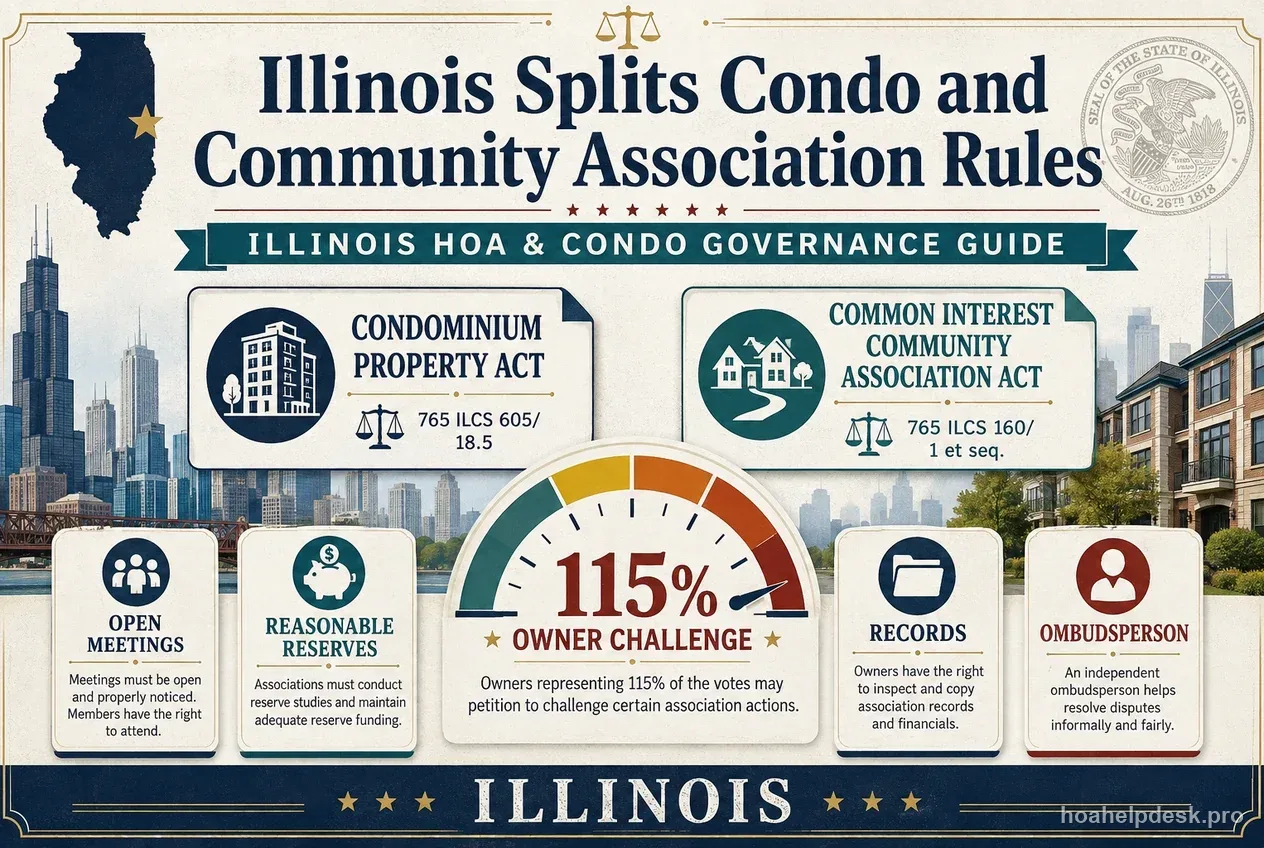
Illinois has separate statutes for condominiums and many non-condominium common-interest communities. Both impose open-meeting and records rules, but budget notice, reserve treatment, and owner challenge procedures differ. Condo boards must budget reasonable reserves unless lawfully waived, while Illinois uses a 115-percent owner-challenge mechanism rather than a simple statewide assessment cap. Apply the correct Act before counting notice days or votes.
Which statute governs your association
Illinois boards need to identify the statutory lane before applying a governance rule. Condominium associations are governed primarily by the Condominium Property Act, 765 ILCS 605. Many non-condominium common-interest communities fall under the Common Interest Community Association Act, 765 ILCS 160, subject to that Act's definitions and exclusions. Corporate law can supplement both. The two property statutes overlap in subjects such as meetings and records, but they are not interchangeable and sometimes use different notice or budget procedures.
A board should keep the declaration, bylaws, rules, and any recorded amendments next to the statute. If those governing documents impose a stricter notice, voting, or approval requirement than the statute, the stricter valid requirement generally needs to be honored unless state law preempts it. Illinois legislation changes frequently, so boards should review effective dates as well as current text. Confirm the current statute text and any recent amendment before relying on this guide.
Reserve study and reserve funding
Illinois condominium law requires boards adopting budgets to provide for reasonable reserves for capital expenditures and deferred maintenance, taking statutory factors into account. The Act does not impose a universal periodic reserve-study cycle. If the condominium instruments do not themselves require reserves, unit owners may waive or reduce the statutory reserve requirement by a vote of two-thirds of the total votes of the association. A reserve study can be evidence informing the board's judgment, but it is not the same thing as a statewide study-every-X-years mandate.
The Common Interest Community Association Act does not create a parallel universal reserve-funding formula for every HOA. It does, however, regulate budgets, records, and board procedure, and an association's declaration may impose stronger reserve obligations. Boards should therefore avoid importing the condominium two-thirds waiver rule into a non-condominium community. The treasurer should label each reserve contribution as statutory, declaration-required, lender-required, or board-policy based so owners can understand why the amount appears in the budget.
Insurance and fidelity bond
Illinois condominium associations have detailed insurance requirements in 765 ILCS 605/12, including property and liability coverage and statutory treatment of fidelity and directors-and-officers protection. Because coverage language and amendment history matter, a board should have the broker map each statutory requirement to a policy declaration or endorsement rather than merely stating that the association is 'fully insured.' Deductibles, exclusions, ordinance-or-law coverage, and responsibility for unit improvements can materially affect the association even when a master insurance policy is in force.
For a non-condominium common-interest community, the declaration and insurance contracts may carry more of the substantive requirements. The board should distinguish D&O insurance from fidelity bond or crime coverage and from property insurance on common assets. When a manager handles association money, directors should verify whether the manager's bond names or protects the association and whether the association maintains its own coverage. A certificate of insurance is useful evidence, but it does not replace reading the operative endorsements.
Open meetings, notice, and agenda
Illinois is prescriptive about association meetings. Under the Common Interest Community Association Act, the board must meet at least four times each year, board meetings are generally open to members, and ordinary board-meeting notice is at least forty-eight hours. A meeting to adopt a budget or a regular or special assessment uses a longer statutory notice window of ten to sixty days. Closed discussion is limited to listed subjects, and the board's final vote must occur in an open meeting.
Condominium boards likewise must meet at least four times yearly, and 765 ILCS 605/18 provides an open-meeting structure with at least forty-eight hours' notice for board meetings. Unit owners may record proceedings subject to reasonable rules. Membership-meeting notices generally run from ten to thirty days. Because budget and assessment decisions can have additional notice requirements, the secretary should not reuse a generic meeting notice without checking the particular action on the agenda.
Quorum and voting thresholds
For common-interest communities under 765 ILCS 160, the statutory membership quorum is twenty percent of the membership unless the community instruments provide a lower percentage. That is not a universal condominium rule. Both statutes also contain subject-specific owner-vote requirements, so a board should identify the denominator before an election, rejection vote, or amendment. The fact that a meeting has quorum does not mean a simple majority of attendees can approve every action reserved to the entire membership.
Illinois also gives owners a statutory mechanism to challenge certain budgets and assessments when the statutory trigger is met. The condominium and common-interest statutes use similar 115-percent concepts but have different petition timing and procedural details. Boards should apply the correct Act rather than summarize the rule as 'owners can veto increases over fifteen percent.' A valid challenge depends on the statutory calculation, petition percentage, timing, meeting, and required vote of the association.
Records access and retention
Illinois condominium recordkeeping is detailed. Section 19 requires retention of board-meeting minutes for at least seven years, financial books and records for the current and ten preceding fiscal years, and ballots and proxies for twelve months after the relevant election or vote. It also sets a ten-business-day response period for specified record requests. These rules make records retention a governance system, not simply a storage preference, and boards should configure management contracts around the statutory response clock.
The Common Interest Community Association Act also establishes owner-access rights and retention periods, including at least seven years for board minutes and at least one year for ballots and proxies. Exceptions protect categories such as privileged material, personnel information, and certain owner data. A records policy should list what can be produced routinely, what requires legal review, and who redacts exempt material. Refusing an entire request because one document contains protected information is usually a poor administrative approach.
Budget and assessment disclosure
For a condominium, the proposed annual budget must be distributed to owners at least twenty-five days before the board meeting at which the budget will be adopted. The budget must provide reasonable reserves unless a lawful waiver applies. Under the Common Interest Community Association Act, the board sends the proposed budget to members within a statutory window before adoption; the researched Act text uses thirty to sixty days. These are action-specific deadlines and should live on the board's annual compliance calendar.
Illinois also regulates owner challenges to certain assessment increases. Under the common-interest statute, if the adopted budget or a separate assessment causes the relevant current-year total to exceed 115 percent of the prior year, owners meeting the statutory petition threshold can force a membership vote. The condominium statute has a related but not identical procedure. A treasurer should calculate the statutory comparison separately from the association's accounting presentation before telling owners whether the challenge right is triggered.
Limits on assessment and fee increases
Illinois does not impose a simple annual percentage cap that makes every increase above a number unlawful. The 115-percent provisions are owner-challenge mechanisms with petitions, meetings, timing, and voting requirements; they are not the same as an automatic ceiling. Condominium law also treats certain additions, alterations, emergencies, and legally mandated expenditures differently. The declaration may impose further limitations. Boards should describe the rule accurately as a statutory review or rejection process, not as a universal fifteen-percent cap.
For special assessments, directors should document the purpose, statutory authority, declaration authority, amount, allocation method, notice, and any owner-vote right. That record becomes important when an assessment funds a reserve shortfall or major project. The budget meeting should not be used to obscure a special assessment that has a distinct statutory procedure. Owners are more likely to understand the decision when the board separates operating costs, reserve contributions, and one-time project funding.
Fines and enforcement due process
Both Illinois regimes contemplate association enforcement, but fines must be reasonable and supported by procedure. The Common Interest Community Association Act authorizes reasonable fines after notice and an opportunity to be heard. Condominium boards likewise should use the violation and hearing framework authorized by the declaration, bylaws, rules, and Condominium Property Act. The board's file should show the rule in force on the violation date, the notice sent, the owner's opportunity to respond, the hearing record, and the final board decision.
A fine should not be treated automatically as a common-expense assessment for every collection purpose. Lien rights, attorney-fee recovery, and collection remedies depend on the controlling statute and documents. Boards should also avoid discussing an owner's alleged violation in closed session beyond the subjects Illinois law permits; any required final action or vote belongs in the open-meeting process. Consistency matters: a published enforcement matrix is useful only if the board preserves discretion required by the governing documents and law.
Sources
- Illinois Common Interest Community Association Act, 765 ILCS 160Official Illinois General Assembly text for non-condominium common-interest communities within the Act's scope.
- Illinois Condominium Property Act, 765 ILCS 605Official Illinois General Assembly chapter page for condominium associations.
- 765 ILCS 605/18 — Condominium bylaws and governanceOfficial section covering meetings, budgets, reserves, owner voting, and association governance.
- 765 ILCS 605/19 — Condominium recordsOfficial condominium records and inspection requirements.
- IDFPR — Condominium and Common Interest Community OmbudspersonIllinois Department of Financial and Professional Regulation program information and educational resources.
- 765 ILCS 605/12 — Condominium insuranceOfficial condominium insurance section; verify the current 2026 amendment history before relying on a specific coverage detail.
Compare nearby state rules
Check one decision against the statute
For a single board decision — a fine, a special assessment, a records request, an election, a CC&R amendment — the State Decision Lookup resolves the verified statutory rule for Illinois and a growing set of other states, and the Board Decision Router lays out the research sequence. Both fail closed when the primary law is unclear rather than guessing.