A no-pets rule doesn't end the conversation
A board's no-pets rule, breed restriction, or weight limit is written to govern pets. An assistance or support animal that a resident needs because of a disability generally isn't treated as a pet for Fair Housing Act purposes, no matter what the governing documents call it. That single distinction is why a board can't just point to the rule and deny the request. Federal fair-housing law requires the association to engage in what's usually called the interactive process once a resident makes a reasonable-accommodation request. Mishandling that process (not the underlying no-pets rule itself) is where most of the board's legal exposure sits.
Why boards are fielding more of these requests
Boards are fielding more of these requests for a fairly simple reason. Online ESA-letter services have made it trivially easy for any resident to obtain some form of documentation. At the same time, HUD's 2026 policy shift has made the standard for evaluating that documentation less settled than it was a year ago. That combination (higher volume, less settled guidance) is the environment where a board without a written, consistently applied process is most likely to over-grant or under-grant a request. Either mistake can create liability.
What changed in 2026, and what didn't
The compliance backdrop shifted in a specific way in 2026. On May 22, 2026, HUD's Office of Fair Housing and Equal Opportunity permanently rescinded its two prior assistance-animal notices (FHEO-2013-01 and FHEO-2020-01). That guidance had told housing providers to evaluate requests for untrained emotional-support animals as potential reasonable accommodations alongside trained service animals. Under the revised enforcement posture, FHEO says it will find reasonable cause and recommend charges only in cases involving an animal individually trained to provide assistance related to the person's disability. Housing providers are no longer expected by FHEO to categorically grant requests (including fee waivers) for untrained emotional-support animals. The operative distinction HUD is now drawing is training, not simply the comfort or support the animal provides. What didn't change is the Fair Housing Act itself. The statute wasn't amended, and existing federal case law recognizing ESA accommodations hasn't disappeared. Private fair-housing lawsuits remain fully available, and state or local civil-rights law can still require more than HUD's current enforcement position does. A board that reads the HUD change as "ESAs no longer need to be accommodated" is reading it wrong and taking on real litigation risk in the process.
The interactive process, step by step
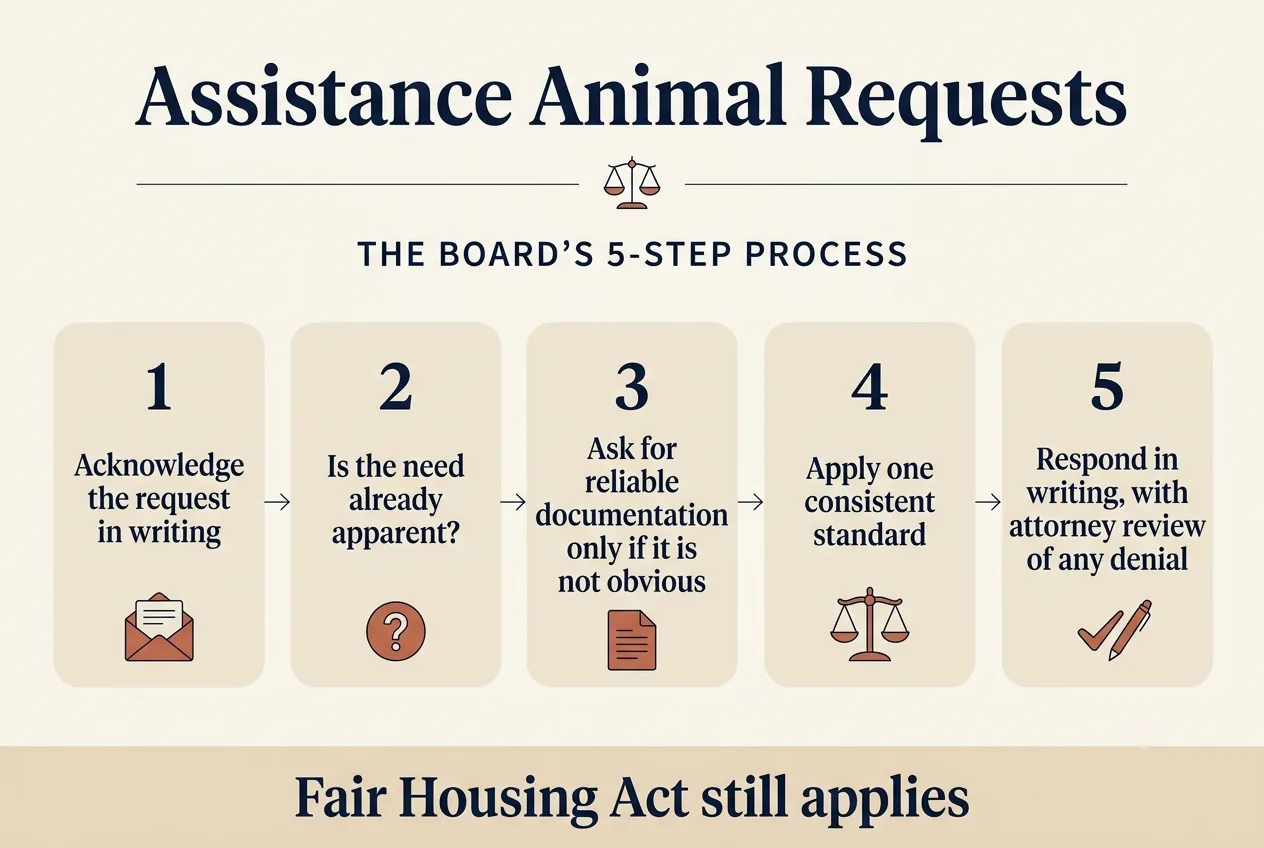
The process itself should run the same basic sequence regardless of which side of the training line a request falls on. First, acknowledge the request in writing. Second, determine whether the disability and disability-related need are already apparent (if so, the board generally can't ask for documentation at all). Third, request reliable documentation only where the need genuinely isn't obvious. Fourth, evaluate what's provided against a consistent internal standard rather than an individual board member's gut reaction. Finally, respond in writing with either an approval, a request for more specific information, or a documented denial. Every step should go through the same person or committee each time. A board that handles similar requests inconsistently from one resident to the next is building its own discrimination claim.
Confirm the current HUD enforcement position and this state's own fair-housing or civil-rights statute, since some states set a stricter standard than federal law → route the specific request to the person or committee responsible for handling accommodation requests, not to the board generally → request documentation only when the disability-related need isn't obvious → document the specific reasoning for every approval and every denial, using the same standard applied to the last request → have counsel review any denial before it goes out in writing.
What the board can ask for
For a request that isn't obviously a trained service animal, the board can generally ask for reliable documentation from a licensed health-care or mental-health professional establishing that the animal is needed because of a disability. A letter is enough. A full medical record is not required. Because a market of instant, pay-and-print online ESA letters has made some documentation unreliable on its face, a board can reasonably question a letter that shows no evidence of an actual provider relationship. That judgment call is the kind of decision worth running past the association's attorney instead of making unilaterally. For an animal that's obviously performing a service-animal role, the law traditionally limits the board to two questions. Is the animal required because of a disability? And what task is it trained to perform?
State rules can be stricter
A few states regulate who can issue an emotional-support-animal letter. California's AB 468, for example, requires a California-licensed clinician, a clinical evaluation, and a relationship of at least 30 days before the letter is issued. Florida's Statute 760.27 lets a housing provider ask for reliable documentation of the disability and the need without setting a fixed relationship length. Check your state's rules before you decide whether a letter is reliable, and have the association's attorney confirm any denial that rests on how a letter was issued.
What the board cannot do
On the other side of the line, a board cannot demand a specific diagnosis or the resident's underlying medical records. It cannot require a specific certification or registration (no government-recognized assistance-animal registry exists, regardless of what a paid registration website implies). It cannot charge a pet deposit or monthly pet fee for an animal approved as a reasonable accommodation. And it cannot apply the community's ordinary breed, weight, or pet-count limits to a verified accommodation animal the same way it would to an ordinary pet. The board also can't retaliate against the resident (through selective rule enforcement, unrelated fines, or anything that looks like it) for having made the request in the first place.
- The original written request and the date it was received.
- Any documentation submitted and the date the board reviewed it, kept as part of the association's broader records retention practice.
- The specific reasoning behind an approval, a request for more information, or a denial.
- Confirmation the same standard was applied as in comparable prior requests.
- Any follow-up communication, including attorney review notes for a denial.
Denial is the highest-risk decision here
Denying an accommodation request is the single highest-risk decision covered in this guide. A defensible denial has to be based on an individualized assessment of this specific animal's conduct, or a specific undue-financial-or-administrative-burden showing. It cannot rest on the animal's breed, size, or a general policy against a certain type of pet. That individualized standard is not unlike the case-by-case review a board should already apply before issuing a fine after notice and hearing. A denial built on a breed generalization instead of this animal's actual behavior is one of the more common ways an association ends up facing a fair-housing complaint. It should never go out the door without the same attorney review the board would want before denying any other federally protected accommodation request.
Frequently asked questions
- Did HUD's 2026 guidance change mean HOAs no longer have to accommodate emotional support animals?
- No. HUD rescinding its ESA guidance changed how HUD itself evaluates complaints, pursuing enforcement only where an animal was individually trained to assist with the person's disability, while no longer expecting housing providers to categorically grant requests for untrained ESAs. The Fair Housing Act itself was not amended, existing case law still stands, and private lawsuits and state or local civil-rights protections remain available, so a board still needs an individualized review process.
- Can the board charge a pet fee for an approved assistance or support animal?
- No. Once an animal is approved as a reasonable accommodation, the board generally cannot charge the pet deposit or monthly pet fee that applies to ordinary pets, and generally cannot apply the community's breed, weight, or pet-count limits to that animal either.
- What can the board ask for if a resident's disability isn't obvious?
- The board can generally request reliable documentation from a licensed health-care or mental-health professional confirming the disability-related need, not the specific diagnosis or full medical records. For an animal that's obviously trained as a service animal, the board is typically limited to asking whether it's required because of a disability and what task it performs.
These answers describe the general research path. The controlling rule for your association comes from your state statute and recorded governing documents — verify the current primary source and its effective date before the board acts.