Start with what the governing documents already say
Before a board decides whether it can touch short-term rentals at all, the more useful first question is what the recorded declaration and CC&Rs already say about leasing. Association rules are private contractual restrictions, not zoning, which means a board's authority to restrict a nightly rental doesn't come from city code. It comes from the governing documents and, layered on top, whatever the state's specific rental-restriction statute allows or forbids the board to add. A declaration that already restricts leasing to a stated minimum term gives the board a straightforward compliance and enforcement question. A declaration that says nothing about rental length puts the board in a very different position. It may need a formal amendment, not just a board resolution, before a short-term-rental restriction is enforceable against existing owners.
States that let a board ban short-term rentals outright
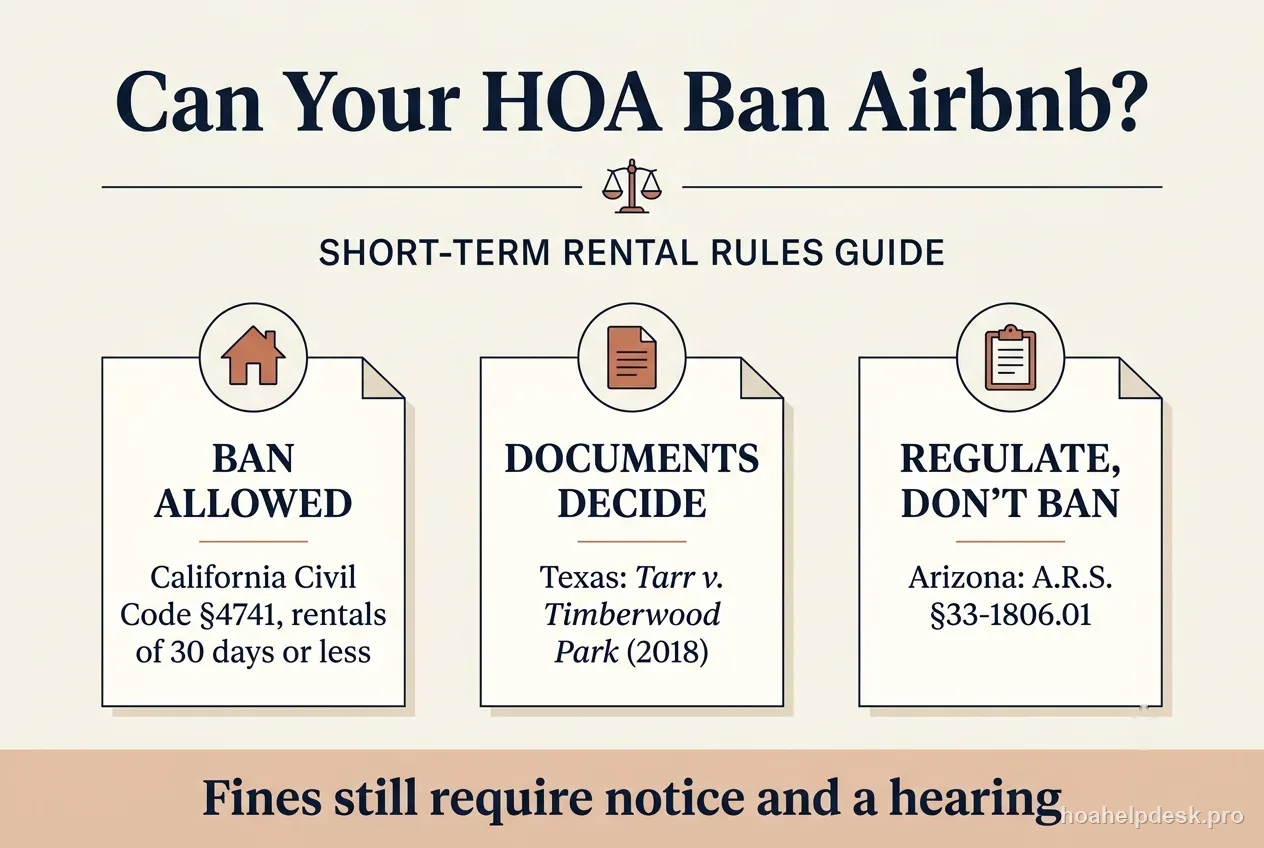
A handful of states let an association adopt a rule banning the shortest rentals outright. California's Civil Code §4741 is the clearest example. An association may adopt and enforce a rule prohibiting rentals of 30 days or less, and may cap the minimum lease term at 30 days. That means the classic Airbnb-style nightly or weekly stay can be restricted. The same statute limits how far a board can go in the other direction (it generally cannot push the minimum lease term above 30 days, cannot reduce the number of rentable homes below 25% of the separate interests in the development, and can require no more than 75% owner-occupancy). Critically, California's rental-restriction rules (Civil Code §§4740–4741) are not fully retroactive. An association generally cannot apply a newly adopted rental restriction to an owner who purchased before the restriction was recorded. That is the detail that trips up boards trying to enforce a brand-new rule against a long-time owner-investor.
States where the recorded documents, not the board, decide
Other states leave the decision to the recorded documents rather than to a board resolution. Texas is the clearest illustration: in Tarr v. Timberwood Park Owners Association (2018), the Texas Supreme Court held that unambiguous covenants limiting a subdivision to single-family "residential purposes" did not, by themselves, prohibit short-term rentals. An association that wants a ban generally needs explicit covenant language or a properly adopted amendment (typically an owner vote at the threshold the declaration sets). A board-only resolution banning Airbnb in Texas is generally not enforceable. Arizona is similar in spirit, though the exact statute depends on entity type: A.R.S. §33-1806.01 governs planned communities and §33-1260.01 governs condominiums. The distinction between a condo association and a planned-community HOA matters here. Both statutes tie rental rights to the recorded declaration and prevent a board from banning rentals the declaration doesn't already restrict. They still let the association require a uniform, capped registration fee and collect basic information about non-owner occupants.
Confirm whether this state's rental-restriction statute permits an outright short-term-rental ban, a registration-only model, or leaves the question entirely to the declaration → pull the current declaration language on leasing and its effective/recording date → if a ban is legally available, confirm whether it can apply to existing owners or only to future purchasers → route any new restriction through the correct adoption mechanism before enforcing it.
What reasonable regulation looks like short of a ban
Even in a state where an outright ban is off the table, "the board can't stop rentals" is usually the wrong conclusion. Most rental-restriction statutes that block a ban still leave room for reasonable regulation. That typically includes a registration requirement with a modest, uniform fee. A minimum-stay or occupancy cap that falls short of a full ban. Parking, trash, noise, and guest-conduct rules that apply regardless of who's occupying the unit. A requirement that the owner or a local contact be reachable during the rental period. And confirmation that the owner carries adequate liability insurance for short-term guest use. None of these substitute for an outright ban. Together, though, they give a board real enforcement tools against the nuisance behavior that usually drives the request for a ban in the first place.
This is not the same thing as a general leasing cap
Don't confuse a short-term-rental restriction with a broader cap on the total percentage of units that may be leased long-term. They're different tools solving different problems, sometimes governed by different statutory sections entirely. A short-term restriction targets rental length. A leasing cap targets the total share of investor-owned, tenant-occupied units regardless of lease length, and can affect the community's eligibility for certain mortgage financing programs. A board considering both should treat them as two separate governance decisions, each requiring its own review of the declaration and the applicable state statute.
Adopting a new restriction without inviting a challenge
A board that wants to add a rental restriction where the declaration is currently silent has to get the adoption method right. This is where boards run into trouble. A simple board-adopted rule can regulate the details (registration, guest conduct, parking). A rule that functions as a leasing restriction typically needs the higher bar of a formal CC&R amendment vote to be enforceable. It restricts an owner's use of their own property instead of just adopting a reasonable operating rule. Confirm which category the proposed restriction falls into (board-adopted rules can't outrank the CC&Rs) before scheduling a vote. Separately, confirm whether the new restriction can bind current owners or only applies going forward.
- The minimum lease term the association will enforce, stated as a specific number of days.
- Whether the restriction applies to all owners or only to those who purchase after the rule's recording date.
- The registration process, information collected, and any capped fee.
- The conduct and use rules that apply to guests, separate from the length-of-stay restriction.
- The enforcement and fine schedule, and who in the community is responsible for reporting suspected violations.
Enforcement still runs through the fine-and-hearing process
Once a rental restriction is validly adopted, enforcing it still runs through the same notice-and-hearing process that applies to any other rule violation. A board can't skip straight to a fine because the violation is a listed nightly rental instead of a fence height or paint color. Document each suspected violation the same way the board would document any other compliance issue. A rental-restriction fine that gets challenged is reviewed on the same procedural record as any other enforcement action.
Before the board sends its first notice
Before a board sends its first notice under a new or existing short-term-rental rule, it's worth confirming two things with an association attorney rather than assuming a statute summary still matches current law. First, has anything changed in the state's rental-restriction statute since it was last checked? Second, does the city or county where the property sits layer its own short-term-rental licensing or zoning rules on top of the HOA's? A property can be fully compliant with the association's rule and still be operating illegally under local law, or vice versa. The board's rule enforcement and the city's licensing enforcement are two separate tracks that don't automatically talk to each other.
Frequently asked questions
- Can an HOA board simply vote to ban Airbnb rentals?
- It depends entirely on the state and what the declaration already says. Some states, like California, let an association adopt a rule banning rentals of 30 days or less. Others, like Texas and Arizona, leave the question to the recorded declaration, a board generally can't ban short-term rentals by resolution alone unless the restriction was already in the declaration or gets added by an owner vote. Confirm the current statute before assuming either outcome applies here.
- Does a new rental restriction apply to owners who already own in the community?
- Not automatically. Several states that do allow a short-term-rental ban, including California, limit how the restriction can apply to owners who purchased before the rule was adopted and recorded. Check the applicable statute's retroactivity language before enforcing a new restriction against an existing owner.
- If the board can't ban short-term rentals outright, can it still regulate them?
- Usually yes. Even where an outright ban isn't legally available, associations can typically still require registration with a capped fee, set parking, noise, trash, and guest-conduct rules, and require proof of adequate insurance: tools that address the nuisance issues driving most rental complaints without needing a full ban.
These answers describe the general research path. The controlling rule for your association comes from your state statute and recorded governing documents — verify the current primary source and its effective date before the board acts.