Restrict, don't prohibit: the starting principle
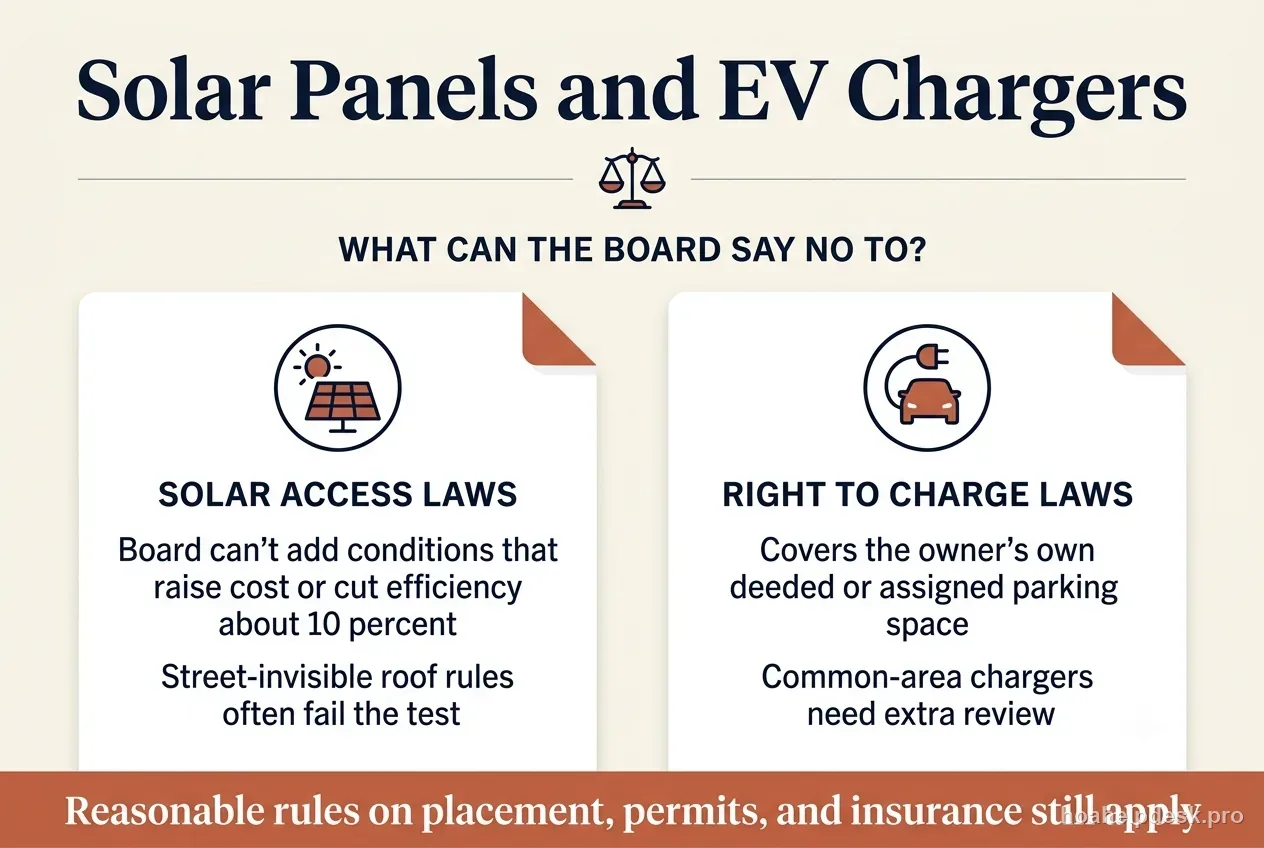
Most architectural-review authority assumes the board can weigh aesthetics, screening, and placement against fairly open discretion to say no. Solar panels and EV chargers break that assumption. A majority of states have adopted some version of a solar-access law. A fast-growing number now have a right-to-charge law for electric-vehicle equipment. Both categories of statute start from the same premise. The board can regulate how the installation looks and where it sits, but it generally cannot use architectural review to prevent the installation altogether. Getting the distinction backwards is the most common way a board ends up on the losing side of a statutory challenge it didn't know existed. That means treating either request as a normal discretionary ARC call.
The test most solar-access statutes use
Solar-access statutes typically don't ask whether the board finds the panels attractive; they ask whether the board's restriction crosses a specific, statute-defined line. The common formulation voids any condition that either increases the installation cost by more than a set amount or reduces the system's expected efficiency by more than roughly 10 percent. That holds even where the board's underlying aesthetic reasoning is genuine. A rule requiring panels to sit only on a roof face invisible from the street tends to fail this test. Street-invisible roof faces frequently don't get the sun exposure the system needs. A rule requiring a specific frame color, or requiring panels to be flush-mounted rather than tilted, can often survive if it doesn't meaningfully touch cost or output.
Right-to-charge laws are newer and spreading fast
Right-to-charge laws are newer and still spreading: as of 2026, roughly 15 states plus Washington, D.C. (including California, Colorado, Florida, Hawaii, Illinois, Maryland, Massachusetts, New Jersey, New York, Oregon, Texas, Utah, Vermont, Virginia, and Washington) have some form of statute preventing an association from prohibiting or unreasonably restricting an owner's EV charger in their own deeded, assigned, or exclusive-use parking space. The specific mechanics differ by state, so a board should confirm the current text instead of assuming a neighboring state's rule applies here. The throughline is consistent, though: reasonable rules on installation method, placement, and safety are still allowed. A flat no is generally not, at least for a space the owner already has exclusive rights to use.
Confirm whether this state has a solar-access statute, a right-to-charge statute, or both, and pull the current definitions section → identify which spaces the statute covers, since coverage of a true common area is not automatic everywhere → compare the association's current ARC guidelines against the statute's cost-and-efficiency (solar) or unreasonable-restriction (EV) test → update the written policy before the next request arrives instead of deciding the test case ad hoc.
What boards can still legitimately require
None of this strips the board of a real review role. Even in a state with a strong solar-access or right-to-charge statute, an association can typically still require several things. One is a permit application through the normal architectural-review process. Others are proof that the installer is a licensed electrician, confirmation the work meets current electrical and fire code, and a certificate of insurance naming appropriate coverage. For equipment that ties into shared wiring or a common-area panel, it can also require an indemnification or maintenance agreement covering that shared infrastructure. The board generally can't add a condition on top of those legitimate requirements if its real effect is to make the installation meaningfully more expensive or less effective than a reasonably placed, code-compliant system would be.
Shared parking and shared wiring complicate the EV question
A single-family home with its own roof and driveway is the easy case. A condominium with shared parking and shared electrical service is not. Before an owner can install a charger, the board often has to sort out whether the parking space is a deeded unit, a limited common element assigned to that owner, or a true common area available to the whole membership. The statute's protection is frequently strongest for the first two categories and weakest for the third. Where the answer is a shared common area, cost-sharing for any electrical panel or infrastructure upgrade becomes a real reserve and capital-planning question, not just an individual owner's install. One early charger request can surface an infrastructure gap the reserve study never anticipated.
California's 2026 insurance change is a preview of how fast this moves
California illustrates how fast this area keeps moving even after a statute is well established. SB 770, effective January 1, 2026, removed the prior requirement that an EV-charger-installing homeowner name the association as an additional insured on their personal liability policy. The owner still has to carry adequate liability coverage and still has to provide the association a certificate of insurance, separate from the association's own master and liability coverage. The change narrows what the association can demand from the owner's policy. It's a useful reminder that even a "settled" right-to-charge or solar-access statute is worth re-checking before the board denies or conditions a request on outdated insurance language.
The cost of getting a denial wrong
A board that denies a solar or EV-charger request in a way that conflicts with the state's statute isn't just risking an unhappy owner. Many solar-access and right-to-charge statutes let the owner sue for an order compelling approval. Some fee-shifting provisions can also make the association pay the owner's attorney's fees if the denial is found unreasonable. That exposure is why a written, statute-checked policy adopted before the first request arrives is worth more than case-by-case discretion. It converts a legal question the board might get wrong under pressure into a documented process staff or a committee can apply consistently.
Adopt the policy before the first request, not after
The lowest-risk approach is a written solar-and-EV policy adopted in advance. It covers the permit process, the specific technical and insurance documentation required, and the placement and screening standards the board will apply. That beats deciding each request individually as it arrives. A pre-adopted, evenly applied policy is easier to defend than an ad hoc denial. It avoids the appearance that one owner's request was treated differently from another's. It also keeps the request moving inside whatever response window already governs the association's ARC process, so a slow board doesn't inadvertently hand the owner a deemed-approved installation by missing its own deadline.
Frequently asked questions
- Can an HOA deny a solar panel request for aesthetic reasons alone?
- Generally not if the restriction meaningfully raises the installation cost or reduces the system's efficiency. Most state solar-access laws void that kind of condition regardless of how legitimate the board's aesthetic concern is. A board can usually still set placement and screening rules that don't cross that cost-or-efficiency line.
- Does every state have a right-to-charge law for EV chargers?
- No. As of 2026 roughly 15 states plus Washington, D.C. have adopted some form of right-to-charge statute. Where no such statute exists, an EV-charger request is typically evaluated under the association's ordinary architectural-review standards and the governing documents rather than a specific state protection.
- Can an HOA require insurance before approving an EV charger installation?
- Generally yes. Most right-to-charge statutes still let the association require adequate liability insurance and a certificate confirming it. What some states have recently narrowed is a requirement that the owner add the association as an additional insured on that policy, so confirm the current statute instead of assuming an older insurance condition still applies.
These answers describe the general research path. The controlling rule for your association comes from your state statute and recorded governing documents — verify the current primary source and its effective date before the board acts.