Absent a statute, the governing documents still control
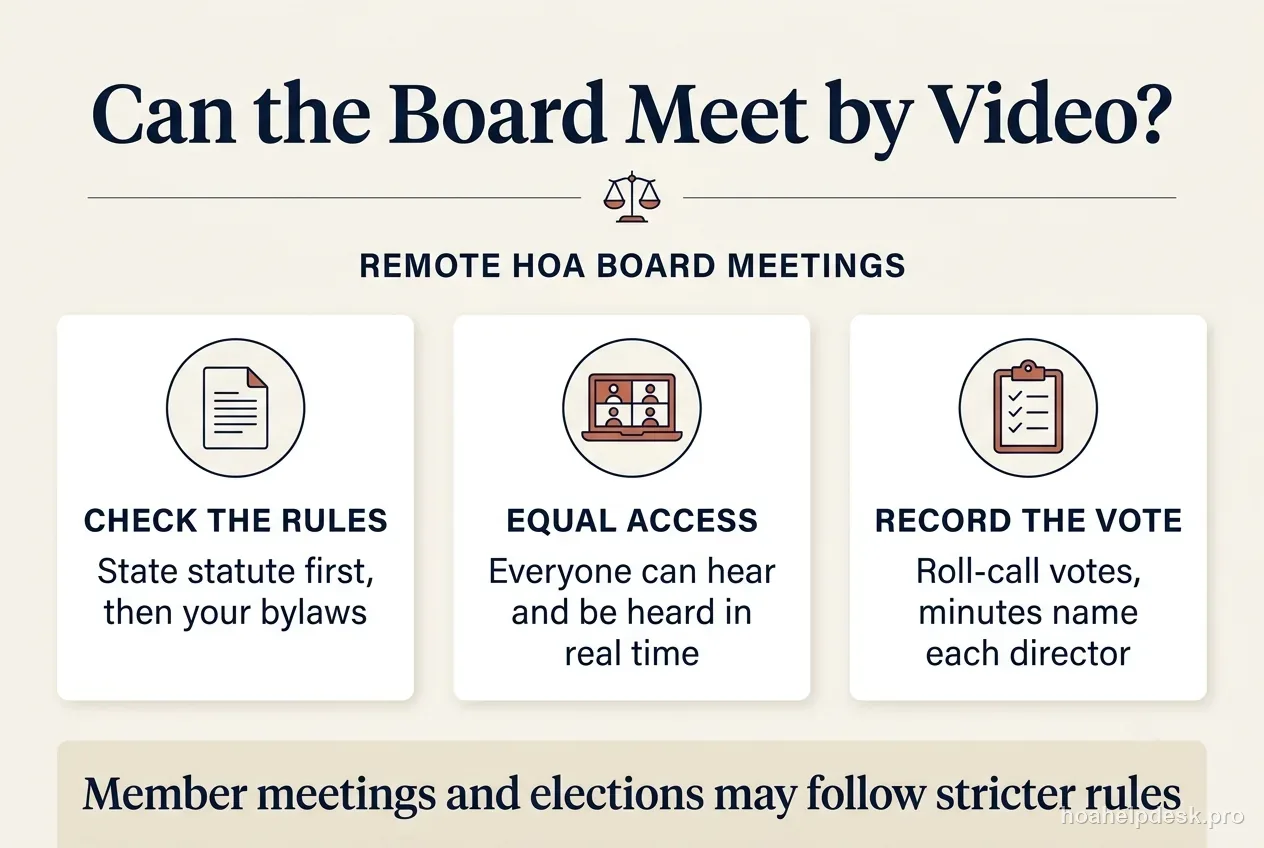
Whether a board can legally hold a meeting entirely by video or phone starts with a question that has nothing to do with technology. Does this state's nonprofit-corporation or common-interest-community statute say anything about it at all? Where the statute is silent, the governing documents are what control, and boards frequently assume a remote meeting is automatically fine because nothing in the bylaws expressly bans it. That's backwards in some jurisdictions, where the safer default reading is that a meeting format needs affirmative authorization, not merely the absence of a prohibition. Before scheduling the next board meeting as video-only, confirm which of those two situations this association is in.
Why this became a live question again in 2026
Remote board meetings stopped being a temporary pandemic accommodation years ago. But the legal footing under them kept shifting well past 2020. Some of the state statutes referenced below were enacted or amended within the last few years. A board that checked "are we allowed to meet by video" once, early on, and never revisited the question may be operating under outdated information. Volunteer boards also face ordinary scheduling pressure. Getting three or five people in the same room every month is harder than getting them on a video call. The practical pressure to keep meeting remotely isn't going away, even as the legal detail keeps evolving underneath it.
States that have specifically codified a right to meet remotely
A growing number of states have moved past that ambiguity and specifically codified a remote-meeting right. California's AB 648 added Civil Code §4926 to the Davis-Stirling Act, effective January 1, 2024. It lets an association hold a meeting entirely by teleconference or video conference, provided the format meets specific statutory conditions. Those include that every director and member has the same ability to participate as they would in person, and that any vote of the directors is taken by roll call. Florida works through its nonprofit-corporation act on two tracks. Florida Statutes §617.0820 lets a board conduct its meetings by any means of communication through which all participating directors can simultaneously hear one another, unless the articles or bylaws provide otherwise. Separately, §617.0721 lets members take part in member meetings by remote communication if the board authorizes it and the corporation can verify who is participating. Florida's condominium and HOA chapters (Chapters 718 and 720) layer their own notice and quorum rules on top, so those need a read as well. Virginia addresses the point in two places. Its Condominium Act, at Virginia Code §55.1-1935, allows meetings of the unit owners' association, the executive board, or a committee to be held entirely or partly by electronic means once the executive board has adopted guidelines ensuring that only authorized people join and that everyone entitled to participate can do so. The Nonstock Corporation Act, at §13.1-844.2, separately covers remote participation by members in meetings of members where the board authorizes it. Washington takes a permission-by-default approach. A 2021 law, SB 5011, amended its condominium act (RCW 64.34.332), its HOA act, and its uniform common interest act (RCW 64.90.445). Meetings of owners may now be held by telephone, video, or other conferencing unless the governing documents restrict it, as long as the notice explains how to participate and every owner can hear or perceive the discussion and comment.
What "equal access" requires in practice
The recurring requirement across these statutes is some version of "equal access". Every participant, whether joining by video, phone, or in person, has to be able to hear and be heard by every other participant in real time. A setup where the board sits in a conference room on video while members call into a listen-only line does not qualify. That requirement is also why several of these statutes specifically require a roll-call vote for anything decided at a remote meeting. A voice vote or show of hands doesn't translate cleanly across a mixed audio-and-video format. A roll-call vote creates an unambiguous record of who voted which way, which matters if a decision later gets challenged.
Confirm whether this state's nonprofit-corporation or common-interest-community statute specifically addresses remote board meetings → if it does, pull the exact equal-access and voting-method requirements rather than assuming a neighboring state's rule applies → if the statute is silent, confirm what the bylaws say about meeting format and whether they need amending before virtual-only becomes the default → separately confirm whether member meetings are governed by the same rule or a stricter one.
Board meetings and member meetings are not the same question
A statute or bylaw provision authorizing remote board meetings doesn't automatically answer the same question for a member meeting. Annual meetings, elections, and other membership votes often carry their own, stricter procedural requirements around notice, secret ballots, and independent inspectors that a routine board meeting doesn't. Boards that have confirmed they can meet virtually for regular business should separately verify how that authority interacts with the annual meeting and election rules already governing member votes. Don't assume the same virtual-meeting authorization automatically extends to a secret-ballot election.
Hybrid meetings solve the fight over "virtual-only"
Separate from what's legally permitted, virtual-only meetings have become a real point of friction in some communities. Resident advocates argue that members without reliable internet, a smartphone, or comfort with video software are effectively excluded, even when the board is following the letter of an equal-access statute. A hybrid format (an in-person room plus a remote option) sidesteps both the legal risk, since it clearly satisfies an equal-access test either way. The practical fairness concern, and it's increasingly the format associations land on even in states where a virtual-only meeting would otherwise be technically defensible.
- Which specific statute or bylaw provision authorizes this meeting format, cited by section.
- How every participant (board and attending members) will be able to hear and be heard in real time.
- Whether a roll-call vote is required, and who's responsible for recording it accurately.
- A fallback plan if the connection drops mid-meeting or mid-vote.
- Whether member meetings follow the same authorization or a separate rule.
Recording the minutes and the vote correctly
The meeting-minutes standard doesn't relax for a remote meeting. If anything, a board should document more, given how much easier it is for a remote format to create ambiguity about who was present and how each person voted. Where a roll-call vote is required, the minutes should reflect the individual vote of each participating director by name. The board should also have a pre-agreed answer for what happens if a director's connection drops during a vote: table the item, proceed without that director if quorum still holds, or pause and reconvene. Otherwise it ends up improvising in the moment a connection fails.
Does the video recording itself become an association record?
If the board records the video or audio of a remote meeting (even informally, just to help whoever takes minutes get the details right), that recording can itself become an association record. It can raise the same kind of retention and owner-access questions as the written minutes, depending on the state and the association's own policy. Decide in advance whether meetings will be recorded, how long any recording is kept, and whether it's treated as the official record or just a drafting aid. That avoids a harder conversation later about whether a specific recording should have been produced in response to an owner's records request.
Frequently asked questions
- Can an HOA board legally hold a meeting entirely over video call?
- In a growing number of states, yes, provided the meeting meets specific statutory conditions such as equal access for all participants and a roll-call vote. Where the state statute is silent, the answer depends on what the governing documents say about meeting format, so confirm both before treating video-only as the default.
- What does 'equal access' mean for a virtual HOA board meeting?
- It generally means every participant (whether joining by video, phone, or in person) must be able to hear and be heard by everyone else in real time. A format where the board is on video while members call into a listen-only line typically does not satisfy an equal-access requirement.
- Does the rule for board meetings also cover annual meetings and elections?
- Not automatically. Member meetings, especially elections, often carry separate and stricter statutory requirements around notice, secret ballots, and independent inspectors. Confirm whether the same remote-meeting authorization extends to member meetings or whether a different rule applies.
These answers describe the general research path. The controlling rule for your association comes from your state statute and recorded governing documents — verify the current primary source and its effective date before the board acts.