Two different documents, two different purposes
Two different charges show up on almost every HOA closing statement, and sellers, agents, and even some boards routinely conflate them. The resale certificate (sometimes called a resale package or disclosure package) is a substantive report on the association's financial and legal status and the seller's specific account standing. The transfer fee is a separate administrative charge for the cost of updating the association's ownership records once the sale closes. A board or management company can charge for one, the other, or both depending on state law and the association's fee schedule. But treating them as the same line item is the kind of mix-up that generates a seller or agent complaint at the closing table.
Who's responsible for getting it right
In a professionally managed association, the management contract usually assigns responsibility for producing the resale certificate to the management company, often as a separate line-item fee the company keeps rather than passes through to the association. Confirm this in the current management contract instead of assuming. In a self-managed association, that responsibility usually falls to the treasurer or secretary. That means the statutory deadline and content checklist below apply directly to a volunteer board member instead of a firm with a standing process for it. It is a much easier deadline to miss without a written procedure the board follows every time a request comes in.
What goes in the package
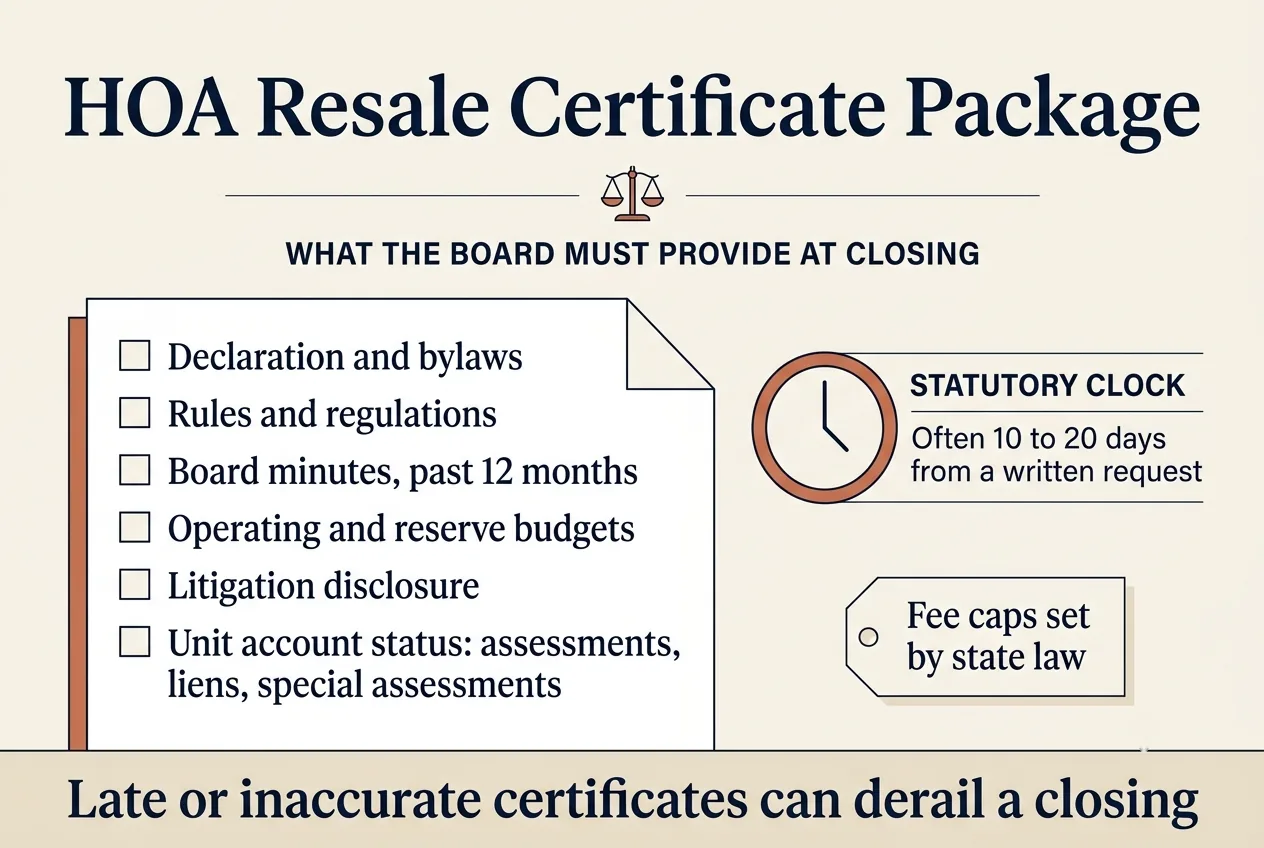
A complete resale certificate package typically includes the current declaration (CC&Rs) and bylaws, the current rules and regulations, board meeting minutes from roughly the past 12 months, the current operating and reserve budgets, and a statement disclosing any pending or threatened litigation involving the association. It also includes the piece sellers care about most directly: a certificate confirming the specific unit's account status. That covers assessments current or delinquent, any recorded lien, and whether a special assessment has been approved but not yet billed. Leaving out the litigation disclosure or an already-approved special assessment is one of the more common ways a resale certificate later becomes the basis for a buyer's claim against the association.
The deadline is a real statutory clock, not a courtesy
The turnaround deadline is a real statutory clock in most states, not an informal courtesy the board or its management company can stretch when things get busy. California's Davis-Stirling Act generally requires resale documents to go out within 10 days of a written request. Virginia Code §55.1-1992 sets a 14-day delivery deadline for condominiums. Maryland gives the association 20 days after a written request and payment of the fee. Washington and the District of Columbia, for condominiums, each run on roughly a 10-day clock. Missing the deadline isn't just a customer-service problem. In several states it exposes the association to a statutory penalty or shifts cost or liability onto the association in a way a routine paperwork delay elsewhere in the office wouldn't.
Confirm the current statutory deadline, required contents, and fee cap for this state → confirm whether the association or the management company is the party obligated to produce the certificate under the management contract → verify the account-status figures against the current ledger before certifying them, not the balance from the last time the file was updated → confirm the delivery method and date are documented, since that date starts other statutory clocks.
Fee caps and who pays
Where a fee cap applies, it typically runs somewhere between $100 and $400 for the resale certificate itself. A separate, usually smaller transfer fee in the roughly $50-to-$300 range is charged once the sale closes. Both figures are set or capped by statute in many states, so a board can't simply set whatever price recovers the management company's convenience-fee markup. Because it's fundamentally the seller's disclosure obligation, the seller, or their agent ordering on their behalf, is usually the one who requests and initially pays for the certificate. The purchase contract or local custom can shift responsibility to the buyer. A management company will often charge extra for a rushed turnaround inside the statutory window.
The buyer's rescission window ties directly to delivery
The delivery date on a resale certificate does more than start the association's compliance clock. In several states it also starts the buyer's own right to walk away. California is a clear example: under Civil Code §4530, a buyer generally has three calendar days to cancel after personal delivery of the resale documents, or five days after delivery by mail. A board or management company that delivers a late, incomplete, or materially inaccurate certificate isn't just risking a compliance complaint. It can hand a buyer grounds to unwind a transaction that was otherwise on track to close, days before the scheduled closing date.
- More than a few weeks have passed since the account-status figures were pulled.
- A special assessment or a significant budget change was approved after the certificate was issued.
- New litigation was filed or threatened against the association after issuance.
- The unit's payment status changed after the certificate was generated.
- The certificate was prepared by a prior management company during a transition.
Why getting this wrong is now a resale-value problem
A resale certificate has quietly become something buyers' lenders scrutinize almost the way they now scrutinize a reserve study. A certificate showing chronic delinquency problems, an unexplained special assessment, or undisclosed litigation can slow down or derail financing well beyond the specific unit being sold. It signals something about the association's overall financial health. A board that treats the resale certificate as routine paperwork handled entirely by the management company, without ever checking that its own financial disclosures and litigation record are accurate and current, can find out about a documentation gap only when a sale stalls. That is when an agent starts asking pointed questions.
Building a written checklist beats reconstructing the process each time
The associations that handle resale requests smoothly are the ones with a written internal checklist: current forms, the actual statutory deadline calendared from the date of request. A named person responsible for pulling current financials rather than reusing last quarter's numbers, instead of reconstructing the process from memory every time a request lands. That checklist is a small amount of upfront work. It pays for itself the first time a closing is scheduled on a tight timeline and the certificate has to go out correctly within days.
Frequently asked questions
- Is the HOA resale certificate the same thing as the transfer fee?
- No. The resale certificate is a substantive report on the association's financial and legal status and the seller's account standing. The transfer fee is a separate administrative charge for updating ownership records after closing. An association can charge for one, both, or neither depending on state law.
- How long does an HOA have to produce a resale certificate after it's requested?
- It varies by state, commonly somewhere between 10 and 20 days from a written request, sometimes contingent on payment of the fee. Examples include roughly 10 days in California and Washington, 14 days in Virginia, and 20 days in Maryland. Confirm the current statute rather than assuming one state's deadline applies elsewhere.
- Who is usually responsible for paying the resale certificate fee?
- The seller typically orders and initially pays for the resale certificate since providing it is generally the seller's disclosure obligation, though the purchase contract or local custom can shift responsibility to the buyer. This is separate from the transfer fee, which is also negotiable between the parties unless state law assigns it.
These answers describe the general research path. The controlling rule for your association comes from your state statute and recorded governing documents — verify the current primary source and its effective date before the board acts.