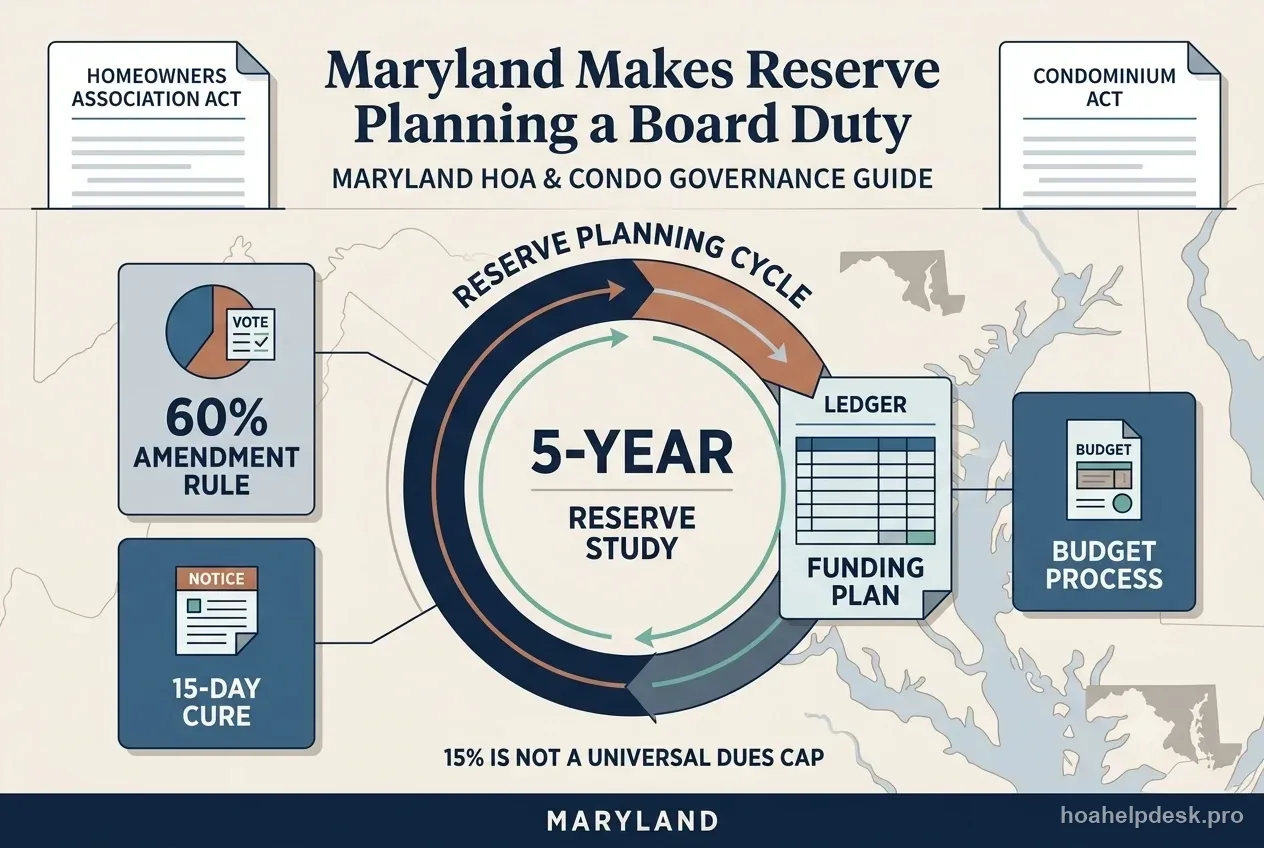
Maryland has separate HOA and condominium statutes and unusually strong reserve requirements. Covered communities generally need reserve studies updated at least every five years and funding plans tied to the study. HOA budgets are proposed at least 30 days before adoption, meetings are broadly open, and enforcement fines require statutory notice and hearing procedure. The 15% budget trigger is not a universal dues cap.
Which statute governs your association
Maryland uses separate statutes for HOAs and condominiums. Mandatory homeowners associations are governed by the Maryland Homeowners Association Act in Real Property Title 11B. Condominiums use the Maryland Condominium Act in Real Property Title 11. Cooperative housing has yet another statutory framework. Boards should identify the legal form before using a meeting, reserve, records, or insurance rule because many section numbers have parallel but not identical counterparts.
Title 11B expressly defines a homeowners association and states that the title may be cited as the Maryland Homeowners Association Act. Condominiums should not be treated as Title 11B associations merely because owners pay common charges. The declaration and bylaws continue to control project-specific procedure where the statute permits variation, but mandatory statutory protections override contrary language. If the declaration, CC&Rs, or bylaws impose a stricter procedural requirement than the statute, the board should follow the governing documents unless the statutory provision is mandatory and does not permit variation. Confirm the current statute text and any recent amendment before relying on this summary.
Reserve study and reserve funding
Maryland is one of the states where boards must treat reserve planning as a statutory compliance item. Residential condominiums subject to §11-109.4 must complete reserve studies and updated reserve studies on the statutory timetable, with an update at least every five years after the applicable initial study. HOAs responsible under the declaration for maintaining common areas have a parallel reserve-study framework under §11B-112.3.
The law goes beyond merely commissioning a study. HOA budgets generally must fund the amount recommended in the most recent reserve study, and the governing body must develop a funding plan. The statute allows a two-thirds governing-body vote to document financial hardship and deviate temporarily within limits, while still protecting critical health, safety, structural, and essential-system priorities. Boards should track the current study, annual progress, deposits to the reserve account, and any hardship vote in the minutes.
Insurance and fidelity bond
Maryland condominiums must maintain property and comprehensive general liability insurance to the extent reasonably available, subject to the distinctions in §11-114 for attached, multifamily, and certain detached-unit projects. Separate fidelity-insurance provisions require coverage against loss from fraud, dishonesty, or criminal acts by people who control or disburse association funds, with a narrow exemption for very small associations that meet the statutory test.
Maryland HOAs have a parallel fidelity-insurance statute. The small-association exemption applies only when the association has four or fewer lot owners and three months’ worth of gross annual HOA fees is less than $2,500. Boards should verify the required amount under the current section, confirm that the managing agent and other fund handlers are covered, and treat D&O insurance as separate from fidelity protection.
Sources: [6]
Open meetings, notice, and agenda
Maryland HOA meetings, including board and committee meetings, are generally open to association members or their agents. Owners must receive reasonable notice of regularly scheduled open meetings, and the board must provide a designated owner-comment period subject to reasonable rules. Closed sessions are limited to listed purposes such as personnel, privacy, legal advice, litigation, negotiations, criminal investigations, protected legal requirements, and individual assessment accounts.
Condominiums have a similar but separate open-meeting framework in Title 11. A regular or special council-of-unit-owners meeting generally requires not less than 10 and not more than 90 days’ notice. Boards should cite the statute that applies to the association’s legal form and document the statutory basis for any closed session. Remote meetings are permitted under separate electronic-meeting provisions when the required access and notice information are provided.
Quorum and voting thresholds
Maryland does not reduce every governance vote to a simple majority. For HOAs, §11B-116 provides a statutory route to amend governing documents by owners in good standing holding at least 60% of the votes, or a lower percentage if the governing document itself requires less, subject to statutory exclusions. That is an amendment threshold, not a general meeting quorum.
Condominium voting and amendment thresholds are governed separately in Title 11 and the declaration. Maryland also has procedures allowing an additional meeting after a failed quorum for certain HOA business, but those procedures do not lower a percentage that the law or governing documents specifically require for an amendment or other protected action. Boards should calculate quorum and approval as two separate numbers and preserve the vote tally.
Records access and retention
HOA books and records are generally open for examination or copying by a lot owner, mortgagee, or authorized representative during normal business hours after reasonable notice. If an owner requests delivery of recent financial statements or governing-body minutes in writing, the association generally has 21 days for records prepared within the prior three years and 45 days for older responsive materials, subject to the statute’s scope and exclusions.
The HOA statute permits withholding specified categories such as personnel, medical, personal financial, current negotiations, legal advice, and closed-meeting minutes. Condominiums have a parallel records section in §11-116. Because Maryland sets concrete response periods for certain delivered records, the manager should date-stamp requests, identify which statute applies, and track the response deadline rather than treating records requests as an informal courtesy.
Sources: [5]
Budget and assessment disclosure
An HOA responsible for common-area maintenance must send or otherwise make available the annual proposed budget at least 30 days before adoption. The budget must separately address income, administration, maintenance, utilities, general expenses, reserves, and capital expenses. It must be adopted at an open meeting, and the adopted budget must be submitted to owners not more than 30 days after the adoption meeting.
Maryland also ties the annual budget directly to reserve funding. The board must review the current reserve study and funding plan and budget for the required reserve contribution unless a valid statutory hardship process is used. An expenditure that would increase assessments for the current fiscal year by more than 15% of the previously adopted budgeted amount generally requires a budget amendment at a special meeting with at least 10 days’ notice, subject to the health-and-safety exception.
Sources: [3]
Limits on assessment and fee increases
Maryland does not impose a simple annual-dues percentage cap comparable to California’s 20% rule. Instead, Title 11B contains procedural controls and expressly allows an HOA governing body to increase assessments when necessary to cover the reserve-funding amount required by the reserve statute, notwithstanding a governing-document assessment cap. Boards should not misstate the 15% budget-amendment trigger as a universal “dues cap.”
The 15% figure in §11B-112.2 concerns an expenditure that would cause assessments for the current fiscal year to rise above the previously adopted budgeted amount; it triggers a special-meeting budget-amendment process unless a statutory safety exception applies. Condo assessments follow Title 11. A board explanation should separate the source of assessment authority, reserve-funding duty, and meeting procedure rather than describing all three as one cap.
Fines and enforcement due process
Maryland gives HOA owners concrete procedural protection before a board may impose a fine, suspend voting, or infringe another association right for a rule violation. Under §11B-111.10, a continuing violation begins with a written cease-and-desist demand and at least 15 days to abate before further sanction. The later notice must provide the opportunity for a hearing under the statutory process.
A Maryland board should treat due process as part of the enforcement file, not as an optional courtesy. Keep the demand, proof of delivery, hearing request or waiver, board deliberation, decision, and the governing authority for the sanction. Condominium enforcement follows its own Title 11 provisions. Before placing any charge in a lien account, confirm that Maryland lien law and the governing documents authorize that category of debt rather than assuming every fine is collectible as an assessment.
Sources: [1]
Sources
- Maryland Code, Real Property Article — official 2026 statute PDF (Titles 11 and 11B)Official 2026 Real Property Article containing the Condominium Act and Homeowners Association Act; use the cited section numbers within the article.
- Md. Code, Real Property §11B-111 — open HOA meetingsOfficial open-meeting and closed-session provisions for HOAs.
- Md. Code, Real Property §§11B-112.2 and 11B-112.3 — HOA budget, reserve study and fundingOfficial HOA budget and reserve-funding rule; §11B-112.3 sets reserve-study details.
- Maryland Condominium Act, Md. Code, Real Property Title 11, including §11-109.4Official condominium reserve-study and funding-plan statute.
- Md. Code, Real Property §11B-112 — HOA records access and delivery deadlinesOfficial HOA records rule; condominium records are in §11-116.
- Md. Code, Real Property §11B-111.6 — HOA fidelity insuranceOfficial HOA fidelity-insurance rule; condominium counterpart is §11-114.1.
Compare nearby state rules
Check one decision against the statute
For a single board decision — a fine, a special assessment, a records request, an election, a CC&R amendment — the State Decision Lookup resolves the verified statutory rule for Maryland and a growing set of other states, and the Board Decision Router lays out the research sequence. Both fail closed when the primary law is unclear rather than guessing.