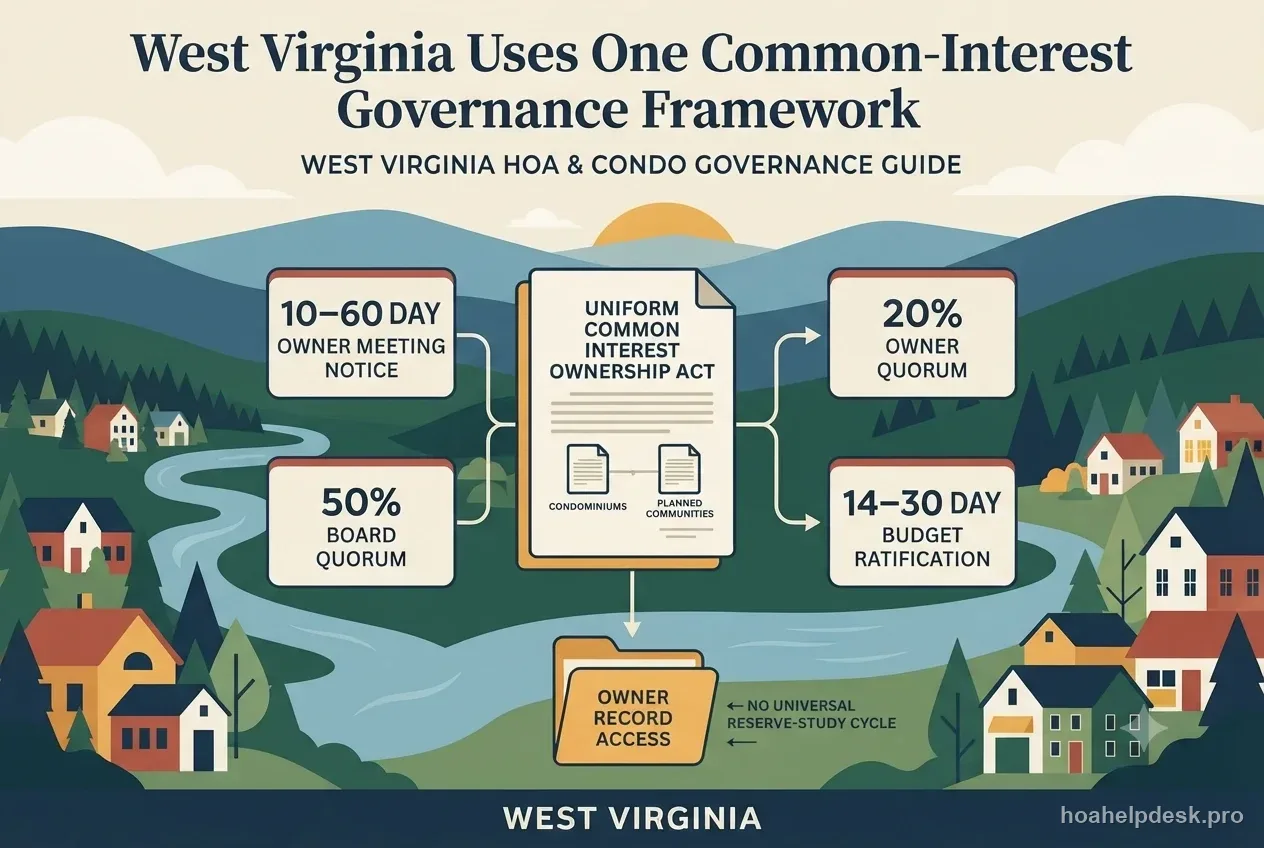
West Virginia uses a Uniform Common Interest Ownership Act framework for many condominiums and planned communities. The statute provides 10–60 days’ notice for owner meetings, a default 20% owner quorum and 50% board quorum, budget ratification after owner notice, and broad owner access to association records. Reserve-study mandates are not a headline statewide feature, so reserve planning often turns on the declaration, budget duties, and board judgment.
Which statute governs your association
West Virginia adopted the Uniform Common Interest Ownership Act in Chapter 36B, creating a common framework for condominiums, planned communities, and other covered common-interest communities. That is different from states that maintain entirely separate modern HOA and condominium acts. Even so, applicability and creation-date provisions matter, particularly for older communities, so a board should not assume that every Chapter 36B rule overrides every recorded provision in a preexisting declaration.
The declaration and bylaws remain central to governance, especially where Chapter 36B supplies a default that the documents may lawfully modify. Corporate law may also apply to the association entity. A board should identify which provisions are mandatory and which are default rules before voting. If the governing documents impose a stricter lawful procedure, follow that stricter rule. Confirm the current statute text and any recent amendment before relying on this guide.
Sources: [1]
Reserve study and reserve funding
West Virginia Chapter 36B does not present the same express recurring reserve-study cycle found in states such as Washington, Virginia, or Maryland. Boards therefore should not tell owners that state law requires a five-year or three-year study unless a separate applicable provision or the community documents actually say so. Reserve planning instead flows from the board’s budgeting authority, maintenance obligations, prudence, and the declaration.
A responsible board should still maintain a component inventory, expected useful lives, replacement costs, current reserve balance, and a contribution plan. If the declaration or bylaws require a reserve study or a minimum contribution, that document requirement controls. Boards should distinguish a recommended reserve practice from a statutory mandate and disclose material deferred maintenance when preparing the annual budget or considering a special assessment.
Sources: [1]
Insurance and fidelity bond
Chapter 36B contains a dedicated insurance section at §36B-3-113. Boards should review that provision together with the declaration to determine required property and liability coverage and how insurance responsibility is allocated between the association and unit owners. Physical configuration matters, especially when units share structures or common systems. Policy limits and deductibles should be aligned with the association’s maintenance and repair responsibilities.
The statute should also be checked for current fidelity or crime-coverage requirements before a treasurer states a numerical formula. Even when no statutory formula applies, associations that hold significant operating and reserve funds should evaluate employee dishonesty, manager theft, social-engineering fraud, and transfer controls. The board’s minutes should document why coverage was selected and how the association protects funds that may substantially exceed one year of operating expenses.
Sources: [1]
Open meetings, notice, and agenda
West Virginia requires an association meeting at least once each year. Special meetings may be called by the president, a majority of the executive board, or owners holding 20% of the votes unless the bylaws specify a lower percentage. Notice must generally be delivered not less than 10 nor more than 60 days before an owner meeting and must state the time, place, and agenda items specified by statute.
The Chapter 36B meeting section is focused heavily on owner meetings, so boards should also read the bylaws and corporate-law rules for executive-board notice and procedure. Do not assume a board can conduct material association business informally merely because the owner-meeting section is more explicit. Minutes should record decisions, recusals, budget action, and any use of a closed discussion authorized by law or the governing documents.
Quorum and voting thresholds
Unless the bylaws provide otherwise, West Virginia’s default owner-meeting quorum is 20% of the votes that may be cast for election of the executive board, present in person or by proxy at the beginning of the meeting. Unless the bylaws specify a larger percentage, a board quorum exists when persons entitled to cast 50% of board votes are present at the beginning of the meeting.
These are quorum rules, not universal approval thresholds. Chapter 36B establishes separate voting percentages for amendments, conveyances, termination, and other protected actions. A board should identify whether a percentage is calculated from all association votes, nondeclarant votes, or those participating. Proxies are recognized, but the board should check the statute and bylaws for form, duration, revocation, and any election-specific limitations before counting them.
Records access and retention
West Virginia requires the association to keep financial records sufficiently detailed to support statutory disclosure obligations, and all financial and other records must be made reasonably available for examination by unit owners and their authorized agents. The statute is broad but does not provide the same detailed category-by-category retention schedule found in Washington. The association therefore needs a written retention policy that preserves the records necessary to prove its decisions and finances.
At a minimum, boards should retain governing documents, amendments, minutes, owner and voting records, budgets, bank statements, invoices, contracts, insurance policies, reserve materials, tax filings, collection ledgers, and enforcement records for an appropriate period. Privileged legal material and sensitive personal information should be screened before production. A management company should be contractually required to return all association records at termination.
Budget and assessment disclosure
Within 30 days after adopting a proposed budget, the West Virginia executive board must provide owners a budget summary and set a ratification meeting not less than 14 nor more than 30 days after mailing the summary. Unless a majority of all unit owners, or a larger percentage required by the declaration, reject the budget at that meeting, it is ratified whether or not a quorum is present.
That procedure means the board should not describe the budget as finally settled before the statutory owner-ratification process runs. The association should keep proof of mailing, the budget summary, meeting notice, minutes, and the vote or absence of rejection. If a special assessment is contemplated, the board should separately review the declaration and Chapter 36B assessment provisions instead of assuming the ordinary budget process automatically authorizes every capital charge.
Limits on assessment and fee increases
West Virginia does not impose one simple statewide annual percentage cap on common assessments for every covered community. Assessment authority comes from Chapter 36B and the declaration, while the budget-ratification framework gives owners a statutory role in the proposed budget. A board should therefore avoid saying dues can increase by a particular percentage merely because another state or neighboring association uses that limit.
For a large increase, document the common expense, the maintenance or reserve reason, the declaration authority, the allocation method, and the owner-notice process. Special assessments may have document-specific requirements beyond ordinary annual assessments. If governing documents are more restrictive than the statutory default, follow the stricter lawful rule. Fines, interest, collection costs, and assessment increases should be tracked as separate legal categories.
Sources: [1]
Fines and enforcement due process
Chapter 36B authorizes associations to exercise powers granted by the Act and governing documents, but enforcement should still be tied to a valid rule and fair procedure. Before imposing a fine or other sanction, the board should identify the exact covenant or rule, document the evidence, provide the notice and hearing process required by the declaration and bylaws, and record the final decision in the minutes.
West Virginia boards should not invent a statewide fine cap where the statute is silent or the documents control. They should also distinguish a fine from an assessment lien and collection charge. Consistent enforcement, written findings, and an opportunity for the owner to respond reduce both governance risk and owner confusion. Confirm any monetary limit or lien consequence in current Chapter 36B before publishing or collecting the charge.
Sources: [1]
Sources
- West Virginia Code Chapter 36B — Uniform Common Interest Ownership ActPrimary official statute portal.
- W. Va. Code § 36B-3-108 — meetingsOfficial owner-meeting notice and special-meeting threshold.
- W. Va. Code § 36B-3-109 — quorumsOfficial default 20% owner and 50% board quorum.
- W. Va. Code § 36B-3-118 — association recordsOfficial owner-access provision.
- W. Va. Code § 36B-3-103 — executive board and budget ratificationOfficial 30-day budget summary and 14–30 day ratification window.
- W. Va. Code § 36B-3-113 — insuranceOfficial association insurance section; verify current subsections before quoting numeric coverage.
Compare nearby state rules
Check one decision against the statute
For a single board decision — a fine, a special assessment, a records request, an election, a CC&R amendment — the State Decision Lookup resolves the verified statutory rule for West Virginia and a growing set of other states, and the Board Decision Router lays out the research sequence. Both fail closed when the primary law is unclear rather than guessing.