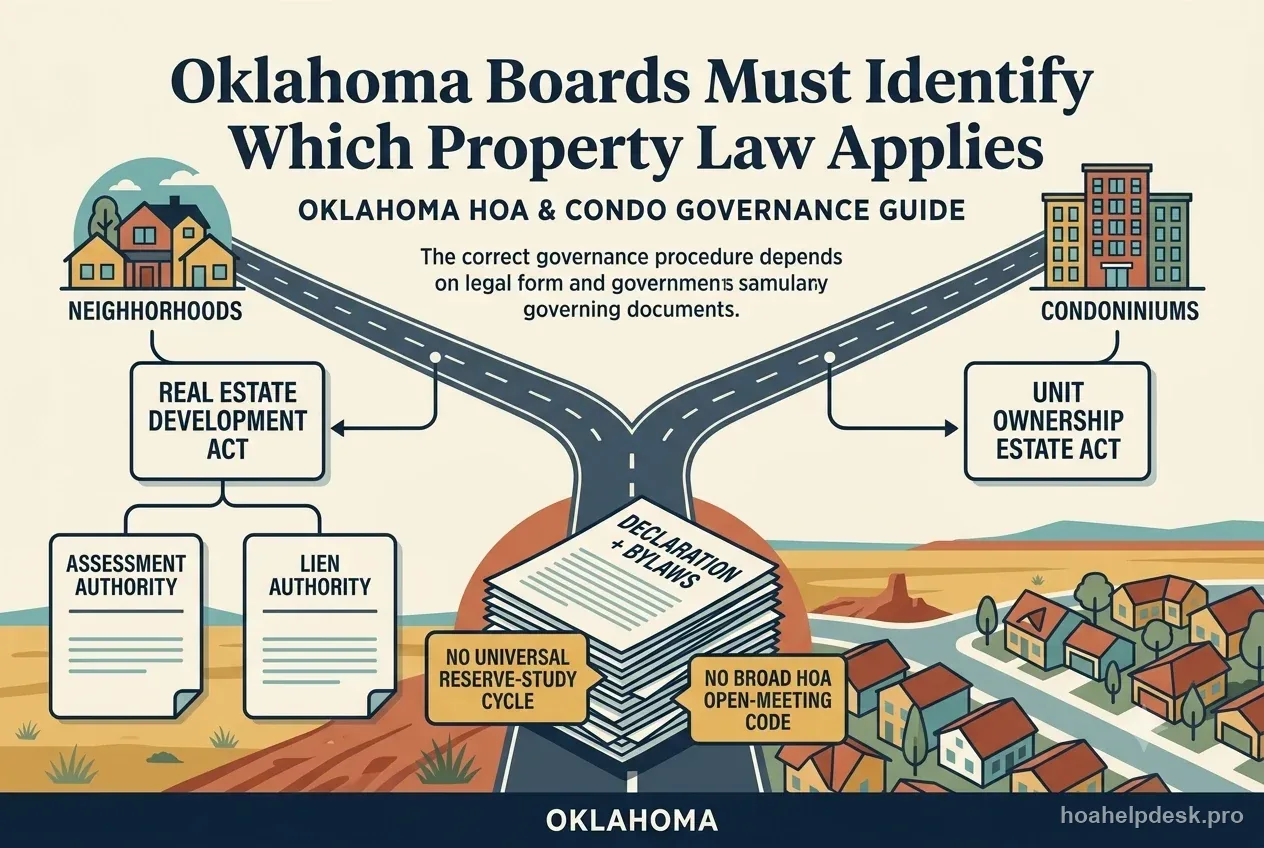
Oklahoma separates lot-based owners associations from condominiums. The Real Estate Development Act gives an owners association assessment and lien authority when properly created, while the Unit Ownership Estate Act supplies a distinct condo framework. Neither act creates a modern statewide reserve-study cycle or broad HOA open-meeting code. Boards therefore need to read the recorded declaration and bylaws alongside the statutes.
Which statute governs your association
Oklahoma does not use one comprehensive common-interest-community statute. A lot-based owners association may fall under the Real Estate Development Act in Title 60, which defines qualifying real estate developments, permits an owners association, and ties membership and enforcement authority to recorded instruments. Condominiums instead use the Unit Ownership Estate Act. A board should first identify the legal form of the community before borrowing a rule from another association type.
The Real Estate Development Act applies its association powers to owners associations created after the act took effect, while the condominium statute dates to 1963 and requires the condominium declaration to be recorded. Corporate law may supplement either structure when the association is incorporated. If the declaration, CC&Rs, or bylaws impose a stricter procedure than the statutory floor, the governing documents control unless they conflict with mandatory law. Confirm the current statute text and any recent amendment before relying on this.
Sources: [1]
Reserve study and reserve funding
Oklahoma statutes reviewed for this guide do not impose a recurring statewide reserve study cycle on ordinary owners associations. The Real Estate Development Act focuses on creation, membership, covenants, assessments, and enforcement rather than prescribing a reserve-analysis schedule. That makes the annual budget, declaration, and board-adopted financial policies especially important for deciding how roofs, streets, drainage, gates, or other long-lived common assets will be funded.
The Unit Ownership Estate Act likewise does not provide a modern statutory reserve-study timetable comparable to Oregon or Florida. Condo boards should still distinguish routine operating expenses from predictable capital replacements and should check the declaration for any reserve requirement. A reserve study can be a prudent governance tool even where the statute does not mandate one, but the board should not describe a voluntary study as an Oklahoma statutory requirement.
Sources: [1]
Insurance and fidelity bond
For condominiums, Title 60 expressly allows the unit owners, by majority resolution, to insure the property against risks, with premiums treated as common expenses. The provision does not create the detailed replacement-cost and fidelity-bond formulas found in some newer common-interest statutes. The declaration and bylaws therefore remain critical when deciding what master insurance policy the association must carry and whether additional crime or fidelity coverage is required.
For a lot-based owners association, the Real Estate Development Act does not supply a statewide fidelity bond formula. Boards handling substantial operating cash or reserves should check the governing documents, lender requirements, management contracts, and insurer underwriting standards. If the documents require a fidelity bond or directors and officers coverage, the board should follow that stronger contractual rule rather than assuming silence in Title 60 means the coverage is unnecessary.
Sources: [1]
Open meetings, notice, and agenda
Oklahoma’s Real Estate Development Act does not establish a general open meeting statute for private HOA boards. It leaves much of the internal meeting machinery to the recorded association documents and, when applicable, the entity’s corporate law. For that reason, a board should not import public-body Open Meeting Act rules into a private association unless another law or the governing documents make them applicable. Notice periods and owner attendance rights should be traced to the bylaws first.
The condominium statute requires the bylaws to state the method for calling or summoning unit owners to assemble, identify who presides, and require a minute book for resolutions. That is governance structure, but it is not the same thing as a universal statutory board-meeting notice period. A sound board calendar should therefore list each bylaw notice deadline, distinguish member meetings from board meetings, and preserve meeting minutes in the form the documents require.
Sources: [1]
Quorum and voting thresholds
Under the Unit Ownership Estate Act, the bylaws must provide that a majority of unit owners, calculated under the act’s voting allocation, is required to adopt decisions at an owners meeting. The same section states that seventy-five percent of the unit owners may modify or amend the bylaws, with the required particulars preserved and the amendment reflected in an amended declaration that is recorded. These are condo-specific thresholds, not automatic rules for every Oklahoma HOA.
Lot-based associations should read the declaration and bylaws for member quorum, board quorum, proxy rules, and amendment thresholds because the Real Estate Development Act does not replace those provisions with a comprehensive statewide voting code. When the documents use percentages, verify whether the denominator is all lots, votes present, or votes cast. That distinction can determine whether an amendment or special assessment actually passed.
Sources: [1]
Records access and retention
The condominium statute requires the administrator or board to keep a detailed chronological book of receipts and expenditures affecting the common elements, with supporting vouchers, and makes both available to unit owners for examination at convenient hours on working days. The section is useful for financial transparency, but it does not create a complete modern retention schedule for every category of association record.
For owners associations under the Real Estate Development Act, the statute reviewed here does not impose a broad, itemized records-access timetable comparable to states with detailed common-interest statutes. Boards should therefore follow the bylaws, nonprofit records rules if applicable, and a written records retention policy. Keep minutes, budgets, bank statements, contracts, insurance policies, tax filings, reserve materials, owner ledgers, and enforcement records long enough to support governance and litigation needs.
Sources: [1]
Budget and assessment disclosure
Title 60 gives a properly created owners association power to enforce membership obligations through a levy or assessment that can become a lien, subject to the statutory conditions. The creating instrument must set out the nature of members’ obligations and be recorded. That means assessment authority should be traced back to the declaration and association instrument before the board assumes it can add a new charge simply because a budget needs more revenue.
The statutes reviewed do not impose a uniform Oklahoma annual budget-disclosure calendar for every HOA and condo. The board should use the governing documents to identify when a proposed budget must be adopted or delivered, whether owners have a ratification or veto right, and what notice is required for a special assessment. If the documents are more protective than the statute, follow the documents.
Sources: [1]
Limits on assessment and fee increases
Oklahoma does not impose a general statewide percentage cap on annual HOA assessment increases in the statutes reviewed for this guide. Instead, the enforceable ceiling usually comes from the recorded covenants, declaration, bylaws, or the specific assessment authority granted to the association. Boards should separate an annual assessment increase from a special assessment because the documents may apply different approval thresholds to each.
For condo common expenses, the Unit Ownership Estate Act provides statutory lien machinery for unpaid assessments, but that collection mechanism is not an independent license to raise assessments without following the declaration and bylaws. Before approving a material increase, the board should document the budget need, check any owner-vote threshold, and confirm that the charge is allocated according to the governing allocation of common expenses.
Sources: [1]
Fines and enforcement due process
The Real Estate Development Act authorizes enforcement of recorded covenants and restrictions and permits an owners association to enforce membership obligations through assessments and liens when statutory conditions are met. It does not, however, create a statewide HOA fine schedule or a detailed notice-and-hearing code for every violation. A board should therefore find its fine authority in the declaration, bylaws, or rules and apply the stated process consistently.
Condo boards likewise should avoid treating assessment-lien provisions as a substitute for violation due process. Written notice describing the conduct, the rule involved, the possible consequence, and any hearing or appeal procedure in the governing documents creates a cleaner record and reduces selective-enforcement risk. If the documents require a hearing before a fine, that stricter procedure controls. Confirm any lien remedy separately before recording or foreclosing a lien.
Sources: [1]
Sources
- Oklahoma Statutes Title 60 — PropertyOfficial Oklahoma Legislature compilation; contains the Unit Ownership Estate Act and Real Estate Development Act.
- Oklahoma Legislature — Property subject indexOfficial bill-status index used to screen pending owners-association legislation and avoid treating bills as enacted law.
- Oklahoma Statutes Title 18 — CorporationsOfficial corporate-law source to consult when an association is organized as a corporation.
Compare nearby state rules
Check one decision against the statute
For a single board decision — a fine, a special assessment, a records request, an election, a CC&R amendment — the State Decision Lookup resolves the verified statutory rule for Oklahoma and a growing set of other states, and the Board Decision Router lays out the research sequence. Both fail closed when the primary law is unclear rather than guessing.