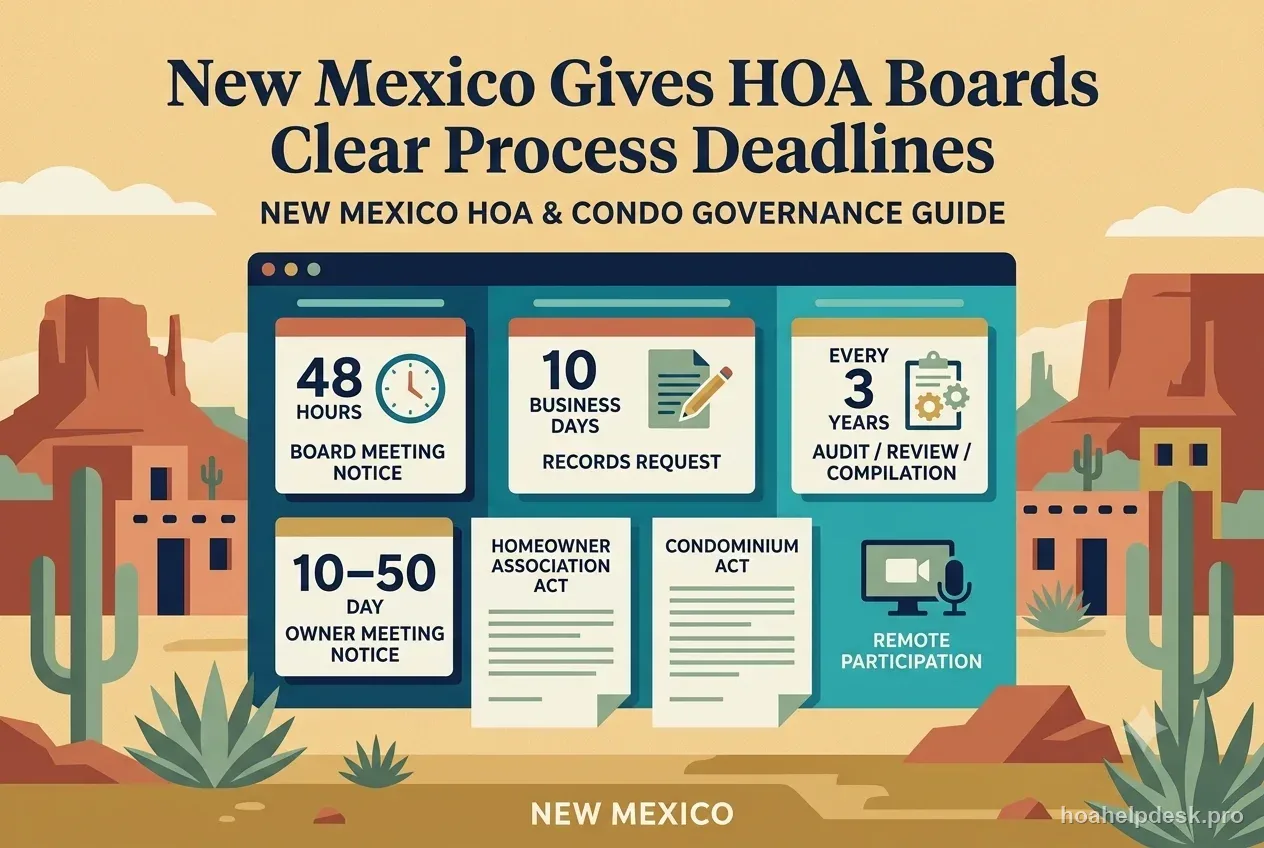
New Mexico gives HOA boards unusually concrete process rules: member meetings generally require 10–50 days’ notice, board meetings at least 48 hours, records must be produced within 10 business days, and an independent audit, review, or compilation is required at least every three years. Condominiums follow a separate Condominium Act, now expressly accommodating remote nonprofit-association business.
Which statute governs your association
New Mexico uses separate statutory tracks. A planned subdivision homeowners association within the Homeowner Association Act follows NMSA 1978, Chapter 47, Article 16. Condominiums instead use the New Mexico Condominium Act in Chapter 47, Articles 7A through 7D, with some older projects still tied to the Building Unit Ownership Act. A board should identify the recorded declaration and creation regime before borrowing a rule from the other type of community.
The Homeowner Association Act expressly excludes condominiums governed by the Condominium Act, so the distinction is operational rather than semantic. Nonprofit-corporation law can also matter to the association’s entity procedures. If the declaration or bylaws impose a stricter lawful notice, voting, or approval requirement than the statutory floor, follow the governing documents. Confirm the current statute text and any recent amendment before relying on this summary.
Reserve study and reserve funding
New Mexico does not impose a statewide recurring reserve study cycle or a fixed reserve-funding percentage on every HOA. The Homeowner Association Act focuses more directly on meetings, records, budgets, disclosure, elections, and enforcement. A board should therefore avoid describing New Mexico as a mandatory reserve-study state unless its declaration, lender requirements, or another project-specific rule creates that obligation.
The Condominium Act authorizes association budgeting and reserve practices but likewise should not be converted into an invented statewide study interval. Boards can still use a reserve study to separate predictable capital replacements from operating expenses, especially where roofs, private roads, walls, or mechanical systems are association responsibilities. The key governance task is to connect the reserve contribution to the adopted budget and disclose the assumptions consistently to owners.
Insurance and fidelity bond
Neither the Homeowner Association Act nor the general HOA framework supplies one universal fidelity bond formula for every New Mexico planned community. The association’s declaration, management agreement, lender conditions, and risk profile therefore remain important when setting crime coverage, D&O insurance, and master property coverage. Boards should document who can sign checks or initiate transfers and match controls and insurance to the maximum cash exposure.
Condominium insurance duties arise under the separate Condominium Act and should be checked against the project’s declaration before renewal. Do not assume a rule written for a condominium automatically applies to a subdivision HOA. If the governing documents require broader master insurance policy protection or a fidelity bond beyond the statutory baseline, the association should follow that stricter lawful requirement and record the renewal decision in the minutes.
Open meetings, notice, and agenda
For HOAs, the statute requires an annual association meeting at least once every 13 months. Written notice of an owner meeting must generally be delivered 10–50 days in advance. Unless the community documents demand more time, board-meeting notice must be provided at least 48 hours in advance by an authorized reasonable method, and drafts of proposed policy resolutions are part of the notice package. Those numbers should be built into the board calendar rather than recreated meeting by meeting.
New Mexico also modernized condominium procedure in 2025. Chaptered SB 72 amended the Condominium Act and nonprofit-corporation provisions to support agreed electronic notices and remote participation for qualifying condominium association and director meetings, effective June 20, 2025. Remote attendance does not eliminate quorum, notice, or voting requirements. Boards should distinguish owner meetings, board meetings, executive discussions, and emergency circumstances in their written meeting policy.
Quorum and voting thresholds
The Homeowner Association Act permits proxy and absentee voting and treats properly cast proxy and absentee votes as relevant to quorum under the statute and community documents. A proxy should be used only for the meeting for which it is executed, and boards should preserve the instrument or reliable voting record with the election file. The declaration and bylaws remain essential for the actual quorum percentage and any higher approval threshold that applies to particular decisions.
Condominium voting and quorum come from the Condominium Act plus the declaration and bylaws, not from the HOA Act. The 2025 remote-business amendments make it more practical for nonprofit condominium associations to count lawful remote participation, but they do not rewrite project-specific supermajority requirements. Before amending a declaration, removing directors, or approving a major property decision, identify whether the denominator is those present, all votes allocated, or another statutory class.
Records access and retention
New Mexico’s HOA statute is unusually concrete on owner access. Association financial and other records must be made available after a written request within 10 business days, subject to statutory exclusions and reasonable procedures. That deadline makes an organized records retention system essential. Minutes, budgets, contracts, bank records, insurance policies, ballots, and enforcement files should be indexed so the board can separate producible material from privileged, personnel, or other protected records.
The board also must arrange an independent financial audit, review, or compilation at least every three years, and the completed work must be made available to lot owners within 30 calendar days after completion. That is not the same thing as a reserve study. Boards should keep the accountant’s engagement, final report, management responses, and any corrective actions together so later directors can understand what was tested and what changed.
Budget and assessment disclosure
For an HOA governed by Chapter 47, Article 16, the annual budget is not merely an internal spreadsheet. The statutory framework requires the board to adopt a budget and provide it to owners, while the community documents determine many details of assessment allocation and any additional approval steps. A useful budget disclosure separates operations, reserve contributions, insurance, contracts, utilities, and expected capital projects instead of hiding a material increase inside one combined expense line.
Condominium boards should follow the separate budget powers and procedures in the Condominium Act and their recorded declaration. If the documents require owner ratification, a special meeting, or advance distribution beyond the statutory baseline, those stricter lawful terms control. Meeting minutes should show the budget adopted, the assessment resulting from it, and the effective date so the board can later demonstrate the authority for the amount billed.
Limits on assessment and fee increases
New Mexico does not impose a general statewide percentage cap on annual HOA dues increases comparable to a fixed 10% or 20% ceiling. The practical limit usually comes from the declaration, bylaws, budget authority, and any owner-vote provision tied to regular or special assessments. A board should therefore answer “how much can dues rise?” by reading the community documents rather than inventing a statewide cap that the Homeowner Association Act does not supply.
The same caution applies to condominiums. A budget increase, special assessment, transfer-related charge, and enforcement fine are different legal tools and should not be treated as interchangeable fees. Before imposing a new charge, identify the statutory and document authority, the required vote, and whether the amount becomes a lienable assessment. Where the documents are stricter than state law, follow the stricter lawful procedure.
Fines and enforcement due process
New Mexico HOA enforcement requires process before a monetary penalty is treated as routine bookkeeping. The statute authorizes reasonable fines only after notice and an opportunity to dispute the alleged violation. The 2019 amendments provide a 14-day notice period tied to the hearing or written-statement opportunity. The board should identify the rule violated, the proposed consequence, the response method, and the decision in a consistent enforcement file.
Do not assume that every fine automatically has the same collection status as a regular assessment. The board should separately verify lien authority and any foreclosure restriction before referring an account. Condominium enforcement is governed by the Condominium Act and project documents, not the HOA Act. A written due process policy should preserve any stronger hearing or appeal right in the declaration or bylaws rather than treating the statutory floor as a maximum.
Sources
- New Mexico OneSource — official NMSA 1978 databaseOfficial New Mexico Compilation Commission database; verify current Chapter 47, Article 16 and Articles 7A–7D text here before publication.
- New Mexico Legislature — official law research linksOfficial Legislature page directing users to New Mexico OneSource and related state legal resources.
- 2017 HB 374 committee substitute — Homeowner Association Act amendmentsOfficial legislative text supporting HOA meeting notice, records, budget, proxy, and related amendments; current codified wording must be checked in OneSource.
- 2019 SB 150 — Homeowner Association Act amendmentsOfficial legislative material supporting the three-year audit/review/compilation rule and enforcement amendments; verify codified current text in OneSource.
- 2025 SB 72 — Nonprofit condo association remote businessOfficial bill history: chaptered as Ch. 62, signed April 7, 2025; agency analysis states June 20, 2025 effective date.
Compare nearby state rules
Check one decision against the statute
For a single board decision — a fine, a special assessment, a records request, an election, a CC&R amendment — the State Decision Lookup resolves the verified statutory rule for New Mexico and a growing set of other states, and the Board Decision Router lays out the research sequence. Both fail closed when the primary law is unclear rather than guessing.