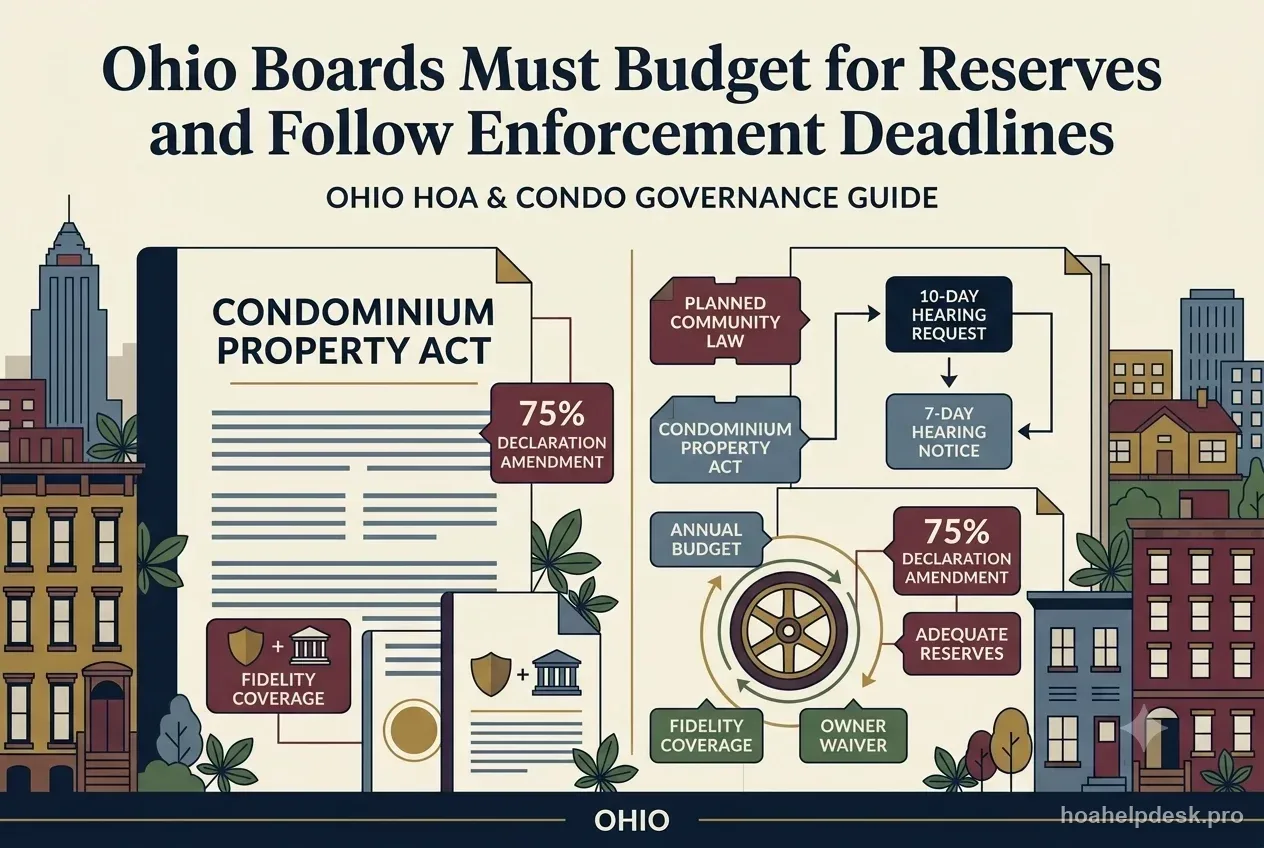
Ohio has separate, detailed statutes for planned communities and condominiums. Boards must budget annually and generally include adequate reserves unless the statutory exception or annual majority-owner waiver applies. Planned-community and condo fidelity coverage is tied to maximum funds in custody plus three months of operating expenses. Default declaration amendments commonly require 75%, while enforcement hearings use a 10-day request and seven-day hearing-notice timetable.
Which statute governs your association
Ohio separates planned communities and condominiums. A planned community uses Chapter 5312, while a condominium property uses Chapter 5311. Both chapters regulate board powers, budgets, records, insurance, assessments, amendments, and enforcement, but the wording is not identical. A board should classify the property first and then read the declaration and bylaws alongside the correct chapter instead of assuming one Ohio common-interest statute covers both forms.
Ohio also gives older governing documents substantial importance. Chapter 5312 expressly describes itself as a uniform framework that supplements existing planned-community documents and provides that a specific conflict with an existing governing document can leave the document controlling in the circumstances stated by the statute. Whatever the community type, a stricter lawful requirement in the declaration or bylaws should be followed when applicable. Confirm the current statute text and any recent amendment before relying on this summary.
Reserve study and reserve funding
Ohio does not mandate a professional reserve study on a fixed statewide cycle, but it does impose a meaningful annual reserve-funding duty. Planned-community boards must adopt an estimated annual budget that includes reserves adequate to repair and replace major capital items in the normal course without needing special assessments, unless owners holding at least a majority of voting power waive the reserve requirement in writing for that year.
Condominium boards have a closely parallel duty under § 5311.081. The condominium statute also recognizes an exception when the declaration or bylaws limit the board’s ability to increase common-expense assessments without an owner vote. This is an important distinction: Ohio requires an adequate reserve budget unless a statutory exception applies, but it does not prescribe one reserve-study frequency or one percentage-funded target. A board should document the basis for its reserve amount and any annual waiver.
Insurance and fidelity bond
Ohio’s insurance rules are unusually specific. For planned communities, Chapter 5312 requires property and liability coverage and blanket fidelity, crime, or dishonesty insurance for people who control or disburse association funds. The fidelity amount must cover the maximum funds that will be in the association’s or agent’s custody at one time plus three months of operating expenses. That formula should be recalculated as cash balances and the annual budget change.
Condominiums must, unless the declaration or bylaws provide otherwise, maintain fire and extended coverage on buildings and structures at not less than 90% of replacement cost, plus liability coverage and the same funds-in-custody-plus-three-months fidelity formula. D&O insurance remains a different protection. Boards should confirm who is an insured person, how deductibles are allocated, and whether the declaration requires broader master insurance policy protection than the statutory minimum.
Open meetings, notice, and agenda
Ohio requires a planned-community owners association to hold an annual owner meeting, and Chapter 5312 permits special meetings under the statutory and document rules. Much of the advance-notice detail for owner and board meetings remains in the declaration and bylaws rather than a single statewide four-day or seven-day open-meeting rule. Boards can use remote or electronic meeting methods when the statute and documents allow them, but should preserve notice and quorum evidence.
Condominium owner meetings are governed by Chapter 5311 and the bylaws, which must contain meeting procedures. The statute permits electronic board participation and recognizes owner meetings under the association framework, but again does not create one universal advance-notice number for every board meeting. A written meeting policy should distinguish annual owner meetings, special owner meetings, regular board meetings, emergencies, and any confidential discussion authorized by the documents or other law.
Quorum and voting thresholds
Ohio does not use one statutory member-quorum percentage for every planned community or condominium; the declaration and bylaws remain central to ordinary meeting quorum. The statutes do provide a strong default amendment rule. Unless an exception or the governing documents provide otherwise, planned-community owners may amend the declaration and bylaws with consent of 75% of owners, and the amendment is not effective until recorded with the county recorder.
For condominiums, the declaration must generally require approval by owners exercising at least 75% of the voting power for amendments, subject to statutory exceptions. Do not treat 75% as the vote for every board action or rule change. Before an election, recall, budget vote, or declaration amendment, the board should identify the specific denominator, proxy or written-consent authority, and any higher threshold in the governing documents.
Records access and retention
Ohio planned-community owners may examine and copy association books, records, and minutes under reasonable standards in the declaration, bylaws, or board rules. The current statute restricts access to records more than five years old unless the board approves the request and also excludes categories such as personnel matters, attorney communications and work product, ongoing negotiations, certain enforcement files, and information protected by state or federal law.
Condominium law has a parallel records and examination structure. The board should therefore maintain a records retention schedule rather than assuming everything can be destroyed at year five. Declarations, amendments, plats, major contracts, insurance history, and foundational minutes may need much longer retention for business reasons. When responding to an owner request, identify the requested record, the statutory exclusion if any, the copying procedure, and any reasonable fee consistently.
Budget and assessment disclosure
Both Ohio regimes require the board to adopt an annual estimated budget. The reserve component matters because the board is generally expected to fund major capital repair and replacement without routine reliance on special assessments unless a statutory exception or annual waiver applies. A board should disclose operating expenses, reserve contributions, insurance, contracts, utilities, debt service, and planned capital work separately so owners can understand the reason for the common-expense assessment.
Assessment authority does not eliminate the governing documents. If the declaration or bylaws limit how much the board may increase common-expense assessments without an owner vote, that provision can affect the condominium reserve exception and the approval process. Minutes should show the budget adopted, the assessment resulting from it, any reserve waiver, and the vote supporting a special assessment or another charge outside the ordinary annual budget.
Limits on assessment and fee increases
Ohio does not impose a general statewide percentage cap on annual planned-community or condominium assessment increases. Instead, the statutes expressly interact with declaration and bylaw limits. A board should therefore locate any internal cap or owner-vote requirement before approving an increase. The absence of a statewide percentage ceiling does not authorize the board to ignore a recorded provision that restricts common-expense increases or special assessments.
Boards should distinguish regular assessments from enforcement assessments, late charges, individual damage charges, and special assessments. Chapter 5312 authorizes defined charges and collection tools, but the amount and process still must fit the statute and governing documents. For a significant budget increase, minutes should identify the cost driver, the authority relied on, and whether owner approval was required. That record is more defensible than citing a nonexistent Ohio dues cap.
Fines and enforcement due process
Ohio planned-community enforcement uses a detailed notice-and-hearing sequence. Before imposing a charge for damages or an enforcement assessment, the board must give written notice describing the violation and proposed charge and explaining the right to a hearing. The owner has 10 days after receiving the notice to request that hearing. If requested, the board must provide at least seven days’ written notice of the hearing and may not levy the charge before holding it.
After a planned-community hearing that results in a charge, the association must deliver written notice of the charge within 30 days. Condominium § 5311.081 uses a closely parallel 10-day hearing-request, seven-day hearing-notice, and 30-day post-hearing notice framework. Boards should treat these timelines as a due process checklist, not optional courtesy, and preserve the violation notice, delivery evidence, hearing request, hearing record, and final decision in the enforcement file.
Sources
- Ohio Laws — Chapter 5312, Planned Community LawOfficial current Ohio planned-community statute portal.
- Ohio Laws — Chapter 5311, Condominium Property ActOfficial current Ohio condominium statute portal.
- Ohio Rev. Code § 5312.06 — budget, reserves, insurance, fidelity, recordsOfficial planned-community provision, including adequate reserves and fidelity formula.
- Ohio Rev. Code § 5311.16 — condominium insuranceOfficial condo provision: 90% replacement-cost property insurance and fidelity formula unless documents provide otherwise.
- Ohio Rev. Code § 5312.07 — owner examination of recordsOfficial planned-community records access and exclusions.
- Ohio Rev. Code § 5312.11 — enforcement assessment hearing processOfficial planned-community 10-day hearing request, seven-day hearing notice, and 30-day decision notice framework.
Compare nearby state rules
Check one decision against the statute
For a single board decision — a fine, a special assessment, a records request, an election, a CC&R amendment — the State Decision Lookup resolves the verified statutory rule for Ohio and a growing set of other states, and the Board Decision Router lays out the research sequence. Both fail closed when the primary law is unclear rather than guessing.