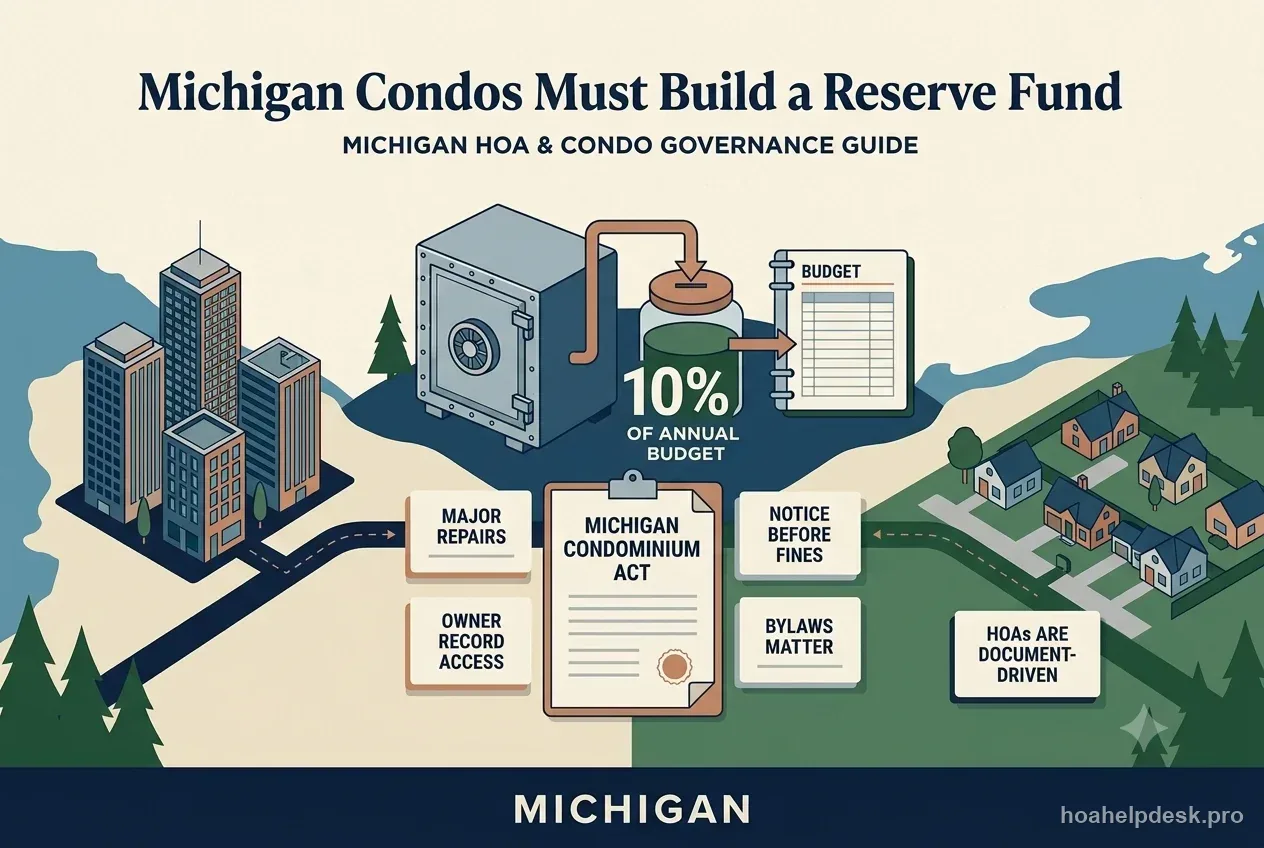
Michigan condominiums must maintain a reserve fund for major repairs and replacements, with an administrative-rule minimum equal to 10% of the current annual budget on a noncumulative basis. The Condominium Act also requires bylaws, owner access to association records, and notice plus a hearing before fines. Michigan has no comparable comprehensive HOA act, so subdivision HOAs remain heavily document-driven.
Which statute governs your association
Michigan has a sharp legal distinction between a condominium association and a conventional subdivision HOA. A condominium, including many site-condominium developments that look like detached-home subdivisions, is governed by the Michigan Condominium Act, 1978 PA 59, MCL 559.101 et seq., together with the state Condominium Administrative Rules. A deed-restricted HOA that is not a condominium does not automatically receive those rules and instead depends primarily on recorded restrictions, bylaws, contract principles, and the law governing its organizational form.
The practical first step is therefore to read the recorded master deed or declaration and confirm the project type before citing a rule. LARA specifically notes that site condominiums must comply with the Condominium Act, while the agency does not adjudicate ordinary association disputes. If governing documents require a stricter notice, vote, reserve, or hearing procedure than the statutory floor, the board should follow them unless a mandatory statute controls. Confirm the current statute text and any recent amendment before relying on this summary.
Reserve study and reserve funding
Michigan does not require a recurring professional reserve study on a fixed three-year or five-year schedule, but condominiums do have a concrete reserve-funding rule. Administrative Rule R 559.511 requires the bylaws to provide for a reserve fund for major repairs and replacement of common elements, and requires the association to maintain a minimum reserve equal to 10% of the current annual budget on a noncumulative basis. The rule also restricts the required fund to major repairs and replacement of common elements.
That 10% figure is a minimum accounting floor, not a promise that the reserve is adequate. The required bylaw language itself warns that the minimum may be insufficient for a particular project. A responsible board should therefore use a reserve study or component schedule to test actual roof, paving, mechanical, façade, and other replacement exposure. For a non-condominium HOA, do not import the 10% rule unless the documents or another applicable law makes it binding.
Insurance and fidelity bond
Michigan condominium documents and administrative rules should be read together when the board evaluates insurance. The statute requires condominium bylaws to address administration and common expenses, while the project documents typically allocate responsibility for casualty coverage, deductibles, and unit improvements. Michigan does not provide a simple statewide fidelity bond formula in the Condominium Act comparable to Massachusetts or Louisiana, so boards should not invent a multiple of assessments or reserves.
Treasurers should separately review the master insurance policy, general liability, D&O insurance, crime or employee-dishonesty coverage, and any lender requirements. The reserve rule does not substitute for insurance, and insurance does not substitute for capital reserves. For a non-condominium HOA, insurance obligations are commonly driven by recorded covenants, contracts, association-owned property, and corporate governance rather than the condominium-specific administrative rules.
Open meetings, notice, and agenda
The Michigan Condominium Act does not create a broad statutory open meeting regime with a universal advance board-notice period for every condominium. Instead, MCL 559.154 requires the condominium bylaws to contain governance provisions, and the project documents generally determine how owner meetings are called, how directors are selected, and what notice is required. Boards should therefore resist copying a fixed meeting-notice number from another state or from an unrelated nonprofit statute.
Good practice is to publish a regular calendar, provide agendas with enough detail for owners to understand the business, and use executive session only when the governing documents or legitimate confidentiality concerns justify it. But those practices should not be mislabeled as a Michigan statutory open meeting mandate. If the master deed or bylaws impose a specific notice period or owner-attendance right, the board must follow that stricter document rule.
Quorum and voting thresholds
Michigan condominium voting begins with the bylaws. The Condominium Act requires bylaws to set the method of administering the project and allocating votes, while amendment statutes impose separate consent rules for changes to condominium documents. There is no single owner-meeting quorum percentage that can safely be stated for every Michigan condominium without checking the bylaws. Likewise, a proxy may be permitted, limited, or conditioned by the governing documents and applicable corporate law.
Amending condominium documents can require different levels of approval depending on what is being changed. MCL 559.190 and related provisions distinguish amendments that may be made without owner or mortgagee consent from changes that materially affect rights and therefore require voting or consent. Boards should not summarize this as “all amendments require two-thirds.” Read the specific amendment authority, the master deed, and any mortgagee-consent clause before publishing a ballot.
Records access and retention
Michigan condominiums must keep current copies of the master deed, amendments, and other condominium documents available for review, and association books, records, and contracts concerning administration and operation must be available to co-owners at convenient times. LARA’s condominium guidance also states that the association must provide an annual financial statement to each co-owner. These are meaningful access rights even though the statute does not supply the same seven-year universal retention number used by Massachusetts.
A board should adopt a records retention schedule that preserves the master deed and amendments permanently, keeps minutes and election records long enough to document governance, and retains accounting, tax, insurance, contract, and reserve records under an appropriate legal and business schedule. Access rules should be written down so owners know how to request records, when inspection occurs, and what reasonable copying or administrative costs apply. Do not destroy records merely because the Act lacks a single retention number.
Budget and assessment disclosure
Michigan’s condominium administrative rules require the bylaws to contain detailed assessment information and provide that the board of directors establishes an annual budget. The reserve minimum is measured against that current annual budget, which makes budgeting and reserve planning inseparable. LARA’s buyer guidance also emphasizes annual financial reporting. A board should show operating costs, the required reserve contribution, known capital projects, insurance, contracts, and any special assessment separately rather than presenting owners with a single unexplained monthly figure.
The Act permits association remedies for unpaid assessments and gives condominium liens significant enforcement consequences. Because the budget becomes the basis for recurring assessments, minutes should show adoption of the budget and any document-required notice or owner vote. A non-condominium HOA should follow its declaration and bylaws instead of assuming the Condominium Administrative Rules govern its assessment procedure.
Limits on assessment and fee increases
Michigan does not impose a general statewide annual percentage cap on condominium assessment increases. The key restraints are the association’s authority under the condominium documents, the annual budget, allocation provisions, and any member-approval requirement in the bylaws. A board should therefore not claim that dues can rise only 10% because the 10% number in Michigan law relates to the minimum condominium reserve fund, not an annual assessment-increase ceiling.
When a major repair exceeds available reserves, the documents may authorize a special assessment, borrowing, or another funding mechanism. The board should document why the increase is needed, whether the reserve fund is being used for a permitted major repair or replacement, and whether owner approval is required. For conventional HOAs, the CC&Rs and bylaws are usually the starting point for any cap or special-assessment threshold.
Fines and enforcement due process
Michigan provides an important procedural protection before condominium fines. MCL 559.206 recognizes reasonable remedies in the condominium documents, including fines against co-owners after notice and a hearing. That means a board should not treat a fine as an automatic administrative charge. The violation, the authority for the rule, the required notice, and the opportunity to be heard should be documented before the board converts the matter into a monetary sanction.
The Act also permits enforcement actions and assessment liens under defined conditions, so boards should keep fines, regular assessments, collection costs, and other charges distinct in the ledger. A hearing record should show what evidence was considered and what decision was made. For an HOA outside the Condominium Act, fine authority and due process are more document-driven; the condominium notice-and-hearing rule should not be represented as automatically binding on every Michigan HOA.
Sources: [1]
Sources
- Michigan Condominium Act, 1978 PA 59Official Michigan Legislature full Act; confirm current PA update before publication.
- Michigan Condominium Administrative RulesOfficial LARA administrative rules; R 559.511 contains the 10% reserve minimum.
- Michigan LARA — CondominiumsOfficial agency page explaining LARA’s limited role and linking condominium resources.
- Michigan Condominium Buyer’s HandbookOfficial LARA handbook summarizing reserve, records, financial-statement, and project-type rules.
- Michigan LARA Condominium FAQsOfficial FAQ confirming association reserve and records responsibilities.
- Michigan Legislature — Condominium Act section indexOfficial section index useful for MCL 559.154, 559.190 and related current text checks.
Compare nearby state rules
Check one decision against the statute
For a single board decision — a fine, a special assessment, a records request, an election, a CC&R amendment — the State Decision Lookup resolves the verified statutory rule for Michigan and a growing set of other states, and the Board Decision Router lays out the research sequence. Both fail closed when the primary law is unclear rather than guessing.