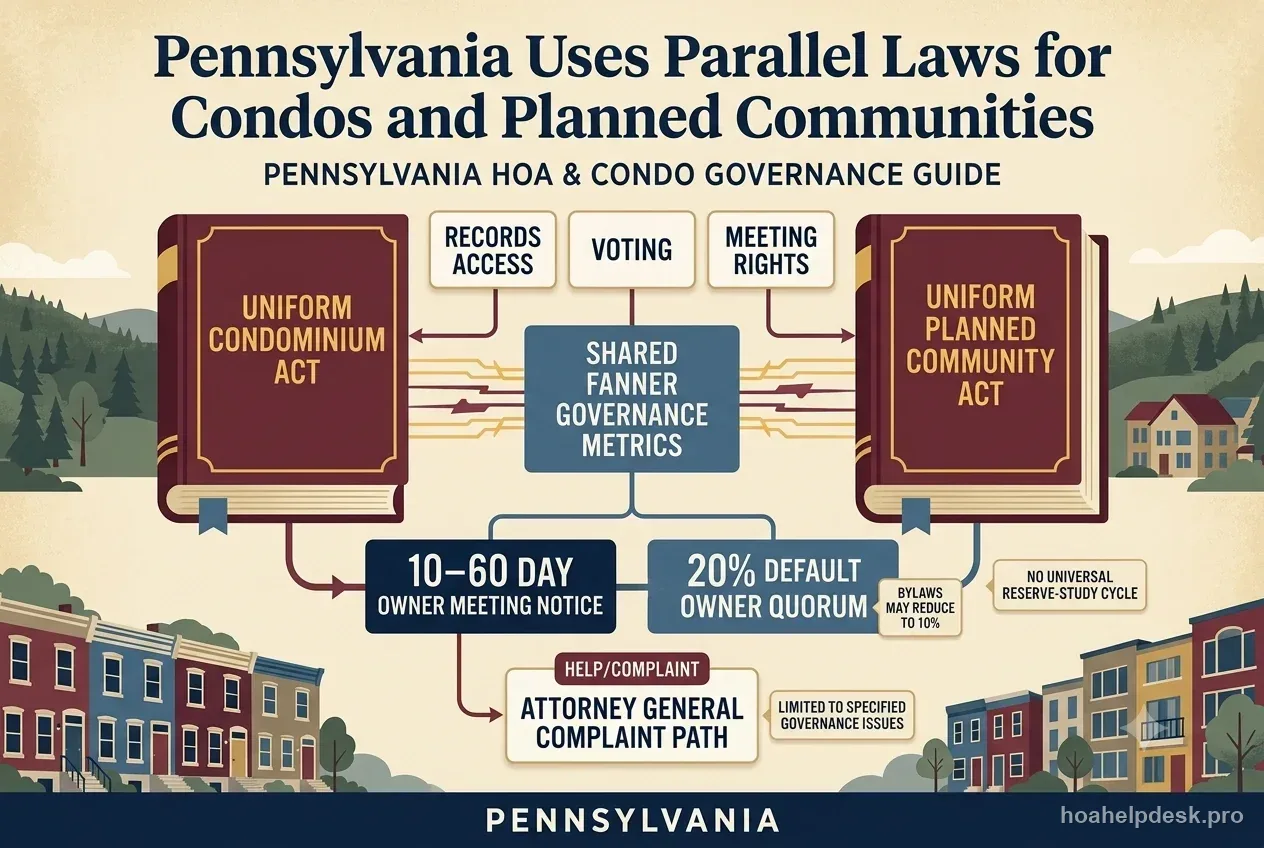
Pennsylvania has parallel uniform acts for planned communities and condominiums. Both set owner-meeting notice at ten to sixty days and default owner quorum at twenty percent, subject to bylaw adjustments down to ten percent. They also require records to be reasonably available and provide a limited Attorney General complaint path for meetings, quorum, voting, and records. Neither act creates a universal recurring reserve-study cycle.
Which statute governs your association
Pennsylvania’s Uniform Planned Community Act governs planned communities, while the Uniform Condominium Act governs condominiums. The two statutes share many governance concepts but use separate chapter numbers, so a board should cite the correct subpart rather than copying a condo section into an HOA policy. Older communities may be subject to only selected provisions depending on the act’s applicability rules and the date the community was created.
Both acts are supplemented by corporate and general legal principles where those principles do not conflict with the common-interest statute. The declaration and bylaws remain central because they can set higher quorum percentages, stricter notice procedures, and additional approval rights. When governing documents demand a stricter process than the statutory minimum, follow the documents unless mandatory law says otherwise. Confirm the current statute text and any recent amendment before relying on this.
Sources: [1]
Reserve study and reserve funding
Pennsylvania’s Uniform Planned Community Act and Uniform Condominium Act do not establish a statewide recurring reserve study schedule for ordinary associations. The statutes authorize associations to adopt budgets and assessments and to manage common property, but a board should not tell owners that Pennsylvania law requires a reserve study every three or five years unless another law, governing document, lender requirement, or local rule actually supplies that mandate.
That statutory silence makes board documentation important. A reserve study can still be the most defensible way to estimate roof, paving, structural, mechanical, and other capital obligations, especially when the declaration requires reserves or the annual budget includes a reserve line. Boards should separate a prudent reserve policy from a legal mandate and should disclose when a funding target is based on professional analysis rather than a state-prescribed percentage.
Sources: [1]
Insurance and fidelity bond
Both uniform acts require the association, beginning no later than the first conveyance of a unit to someone other than a declarant, to maintain specified property and liability insurance to the extent reasonably available. The exact insured property differs between a planned community and a condominium, so the board should use the correct section and compare it with the declaration’s maintenance allocation.
The statutes reviewed do not provide a single statewide fidelity bond formula that can be applied mechanically to every Pennsylvania association. Boards should therefore check the declaration, bylaws, management agreement, lender requirements, and insurance underwriting standards for crime or fidelity coverage. D&O insurance remains a separate governance consideration and should not be confused with property, liability, or employee-dishonesty coverage.
Sources: [1]
Open meetings, notice, and agenda
For both planned communities and condominiums, the bylaws must require at least one association meeting each year and provide for special meetings. Owner-meeting notice is generally delivered not less than ten nor more than sixty days in advance and must state the time, place, and agenda items, including the general nature of proposed declaration or bylaw amendments and budget or assessment changes.
Pennsylvania law also gives unit owners in good standing a limited statutory complaint path to the Bureau of Consumer Protection for violations of the meeting, quorum, voting/proxy, and records sections. That does not make the Attorney General a general HOA regulator, but it gives boards an extra reason to document notice, attendance, proxies, ballots, and minutes carefully. Board-meeting procedures should also be checked against the bylaws and any applicable nonprofit statute.
Sources: [1]
Quorum and voting thresholds
The default owner quorum under both uniform acts is twenty percent of the votes that may be cast for election of the executive board. Bylaws may set a larger percentage or a smaller percentage, but not lower than ten percent. If the association fails to reach quorum at two subsequent meetings, the statutes allow use of a nonprofit-corporation quorum mechanism unless the declaration or bylaws provide otherwise.
The bylaws amendment framework is also specific. For both planned communities and condominiums, bylaws may generally be amended by at least fifty-one percent of association votes unless the bylaws require a larger percentage; the vote must occur at a scheduled meeting after fourteen days’ advance advertisement to owners, and absentee voting is permitted subject to the statutory process. Declaration amendments are separate and should be checked under the correct subpart.
Sources: [1]
Records access and retention
Both acts require the association to keep financial records sufficiently detailed to support resale disclosures and make financial and other records reasonably available for examination by unit owners and authorized agents. The statutes also provide a complaint route to the Bureau of Consumer Protection for specified records violations. In planned communities, annual financial statements and supporting records have additional request and review provisions.
A board should use a records retention schedule rather than treating “reasonably available” as permission to keep records indefinitely in an unorganized archive. Keep governing documents, amendments, minutes, reserve materials, audits, insurance history, major contracts, and capital-project records for long periods. For owner requests, separate accessible association records from privileged communications, personnel material, and other protected information, and document what was produced and when.
Sources: [1]
Budget and assessment disclosure
Pennsylvania’s uniform acts give associations authority to adopt budgets and levy common-expense assessments, while meeting notice must identify budget or assessment changes that are to be considered at an owner meeting. The governing documents may add ratification rights, delivery deadlines, or owner-vote requirements. Boards should therefore build the annual budget calendar from both the statute and the declaration rather than assuming board adoption alone completes the process.
When the budget contains reserves, explain the basis for the contribution even though Pennsylvania does not impose a universal reserve-study cycle. For a special assessment, document the project, allocation method, payment schedule, and approval authority. If the declaration requires owner approval above a certain amount or for a capital improvement, that restriction remains a central part of the assessment process.
Sources: [1]
Limits on assessment and fee increases
Pennsylvania’s common-interest statutes do not set a simple statewide annual percentage cap on assessments for all associations. The practical limits come from the declaration, bylaws, statutory allocation rules, budget authority, and any owner-approval provisions. A board should not advertise “no cap” as unlimited power; an assessment still must be authorized, allocated correctly, adopted through the required process, and used for legitimate association purposes.
Late fees, interest, collection costs, and lien remedies should be treated separately from the annual assessment rate. Before changing a fee schedule, review the declaration and the applicable lien section for the association type. A special assessment may require a different vote than an ordinary annual budget, and a capital-improvement charge may be subject to document restrictions even when routine operating assessments are not.
Sources: [1]
Fines and enforcement due process
Pennsylvania associations can enforce declarations, bylaws, and rules, but fines should be grounded in actual association authority and applied consistently. The board should provide written notice of the rule, the facts supporting the alleged violation, the amount or range of the proposed fine, and any hearing or appeal opportunity required by the governing documents or applicable statute before posting the charge to an owner ledger.
Because statutory complaint rights expressly cover meetings, quorum, voting/proxies, and records, enforcement decisions that affect voting eligibility or owner access deserve special care. Keep the violation file separate from general meeting minutes where appropriate, use comparable sanctions for comparable conduct, and verify lien treatment before attempting collection. A fine does not automatically receive the same priority or foreclosure rights as a common-expense assessment.
Sources: [1]
Sources
- Pennsylvania Consolidated Statutes Title 68 — Real and Personal PropertyOfficial Pennsylvania General Assembly text containing the Uniform Condominium Act and Uniform Planned Community Act.
- Pennsylvania Title 68 PDFOfficial consolidated PDF used as a stable cross-check for chapter and section numbering.
- Pennsylvania Office of Attorney General — Bureau of Consumer ProtectionOfficial Bureau of Consumer Protection complaint form; Title 68 itself defines the limited common-interest complaint categories.
Compare nearby state rules
Check one decision against the statute
For a single board decision — a fine, a special assessment, a records request, an election, a CC&R amendment — the State Decision Lookup resolves the verified statutory rule for Pennsylvania and a growing set of other states, and the Board Decision Router lays out the research sequence. Both fail closed when the primary law is unclear rather than guessing.