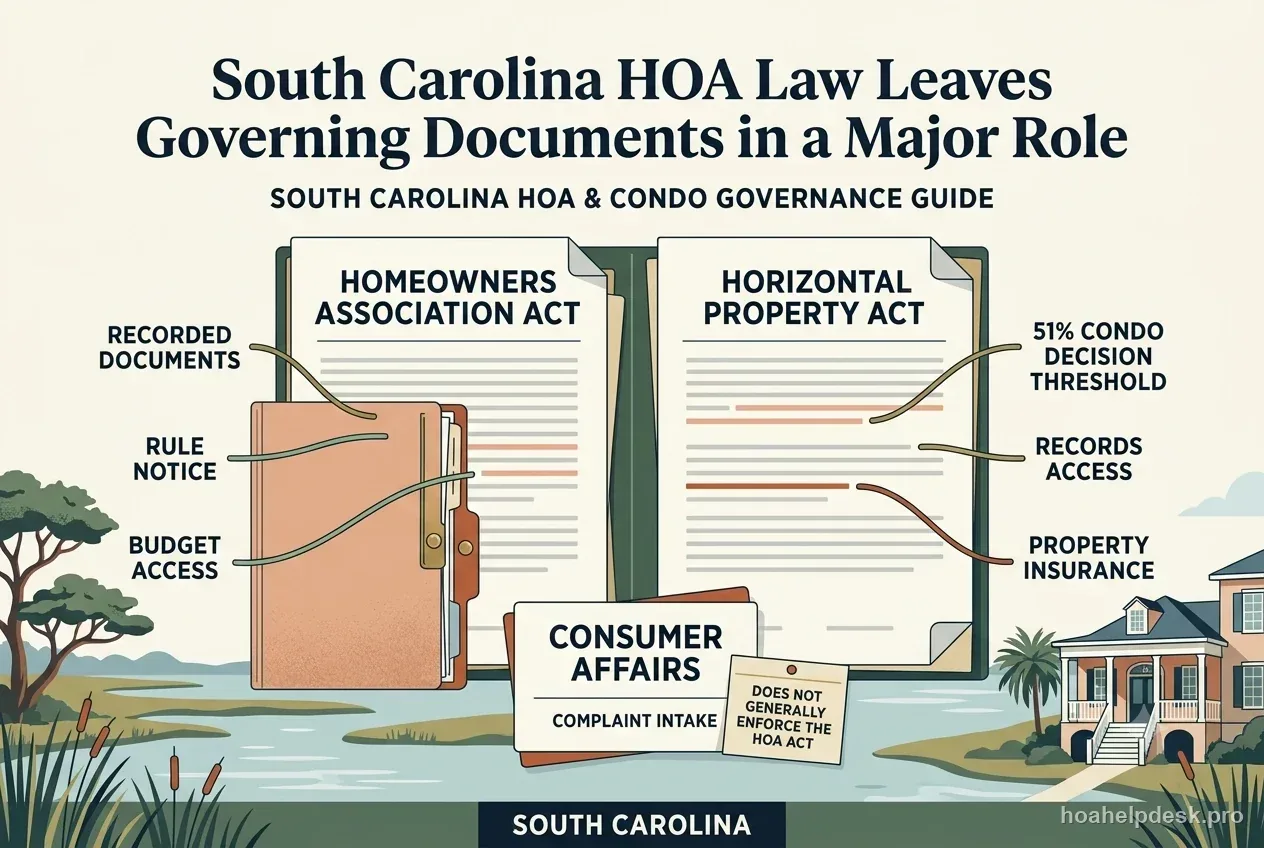
South Carolina’s HOA Act is narrower than many states’ common-interest statutes. It emphasizes recorded governing documents, notice of adopted rules and budget access, while the older Horizontal Property Act supplies condo rules such as a fifty-one-percent decision threshold, records access, and property insurance. The Department of Consumer Affairs accepts HOA complaints but expressly says it does not administer or enforce the HOA Act.
Which statute governs your association
South Carolina uses multiple layers. Lot-based associations are subject to the South Carolina Homeowners Association Act, while condominiums organized as horizontal property regimes also use the Horizontal Property Act. The Department of Consumer Affairs notes that the HOA Act, Nonprofit Corporation Act, and Horizontal Property Act are among the statutes commonly relevant to association governance. The HOA Act is not a comprehensive operational code, so recorded documents remain unusually important.
The HOA Act requires governing documents to be recorded to remain enforceable and also regulates the handling of rules, regulations, and amendments. Condo administration under the Horizontal Property Act is governed by recorded bylaws appended to or inserted in the master deed or lease. If CC&Rs, bylaws, or the master deed impose a stricter process than statute, follow the stricter document rule unless it conflicts with mandatory law. Confirm the current statute text and any recent amendment before relying on this.
Reserve study and reserve funding
South Carolina’s HOA Act does not impose a recurring statewide reserve-study cycle or a universal statutory reserve-funding percentage. The Horizontal Property Act likewise does not create a modern reserve-study schedule comparable to Oregon or Florida. Boards therefore should not state that a South Carolina association “must” obtain a reserve study every fixed number of years unless the declaration, lender requirements, or another applicable rule supplies that obligation.
The absence of a statutory cycle does not eliminate capital-planning responsibility. A board should inventory roofs, roads, pools, drainage, gates, structural components, and other long-lived common property, estimate useful lives and replacement costs, and connect those estimates to the budget. If the governing documents require a reserve fund or owner approval before borrowing from reserves, those provisions should be built into the financial calendar.
Insurance and fidelity bond
For condominiums, the Horizontal Property Act states that the council of co-owners shall insure the property against risks, while preserving each owner’s right to insure the individual apartment. The act also contains reconstruction rules following casualty loss, including an eighty-percent owner vote threshold in specified circumstances for deciding not to rebuild. These are condo rules, not a blanket insurance formula for every South Carolina HOA.
The HOA Act does not supply a statewide fidelity bond formula for ordinary associations. Boards should check the declaration, bylaws, lender requirements, and insurer recommendations for crime or fidelity coverage, especially when managers or volunteers handle reserves. D&O insurance should be reviewed separately from property, liability, and fidelity coverage. If the documents require broader insurance than the statute, the board should budget to the stronger requirement.
Sources: [3]
Open meetings, notice, and agenda
South Carolina’s current HOA Act is not a comprehensive open-meeting statute for private association boards. The Department of Consumer Affairs describes the act as providing certain meeting-notice requirements, but boards still need to read the bylaws and nonprofit-corporation rules for the precise meeting type, notice method, and owner participation right. Several bills introduced in 2025 and 2026 proposed broader open-board-meeting rules, but a pending bill should not be treated as current law.
For horizontal property regimes, the recorded bylaws must provide the method of calling or summoning co-owners to assemble, identify who presides, and provide for a minutes book. That gives the board a document-based meeting framework even where the statute does not state a universal number of days for every meeting. Use a written annual calendar and preserve proof of notice whenever a vote could later be challenged.
Quorum and voting thresholds
The Horizontal Property Act requires condominium bylaws to provide that a majority of at least fifty-one percent is required to adopt decisions. It also permits co-owners representing two-thirds of the total value of the property to modify the system of administration, with required bylaw particulars preserved and the change recorded. Those thresholds are specific to the horizontal-property framework and should not be copied into a subdivision HOA without authority.
For an HOA, quorum, director elections, proxies, declaration amendments, and special-assessment votes are primarily document-driven unless another statute applies. The Nonprofit Corporation Act may supply default corporate rules when the association is incorporated, but the declaration and bylaws can be decisive. Before certifying a vote, identify the denominator: all members, votes present, or votes actually cast. A mistaken denominator is a common source of invalid amendments.
Records access and retention
Under the Horizontal Property Act, the administrator or board must keep a detailed chronological account of receipts and expenditures affecting the property and administration, with supporting vouchers, and make those materials available for examination by co-owners at convenient hours on working days. The HOA Act also supports access to specified association information, and the Department of Consumer Affairs publishes education materials on those rights.
South Carolina does not provide one simple statewide retention schedule for every HOA record category. Boards should therefore adopt a policy covering permanent governance records, minutes, budgets, bank statements, tax filings, contracts, bids, insurance, owner ledgers, reserve materials, and enforcement files. Requests should be logged, fulfilled consistently, and redacted when only part of a record is protected. The DCA complaint process is voluntary mediation, not adjudication.
Budget and assessment disclosure
The HOA Act contains budget-access and notice concepts, but it does not replace the declaration’s assessment authority with a single statewide budget-ratification model. The board should check when the annual budget must be adopted, when owners must receive it or be given access, and whether the governing documents require a meeting or vote for a special assessment. Recorded document requirements matter because unenforceable amendments can undermine an assessment decision.
For condominiums, the Horizontal Property Act requires co-owners to contribute pro rata toward administration, maintenance, and repair of common elements and other lawfully agreed common expenses. The allocation is tied to the statutory percentage interests and governing documents. A board should distinguish ordinary common expenses from a capital improvement or one-time special assessment and document the authority for each charge.
Limits on assessment and fee increases
South Carolina does not impose a universal statewide percentage cap on annual HOA assessment increases in the statutes reviewed for this guide. Instead, the declaration, master deed, bylaws, recorded amendments, and applicable corporate rules determine the board’s authority and any member-vote threshold. A board should not treat “no statutory cap” as permission to ignore a contractual ceiling in the CC&Rs.
Condominium common expenses under the Horizontal Property Act are allocated according to ownership percentages and the governing documents. If the board proposes a special assessment, first identify the legal purpose, allocation formula, notice procedure, and vote required by the documents. Transfer charges, collection costs, late fees, and violation fines should be analyzed separately because authority for one type of charge does not automatically authorize another.
Fines and enforcement due process
The HOA Act focuses heavily on enforceability of governing documents rather than creating a statewide fine schedule with universal dollar caps. A board therefore should trace fine authority to a properly recorded declaration, bylaw, or rule and confirm that the rule itself was adopted and made accessible as required. Pending legislation proposed broader fine and meeting restrictions, but proposals that have not become law should not be applied to current violations.
For both HOAs and condominiums, a defensible enforcement process uses written notice, identifies the specific restriction, states the proposed sanction, and follows any hearing or appeal right in the governing documents. Apply comparable sanctions to comparable conduct and keep the decision in the association’s records. Before treating a fine as a lien or starting foreclosure, verify the separate lien statute and document authority; do not assume every monetary charge has assessment-lien status.
Sources
- South Carolina Code Title 27 — Property and ConveyancesOfficial South Carolina Legislature code portal; source index for HOA and Horizontal Property statutes.
- South Carolina Homeowners Association Act — Chapter 30Official current HOA Act text.
- South Carolina Horizontal Property Act — Chapter 31Official condominium/horizontal-property statute.
- South Carolina Department of Consumer Affairs — HOA InformationOfficial state consumer resource explaining scope of HOA laws and DCA’s limited complaint role.
- South Carolina Department of Consumer Affairs — HOA Complaint ReportsOfficial annual complaint-report page, including 2026 reporting.
Compare nearby state rules
Check one decision against the statute
For a single board decision — a fine, a special assessment, a records request, an election, a CC&R amendment — the State Decision Lookup resolves the verified statutory rule for South Carolina and a growing set of other states, and the Board Decision Router lays out the research sequence. Both fail closed when the primary law is unclear rather than guessing.