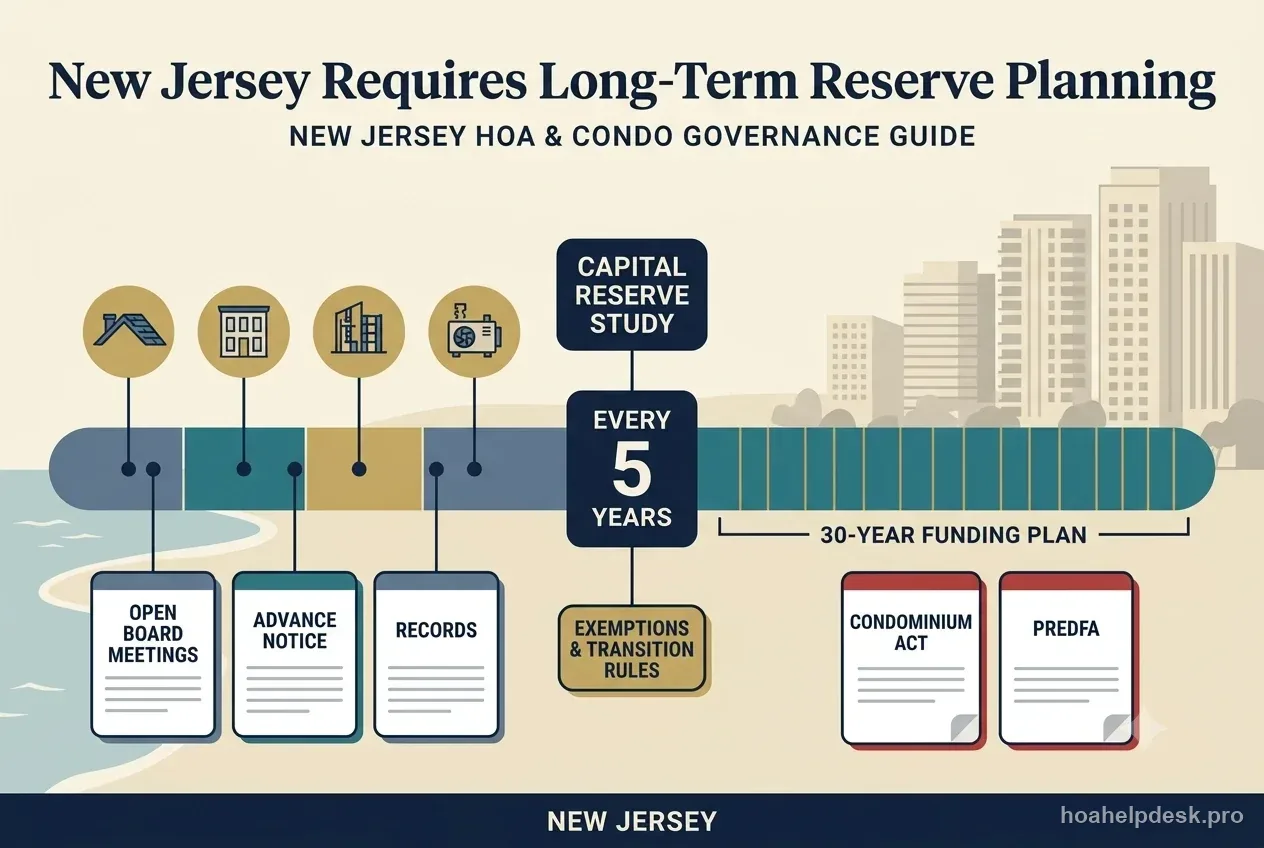
New Jersey now has unusually strong reserve requirements: covered planned real estate development associations must conduct a capital reserve study at least every five years and maintain a 30-year funding plan, subject to statutory exemptions and transition rules. Binding-vote board meetings are generally open with advance notice, while condo and PREDFA statutes separately govern board powers, elections, records, insurance, and due process.
Which statute governs your association
New Jersey boards usually need more than one statute. Condominium associations are governed by the New Jersey Condominium Act, N.J.S.A. 46:8B-1 et seq. Planned real estate developments, including many condominium and HOA communities, also operate under the Planned Real Estate Development Full Disclosure Act and its association-governance provisions. The correct analysis depends on the project’s legal form, creation documents, and whether a particular PREDFA provision applies.
The Department of Community Affairs administers important parts of this framework, including planned-real-estate-development regulation and the newer structural-integrity and capital-reserve requirements. Boards should not rely on a single “HOA law” citation when a rule actually comes from the Condominium Act, PREDFA, DCA regulations, or the declaration. If governing documents are stricter than the statutory floor, follow them unless mandatory law says otherwise. Confirm current statute text and amendments before relying on this summary.
Reserve study and reserve funding
New Jersey now requires covered planned real estate development associations to undertake and fund a capital reserve study assessing whether reserves are adequate for common-area capital assets the association must maintain. Under the current law, the study must be conducted and reviewed at least once every five years by or under the oversight of a qualified reserve specialist, engineer, or architect. Associations with less than $25,000 in total common-area capital assets are exempt from this reserve-study section.
The funding rules are stronger than a study-only requirement. The association must obtain a reserve study with a 30-year funding plan and fund reserves in accordance with the statutory framework, subject to the transition and flexibility provisions in P.L.2023, c.214 as amended by P.L.2025, c.132. Boards should verify which transition option applies before setting assessments, because the 2025 amendments changed how existing associations may reach adequate funding.
Insurance and fidelity bond
The Condominium Act makes the association responsible for maintaining insurance against fire and other casualties normally covered by broad-form property coverage on common elements and structural portions of condominium property. The master deed and bylaws may impose additional requirements, and other statutes or lender rules can affect coverage. Boards should coordinate association coverage with unit-owner policies, deductibles, and responsibility for improvements or betterments.
New Jersey does not use one simple statewide fidelity formula in the reserve-study provisions summarized here. Crime or fidelity coverage, D&O insurance, cyber coverage, and property insurance should be evaluated separately. If a manager or board member handles substantial association funds, internal controls and crime protection remain important even when a single statutory formula is not applicable. The declaration may require stronger insurance than the statutory baseline.
Sources: [1]
Open meetings, notice, and agenda
New Jersey generally requires meetings at which a governing board will take a binding vote to be open to owners, subject to statutory closed-session topics such as privacy, pending or anticipated litigation or contract negotiations, attorney-client matters, and specified personnel issues. Current N.J.A.C. 5:26-8.12 requires an annual meeting and an executive-board open-meeting schedule, plus adequate notice at least seven days before a scheduled binding-vote meeting.
The Condominium Act contains a parallel open-meeting requirement in the mandatory bylaw provisions for condominium governing boards. Working sessions where no binding vote is taken are treated differently, but a board should not use a working-session label to take final action privately. Minutes of open meetings must be taken and made available under the governing statute and regulations. If the bylaws require longer notice, follow the longer period.
Quorum and voting thresholds
New Jersey statutes leave many owner-meeting quorum percentages to the bylaws, but the Condominium Act provides that a majority of the governing board or association, as applicable, constitutes a quorum for transaction of business when the association is unincorporated, subject to the statute and governing documents. PREDFA requires bylaws to state the percentage needed for decisions and quorum and supplies detailed election protections for association members.
New Jersey election law emphasizes owner eligibility, fair nominations, and democratic procedures, and it has been amended repeatedly. The board should therefore use current DCA election regulations and statute text instead of relying on an old proxy form. Declaration and master-deed amendment thresholds vary by subject, so a board should identify the exact instrument being amended and the approval formula written in that instrument and applicable law.
Records access and retention
PREDFA requires association governance to embody due process, open governance, democracy, and fundamental fairness, including access to records. The Condominium Act and DCA regulations also support owner access to association records while protecting categories that may be confidential. Because the governing framework is split among statutes and regulations, a board should use a written request process and identify the legal basis before denying access.
New Jersey does not reduce recordkeeping to a single retention period for every category in the provisions summarized here. Boards should preserve recorded master deeds, declarations, bylaws, amendments, plats, reserve studies, structural reports, and material governance history permanently or for the legally appropriate period, and adopt category-specific retention for financial statements, contracts, insurance, elections, minutes, violations, and owner ledgers.
Budget and assessment disclosure
New Jersey association budgets are governed by the board powers in the Condominium Act, PREDFA, DCA regulations, and the community’s documents. The newer reserve statutes make capital planning part of the budget conversation because covered associations must align reserve contributions with the current reserve study and 30-year funding plan. A board should clearly separate ordinary operating assessments from reserve contributions and project-specific special assessments.
Owners should receive the disclosures and meeting opportunities required by the governing statutes, regulations, and bylaws. The board should not assume the reserve law itself replaces existing budget notice procedures. When a funding adjustment materially increases assessments, minutes should explain the reserve-study recommendation, transition option, expected capital work, and why the board selected the contribution level. Stricter notice or owner-approval requirements in the documents remain important.
Limits on assessment and fee increases
New Jersey does not impose one general statewide annual percentage cap on every HOA or condominium assessment increase. The amount an association may assess depends on its lawful budget authority, declaration or master deed, bylaws, reserve obligations, and any special-assessment approval rules. The reserve-funding statute can require materially higher contributions, but that requirement is not the same thing as a universal dues-increase percentage.
Boards should identify whether a proposed increase funds ordinary operations, the 30-year reserve plan, an emergency, or a special project. If the governing documents require owner approval above a certain amount or for a special assessment, that procedure must be followed unless mandatory state law changes the result. The board should also avoid hiding discretionary fines or collection charges inside the regular assessment line item.
Fines and enforcement due process
The Condominium Act authorizes associations to adopt and enforce reasonable rules and, when authorized by the master deed or bylaws, impose reasonable fines, assessments, and late fees. PREDFA separately requires association governance to embody due process and fundamental fairness. A board should therefore confirm both substantive authority for the rule and the procedure used to enforce it before posting a charge to an owner account.
Notice of the alleged violation, a meaningful opportunity to respond, consistent application, and access to any required alternative dispute resolution should be built into the enforcement process. New Jersey law also recognizes statutory ADR rights for certain common-interest-community disputes. A board should not assume that every fine is automatically collectible as an assessment lien; the legal basis and collection remedy should be checked separately before escalation.
Sources
- New Jersey Legislature — current unannotated statutes portalOfficial New Jersey statute publication directory; use the current Title 46 text for the Condominium Act.
- P.L.2025, c.132 — amended capital reserve study and 30-year funding rulesOfficial enacted law amending P.L.2023, c.214.
- New Jersey DCA — Structural Integrity / Capital Reserve Studies FAQOfficial DCA guidance on reserve-study timing, exemptions, and administration.
- P.L.2023, c.214 — original structural integrity and reserve study lawOfficial enacted law; use with 2025 amendments.
- N.J.S.A. 45:22A-46 — association bylaws and open meetingsOfficial PREDFA governance provision; verify live portal path before publication.
- New Jersey DCA — N.J.A.C. 5:26 Planned Real Estate Development regulationsOfficial current regulation compilation; § 5:26-8.12 contains open-meeting notice and minutes rules.
Compare nearby state rules
Check one decision against the statute
For a single board decision — a fine, a special assessment, a records request, an election, a CC&R amendment — the State Decision Lookup resolves the verified statutory rule for New Jersey and a growing set of other states, and the Board Decision Router lays out the research sequence. Both fail closed when the primary law is unclear rather than guessing.