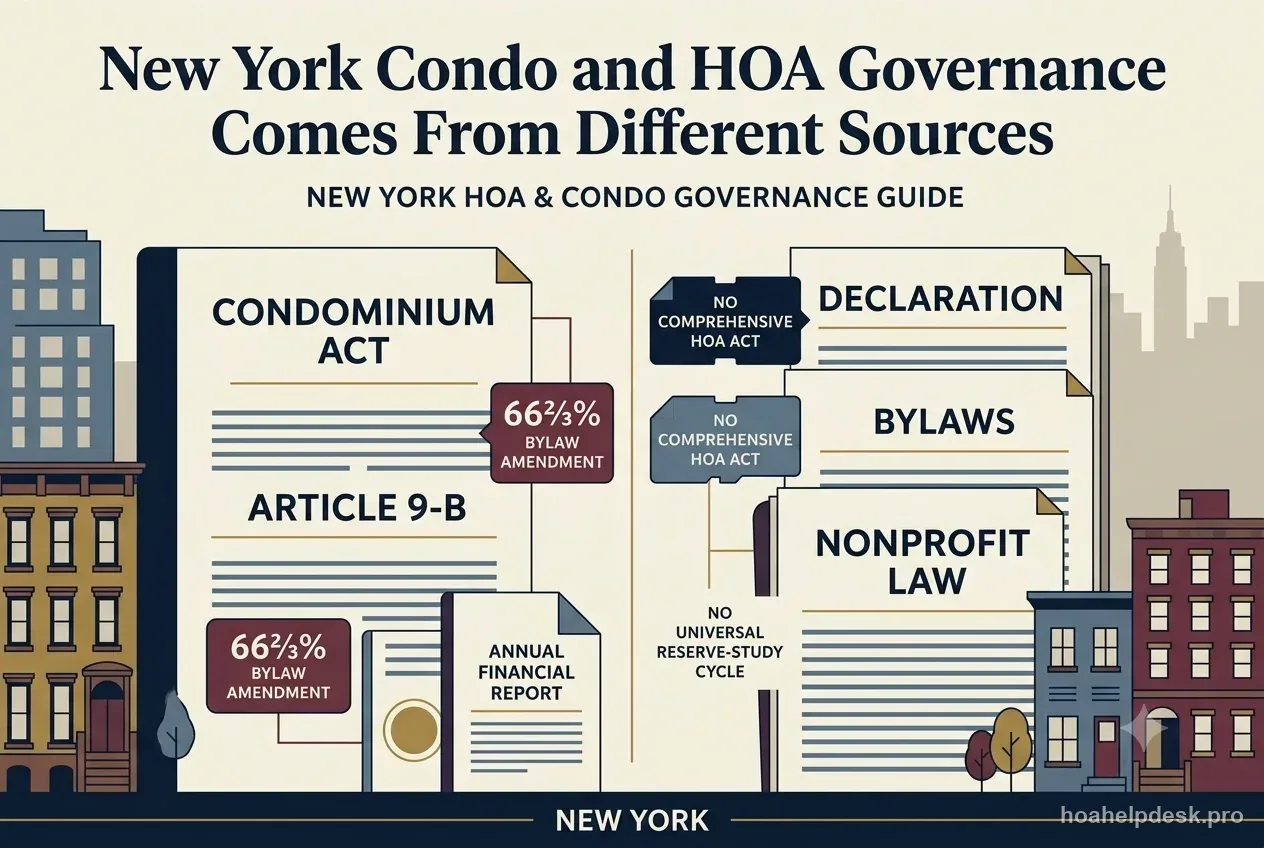
New York does not have one comprehensive HOA governance act. Condominiums use Real Property Law Article 9-B, while many incorporated HOAs also rely on Not-for-Profit Corporation Law. Condo bylaws must define meeting and quorum mechanics, bylaw amendments generally require at least 66⅔% in number and common interest, and boards must provide an annual receipts-and-expenditures report. No statewide reserve-study cycle applies generally.
Which statute governs your association
New York condominium boards start with Real Property Law Article 9-B, the Condominium Act. It requires a declaration and bylaws and assigns core administration to the board of managers. A subdivision HOA, however, is not automatically governed by Article 9-B. Many HOAs are organized as not-for-profit corporations, so the recorded declaration and bylaws operate alongside the Not-for-Profit Corporation Law rather than a separate comprehensive planned-community act.
The Attorney General’s Real Estate Finance Bureau regulates offering plans and real-estate securities for condominiums and homeowners associations, but that role should not be described as routine supervision of every board vote or enforcement dispute. Boards must identify both property-law and entity-law layers. If the declaration or bylaws impose a stricter lawful rule than the statutory floor, follow them. Confirm the current statute text and any recent amendment before relying on this summary.
Reserve study and reserve funding
Article 9-B permits condominium bylaws to address reserves for maintenance, repairs, replacements, working capital, bad debts, depreciation, and similar needs, but it does not impose one recurring statewide reserve study cycle on every existing condominium. A board should not convert the statute’s authorization to maintain reserves into an invented requirement for a professional study every three or five years.
New York HOAs are similarly document-driven unless another project-specific rule applies. Boards should inventory common assets, estimate useful lives, and build reserve contributions into the budget because the financial need exists even without a statewide study mandate. Conversion projects and offering plans can carry additional financial promises, so older boards should review the filed offering plan and amendments before concluding that Article 9-B is the only source of reserve obligations.
Insurance and fidelity bond
New York’s Condominium Act addresses building insurance in Real Property Law § 339-bb, but the declaration and bylaws remain important to scope, deductible allocation, and additional coverage. The statute does not create one universal fidelity bond formula for every condominium board. Directors should separate the master insurance policy from D&O insurance and crime coverage protecting association funds, and should document why limits remain reasonable as property values and cash balances change.
For a conventional HOA, insurance obligations commonly come from the declaration, contracts, mortgage requirements, and the board’s corporate duties. The absence of a comprehensive HOA act is not a reason to leave common property uninsured. If the recorded documents require replacement-cost coverage, fidelity insurance, or other protection broader than the statutory baseline, the association should follow the stricter lawful requirement and retain certificates, policies, and renewal decisions with the permanent governance file.
Open meetings, notice, and agenda
Article 9-B requires condominium bylaws to specify how unit-owner meetings are called, the quorum percentage if different from a majority, and the percentage required for binding decisions. The law now permits the board of managers to hold unit-owner meetings wholly or partly by electronic communication. It does not supply one general statewide advance-notice number for every condominium meeting, so the recorded bylaws remain the first operational checklist.
For an HOA incorporated under the Not-for-Profit Corporation Law, member-meeting notice is more specific: personal delivery, first-class mail, fax, or email generally requires 10–50 days’ notice, while other classes of mail use a 30–60 day window. Those corporate rules do not automatically replace a stricter covenant or bylaw requirement. Boards should keep owner-meeting, board-meeting, and any closed-session procedures separate instead of assuming one notice rule covers all three.
Quorum and voting thresholds
Condominium bylaws must state meeting and decision rules, but Article 9-B imposes a significant floor for bylaw amendments: the amendment percentage may not be less than 66⅔% of the unit owners in both number and common interest, except for the statutory nonresidential exception. Boards should not confuse that threshold with the vote for every ordinary motion, election, rule adoption, or declaration change.
For a not-for-profit HOA, the statutory default member quorum is a majority of votes entitled to be cast. The certificate or bylaws may reduce that quorum, but not below the lesser of 100 votes or one-tenth of all votes entitled to be cast. Proxy voting is generally permitted unless the certificate or bylaws provide otherwise, and a proxy normally expires after 11 months unless the instrument says differently. Always check the community documents before counting ballots.
Records access and retention
Article 9-B requires the condominium manager or board to keep detailed, accurate receipts-and-expenditures records in chronological order, together with payment vouchers. Those records must be available to unit owners for examination at convenient weekday hours, and the board must deliver a written report summarizing receipts and expenditures at least annually. That statutory right is narrower than a request for every document the association possesses, so confidentiality and privilege still require analysis.
An incorporated HOA may also be subject to Not-for-Profit Corporation Law § 621 and its corporate record-inspection framework. Boards should maintain a retention schedule for minutes, financial statements, bank records, contracts, insurance, ballots, enforcement files, and recorded instruments. Offering plans and amendments deserve especially long retention because they may contain sponsor commitments that do not appear verbatim in the current bylaws or annual budget.
Budget and assessment disclosure
New York condominium bylaws must address operation of the property, payment of common expenses, and determination and collection of common charges. Article 9-B also expressly allows the bylaws to create reserves. The statute does not create a single statewide budget-ratification vote for every condominium, so the board should read the declaration, bylaws, offering plan, and later amendments before adopting the annual common-charge schedule.
For an HOA, assessment authority is similarly anchored in the declaration and bylaws, with corporate law governing the entity’s approval mechanics where applicable. A useful budget disclosure separates operating expenses, reserve contributions, insurance, contracts, utilities, and expected capital work. If the documents require owner approval for a special assessment or an increase beyond a specified level, that stricter lawful requirement controls even though New York has no general HOA fee-cap statute.
Limits on assessment and fee increases
New York does not impose a general statewide percentage cap on annual condominium common-charge or HOA assessment increases. The legal question is usually whether the board has authority under the declaration, bylaws, offering plan, and applicable corporate rules to adopt the budget or levy the particular charge. Boards should avoid presenting a percentage from another state or a lender guideline as if it were a New York statutory ceiling.
Regular assessments, special assessments, transfer-related charges, late fees, and fines should be analyzed separately because the source of authority may differ. Before a large increase, minutes should identify the budget need and the clause authorizing the assessment. If the governing documents require an owner vote, advance notice, or a lower internal cap, those terms remain binding unless a mandatory statute overrides them.
Fines and enforcement due process
Article 9-B does not create one statewide condominium fine schedule with a universal hearing deadline. The board should first identify the bylaw or rule authorizing the sanction, the conduct prohibited, and any notice or hearing procedure promised by the governing documents. Because New York condominium governance is strongly document-based, skipping a bylaw procedure can be more consequential than the absence of a separate statutory fine cap.
The same caution applies to HOAs. Not-for-Profit Corporation Law governs the corporation but does not transform every covenant violation into an automatic monetary fine or lien. Before enforcement, the board should separate rule-making authority, fine authority, common-charge collection, and lien remedies. Use written notice and a consistent opportunity to respond where the documents provide it, and preserve any stricter due process requirement in the declaration or bylaws.
Sources
- New York Senate — Real Property Law Article 9-B, Condominium ActOfficial New York Senate statute portal for the Condominium Act.
- RPL § 339-v — contents of condominium bylawsOfficial statute: meetings, quorum mechanics, electronic meetings, bylaw amendment floor, reserves, and administration.
- RPL § 339-w — receipts and expenditures recordsOfficial statute requiring detailed records, owner examination, and an annual written summary.
- N-PCL § 605 — notice of member meetingsOfficial corporate-law notice windows for qualifying not-for-profit associations.
- N-PCL § 608 — quorum at meeting of membersOfficial corporate-law default quorum and permitted bylaw reduction.
- New York Attorney General — Real Estate RegulationOfficial description of AG regulation of condominium and HOA offering plans and real-estate securities.
Compare nearby state rules
Check one decision against the statute
For a single board decision — a fine, a special assessment, a records request, an election, a CC&R amendment — the State Decision Lookup resolves the verified statutory rule for New York and a growing set of other states, and the Board Decision Router lays out the research sequence. Both fail closed when the primary law is unclear rather than guessing.