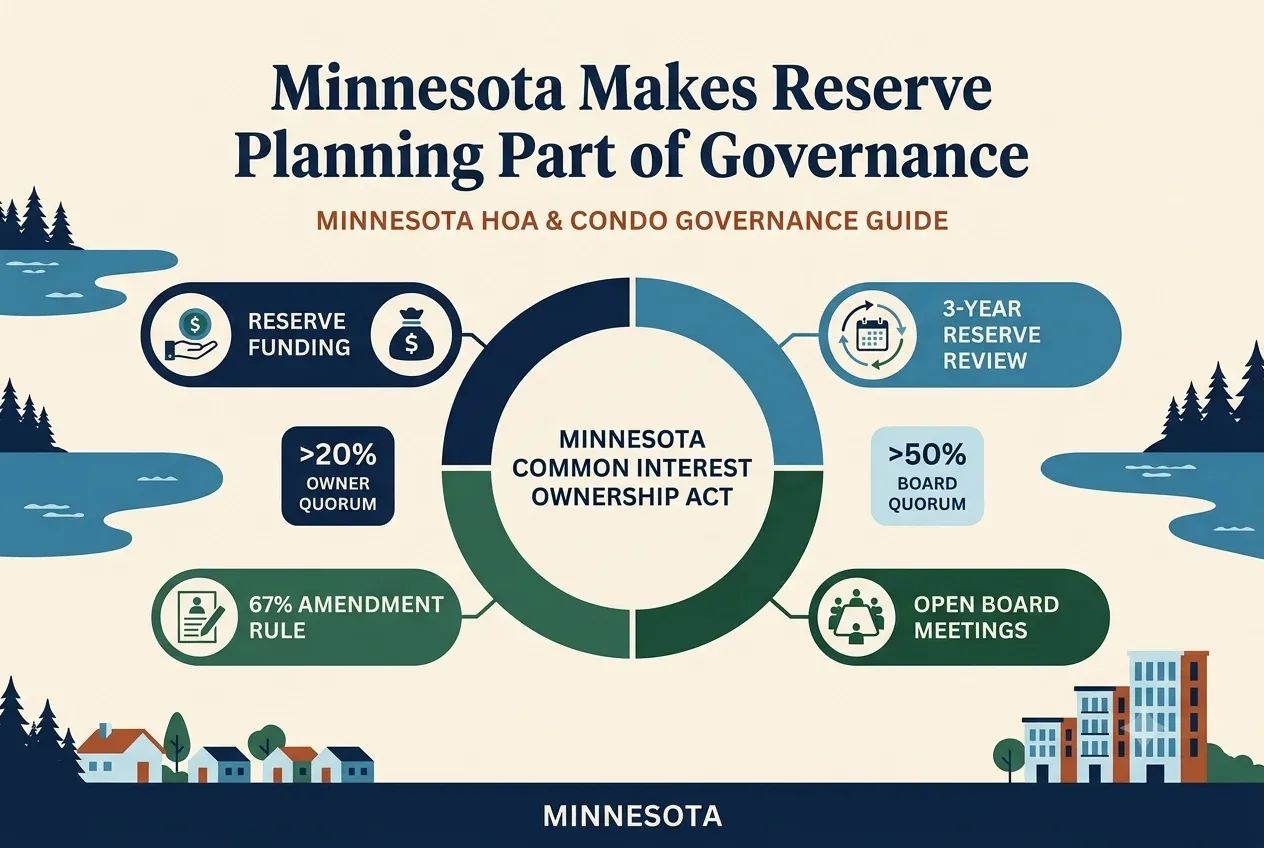
Minnesota’s MCIOA is unusually detailed: covered communities must budget replacement reserves, reevaluate reserve adequacy at least every three years, hold owner meetings with statutory notice windows, and generally keep board meetings open to owners. Default quorum is more than 20% for owner meetings and more than 50% for board meetings, while ordinary declaration amendments generally require 67% of association votes.
Which statute governs your association
Minnesota uses a common-interest-community framework rather than completely separate modern statutes for HOAs and condominiums. Minn. Stat. ch. 515B, the Minnesota Common Interest Ownership Act, governs condominiums, planned communities, and cooperatives within its scope, and generally applies to communities created on or after June 1, 1994. That makes Minnesota different from states where the board must switch between an HOA act and a separate condominium act for every issue.
Older condominiums require extra care. Chapter 515B contains transition rules for projects created under Chapters 515 and 515A, and some declarant rights in older Chapter 515A condominiums continue to be governed by the older law. Before applying a modern reserve, meeting, or amendment rule, identify the creation date and statute. If governing documents impose a stricter valid requirement than the statutory floor, follow the documents. Confirm the current statute text and any recent amendment before relying on this summary.
Sources: [1]
Reserve study and reserve funding
Minnesota requires more than a vague promise to save for the future. For fiscal years covered by Minn. Stat. § 515B.3-1141, the annual budget must include replacement reserves projected to be adequate, together with past and future contributions, to replace common-interest-community components the association is obligated to replace because of ordinary wear, tear, or obsolescence. Reserve money must be held separately from operating funds and generally may not be borrowed to cover operating expenses.
The statute also requires the association to reevaluate the adequacy of budgeted replacement reserves at least every third year. That is a statutory reserve-planning cycle, although the text does not say every community must hire a particular type of reserve-study professional. Certain components can be excluded and post-turnover owners can approve defined special-assessment funding treatment under the statute. Boards should distinguish that limited flexibility from a claim that Minnesota permits reserve funding to be ignored.
Sources: [2]
Insurance and fidelity bond
MCIOA requires the association, to the extent reasonably available, to maintain property insurance on covered common elements and specified planned-community property at not less than full insurable replacement cost, less deductibles, along with commercial general liability insurance. The detailed scope differs for common-element configurations and can be affected by the declaration. Boards should match the master insurance policy to the current statutory text rather than relying on an old certificate or generic HOA checklist.
Minnesota does not use one simple statewide fidelity bond formula in the same manner as some other states. Crime coverage, fidelity bond protection, and D&O insurance should therefore be evaluated separately from the property-insurance mandate and from any declaration or lender requirement. Because insurance provisions were among the sections touched by 2026 legislation, the board should confirm the effective session-law text before renewing coverage or publishing a numerical summary.
Open meetings, notice, and agenda
Minnesota generally requires board meetings to be open to unit owners. Under § 515B.3-103, the board should give reasonable notice of the date, time, and place when practicable, subject to statutory exceptions. Meetings may be closed for listed matters such as personnel, certain litigation or adversarial strategy, and qualifying criminal-activity privacy concerns. A closed portion is an executive session, not a license to move routine decisions out of owner view.
Owner meetings have clearer notice windows. Annual-meeting notice must be sent not less than 21 nor more than 30 days in advance, while special-meeting notice must be sent not less than seven nor more than 30 days in advance. The notice states the date, time, place, purposes, and proxy procedure if proxies are permitted. These numbers should be source-linked because they are statutory deadlines, and stricter valid governing-document procedures should also be honored.
Quorum and voting thresholds
Unless the bylaws provide otherwise, an owner-meeting quorum exists when owners entitled to cast in excess of 20% of association votes are present in person or by proxy at the beginning of the meeting. For the board, the default quorum is persons entitled to cast in excess of 50% of board votes. These are default rules, so the bylaws must still be checked before the secretary rejects a meeting or counts a vote.
For an ordinary declaration amendment, § 515B.2-118 generally requires votes or written consent from units allocated at least 67% of association votes, or a greater or otherwise permitted requirement in the declaration, with special rules for changes that alter fundamental unit or declarant rights. Proxy and alternative-voting procedures are separately regulated. A board should not apply the 67% number to every bylaw amendment, election, or special assessment without identifying the specific action first.
Records access and retention
MCIOA requires associations to keep adequate membership, owner-meeting, board-meeting, committee, contract, lease, operational correspondence, and financial records. With statutory exceptions, records must be made reasonably available for examination by a unit owner or authorized agent. The association must provide copies in paper or electronic form as requested, although it need not create an electronic version of a record it does not maintain electronically.
The statute also regulates copy charges: actual search, retrieval, copying, and transmission costs may be charged, or for 100 or fewer black-and-white letter or legal pages the association may use the statutory per-page alternative of no more than 25 cents. MCIOA does not reduce records retention to one universal “keep everything X years” rule in this section, so boards should pair statutory access with a category-based retention schedule for permanent documents, minutes, contracts, insurance, and financial files.
Sources: [1]
Budget and assessment disclosure
Minnesota requires an annual association meeting and an annual report that gives owners meaningful financial information. The report includes capital expenditures above the statutory threshold, total replacement reserves and the components they support, prior-year revenues and expenses, a balance sheet, litigation status, insurance information, and total past-due assessments. The annual budget and reserve process should therefore be treated as a board-governance system, not merely as a monthly dues calculation.
Assessment statutes differ depending on community creation date, but recurring common expenses are generally budget-driven and assessed under the declaration’s allocations. Boards should clearly disclose reserve contributions, operating costs, insurance, and any special assessment rather than blending them. Because §§ 515B.3-106 and 515B.3-115 were affected by 2026 legislation, use the current Revisor version plus the effective session law when preparing the final publication.
Limits on assessment and fee increases
Minnesota does not impose a general annual percentage cap on regular assessment increases for all common-interest communities. The board’s power comes from MCIOA, the declaration, and the budget process, while particular special assessments or reserve alternatives can trigger separate rules. Boards should not confuse reserve-approval percentages with a dues-increase ceiling. If the declaration sets a cap or requires owner approval above a threshold, that governing-document limit must be incorporated into the budget calendar.
Collection rules are detailed, including liens and notices, but a valid assessment still needs a valid budget and allocation basis. When costs rise sharply, the minutes should identify whether the increase is operating, reserve-related, insurance-driven, or a special assessment. That record helps demonstrate that the board followed fiduciary duty rather than simply choosing a percentage increase first and finding a justification later.
Fines and enforcement due process
Minnesota expressly conditions reasonable fines on notice and an opportunity to be heard before the board or an appointed committee. The current statute also requires detailed information in the notice for a fine or certain damage assessments, including the amount, reason, alleged violation, relevant governing-document provision, lien consequences, hearing right, and potential collection costs. This is a genuine due process rule, not merely a recommended courtesy letter.
Because fine and lien provisions were amended during the 2026 session, boards should use the current effective text rather than an older management template. The hearing record should show the evidence, the owner’s response, and the resolution actually adopted. A fine should not be posted to the ledger as final before the process is complete, and collection counsel should receive the same violation and hearing record the board relied on.
Sources
- Minnesota Common Interest Ownership Act, Chapter 515BOfficial Revisor full chapter; primary source for applicability, open boards, records, budgets, liens, and enforcement.
- Minn. Stat. § 515B.3-1141 — Replacement reservesOfficial reserve-funding and three-year reevaluation provision.
- Minn. Stat. § 515B.3-108 — MeetingsOfficial annual/special owner-meeting notice windows.
- Minn. Stat. § 515B.3-109 — QuorumsOfficial default owner and board quorum rules.
- Minn. Stat. § 515B.2-118 — Amendment of declarationOfficial 67% ordinary declaration-amendment rule and exceptions.
- Minnesota Laws 2026, Chapter 61Official 2026 session law affecting multiple MCIOA sections; confirm effective dates together with Chapter 82.
Compare nearby state rules
Check one decision against the statute
For a single board decision — a fine, a special assessment, a records request, an election, a CC&R amendment — the State Decision Lookup resolves the verified statutory rule for Minnesota and a growing set of other states, and the Board Decision Router lays out the research sequence. Both fail closed when the primary law is unclear rather than guessing.