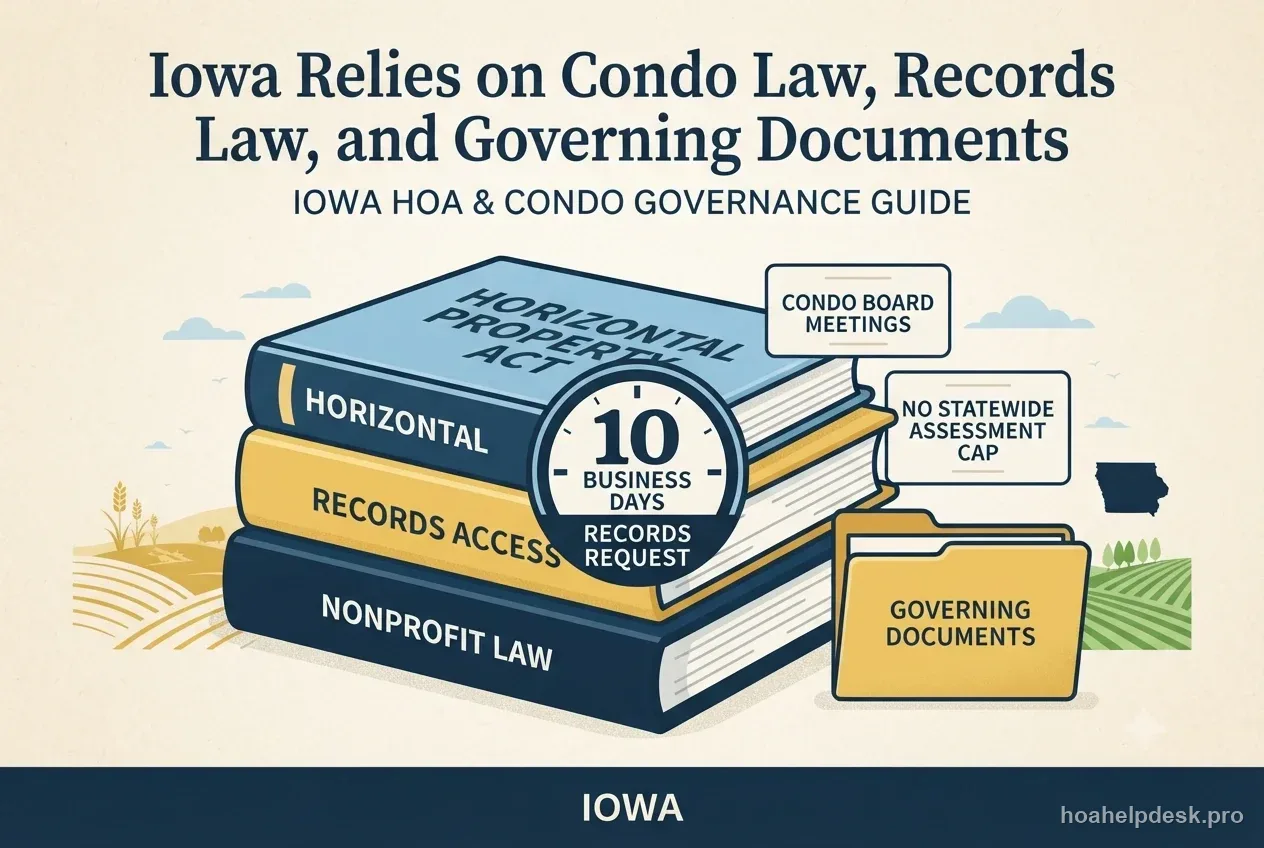
Iowa condominiums operate under Chapter 499B, while planned-community HOAs rely heavily on covenants, nonprofit law, and the newer Chapter 499C records statute. Condo board meetings require seven days' notice and are generally open. Covered associations must provide specified records within ten business days. Iowa does not impose one universal reserve-study cycle or annual assessment-increase cap.
Which statute governs your association
Iowa does not have one comprehensive modern HOA act covering every planned community. Condominiums are governed by Chapter 499B, the Horizontal Property Act. Planned communities and other owner associations may rely heavily on recorded covenants, bylaws, and—when incorporated as nonprofits—Chapter 504. Iowa also added Chapter 499C, a targeted records-access statute that applies to 'unit owners associations' and defines that term broadly enough to include planned communities, condominiums, and cooperatives within the chapter's scope.
That structure means an Iowa board may need three sources for one governance question: the declaration, the entity statute, and a targeted property statute. A condominium should not use a planned-community records policy without checking Chapter 499B, and an HOA should not assume every condominium rule applies to it. If the governing documents impose a stricter lawful procedure, follow that stricter requirement. Confirm the current statute text and any recent amendment before relying on this guide.
Reserve study and reserve funding
Iowa Chapter 499B does not impose a statewide periodic reserve-study cycle or a universal reserve-funding percentage on condominium associations. Chapter 499C is a records-access law, not a reserve mandate, and Iowa planned communities remain largely document-driven on reserve funding. Boards should therefore look to the declaration, bylaws, lender requirements, contracts, and the actual condition of common property when building a capital plan rather than claiming that Iowa law supplies a fixed study interval.
Statutory silence should not be confused with good financial practice. A condominium or HOA responsible for roofs, siding, private streets, drainage, or other long-lived assets may still need a reserve study to support responsible budgeting and explain future assessments. The board should distinguish a board-adopted reserve policy from a recorded requirement. If the declaration restricts how reserves may be spent or requires owner approval for borrowing, those limits should be shown directly in the reserve plan.
Insurance and fidelity bond
Iowa's researched condominium and association statutes do not create one statewide fidelity-bond formula or a detailed master-policy schedule for every HOA and condominium. The declaration, bylaws, mortgage requirements, contracts, and insurance policies therefore matter greatly. Condominium directors should still review Chapter 499B for association powers and common-element responsibility, while planned-community boards should start with the covenants describing what property the association owns, maintains, or must insure.
Boards should separately review property coverage, general liability, D&O insurance, and fidelity bond or crime coverage. They protect different risks. If a manager collects assessments or can transfer reserve money, directors should verify whether the association is an insured or loss payee under relevant crime coverage and whether policy limits reflect the cash actually at risk. A broker's annual presentation should identify policy changes and deductibles rather than simply report that coverage was renewed.
Open meetings, notice, and agenda
Iowa condominium boards have a clear statutory meeting rule. Section 499B.15 requires board meetings to be open to apartment owners except for privileged board-attorney communications concerning proposed or pending litigation. Notice of each board meeting must be mailed or delivered to each owner at least seven days before the meeting. The board must maintain minutes. A condominium board therefore should not use a nonprofit corporation's general meeting practice as a substitute for this more specific property-law requirement.
Planned-community HOAs do not receive the same comprehensive open-board-meeting framework from Chapter 499B because they are not condominiums. Their bylaws, covenants, Chapter 504 if applicable, and any targeted statute govern meeting procedure. For nonprofit member meetings, Chapter 504 supplies general notice standards, but those should not be confused with the seven-day condominium board rule. The secretary should label calendars and templates 'condo board,' 'member meeting,' or 'HOA' to avoid applying the wrong notice period.
Quorum and voting thresholds
Chapter 499B requires condominium bylaws to address the method of calling meetings, quorum, and voting, so the recorded documents carry much of the detail. Iowa does not impose one universal condominium CC&R-amendment percentage in the researched provisions; amendments to bylaws operate through the declaration-amendment framework and must be recorded as required by Chapter 499B. Boards should therefore identify the declaration's threshold and voting denominator instead of assuming a simple majority of those attending can amend the project documents.
For associations organized under Chapter 504, the nonprofit statute supplies default member-meeting rules when the articles, bylaws, or another statute do not control. The researched default quorum is ten percent of the votes entitled to be cast, and special limitations apply when less than one-third of voting power is present. That default should not override a condominium or HOA document that lawfully sets another threshold. Every election packet should state which legal source establishes quorum and the approval vote.
Records access and retention
Iowa's newer Chapter 499C gives owners a practical records-access right across covered unit owners associations. Upon a qualifying request from an owner or authorized agent, the association, its designee, or its management company must make listed records available within ten business days. The covered list includes organizational documents and amendments, bylaws, rules, recent owner-meeting minutes and financial reports, and recent executive-board meeting minutes and financial reports. Records may be provided on paper, electronically, or through a website.
Chapter 499C permits a reasonable production fee no greater than the estimated cost of producing and reproducing the records. Condominium boards also have Chapter 499B records duties, including maintaining meeting minutes and making official records available for inspection and copying at reasonable times and places. Chapter 504 adds corporate recordkeeping for nonprofits. A board should use the shortest applicable response deadline and should not require owners to know which chapter makes a requested record available.
Budget and assessment disclosure
Iowa's condominium statute leaves much of annual budget procedure to the bylaws and declaration rather than imposing a statewide budget-distribution calendar comparable to some other states. Planned-community HOAs are similarly document-driven, with Chapter 504 supplying general corporate rules when applicable. The board should therefore create a compliance table showing when the governing documents require the proposed budget, annual meeting, assessment notice, financial report, and any owner approval. A management company's standard calendar is not a substitute for the recorded documents.
Chapter 499C strengthens transparency after the fact by making recent financial reports and meeting materials available within its ten-business-day records framework. That access right does not itself authorize an assessment or create a percentage ceiling. The board still needs substantive authority in the declaration or condominium instruments to allocate common expenses. When a budget increases sharply, directors should explain which cost categories changed and whether the declaration requires an owner vote for the increase or a related special assessment.
Limits on assessment and fee increases
Iowa does not have a general statewide annual percentage cap on HOA or condominium assessment increases in the statutes researched for this guide. Authority and limits therefore depend heavily on the declaration, bylaws, budget powers, and the nature of the expense. A board should not infer unlimited authority from statutory silence. If the covenants cap regular assessments, require a membership vote above a threshold, or treat capital projects as special assessments, those provisions remain central to the decision.
For condominiums, unpaid common expenses can create statutory lien consequences under Chapter 499B, which makes accurate allocation and notice especially important. A fine for a rule violation should not automatically be categorized as a common expense merely to obtain stronger collection remedies. Before approving an increase, the treasurer should document the legal source of the charge, the allocation formula, the effective date, and any voting or notice requirement found in the governing documents.
Sources: [2]
Fines and enforcement due process
Iowa's statutes do not provide one statewide fine schedule or comprehensive HOA hearing code for every association. Enforcement authority therefore begins with the recorded declaration, bylaws, and rules, supplemented by entity law and any applicable property statute. A board should identify the exact restriction violated, confirm that the association has authority to impose the proposed sanction, give the notice and hearing opportunity required by the governing documents, and keep a written record of the final decision.
Condominium boards should also separate violation fines from common-expense assessments and statutory liens. Chapter 499B gives associations remedies for unpaid common expenses, but that does not mean every sanction has identical lien status. Consistency in enforcement matters, but so does individualized review when the documents require it. A defensible file should contain the rule in effect on the violation date, evidence, notices, owner submissions, minutes or hearing notes, and the board's stated basis for action.
Sources
- Iowa Code (2026) — official code portalOfficial Iowa Legislature code portal; primary source for current chapters and effective text.
- Iowa Code Chapter 499B — Horizontal PropertyOfficial 2026 Iowa Code chapter listing for condominiums.
- Iowa Code § 499B.15 — Bylaws, board meetings, notice, recordsOfficial Iowa Legislature section PDF; verify generated-PDF URL during assembly if the portal redirects.
- Iowa Code Chapter 499C — Unit Owners Associations: Access to RecordsOfficial 2026 chapter governing records access for unit owners associations, including planned communities and condominiums.
- Iowa Code Chapter 504 — Revised Iowa Nonprofit Corporation ActOfficial 2026 nonprofit-corporation statute, relevant to many incorporated associations.
Compare nearby state rules
Check one decision against the statute
For a single board decision — a fine, a special assessment, a records request, an election, a CC&R amendment — the State Decision Lookup resolves the verified statutory rule for Iowa and a growing set of other states, and the Board Decision Router lays out the research sequence. Both fail closed when the primary law is unclear rather than guessing.