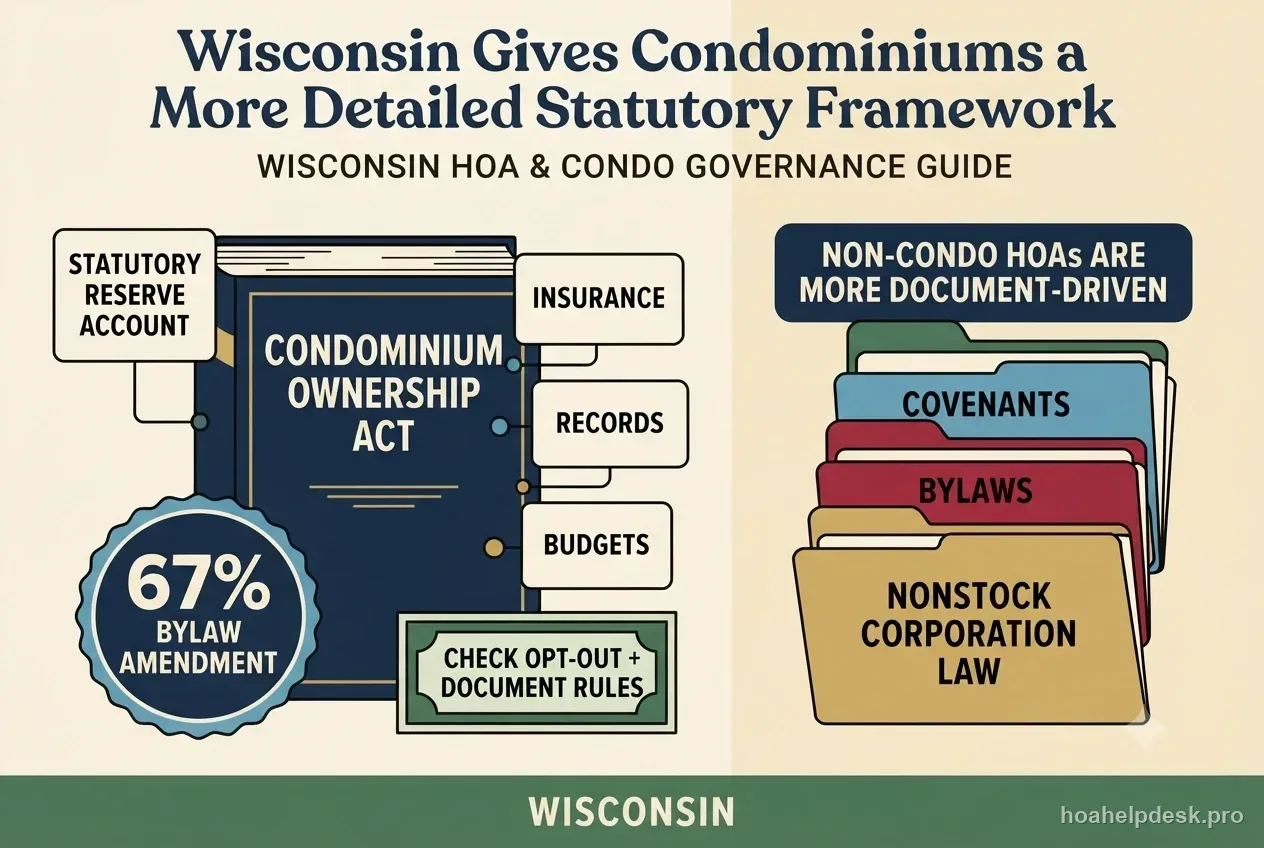
Wisconsin treats condominiums much more specifically than ordinary subdivision HOAs. Chapter 703 governs condominium budgets, statutory reserve accounts, insurance, records, and association powers, while many non-condominium HOAs depend heavily on covenants and nonstock-corporation law. Condominium bylaws generally may be amended with 67% of votes, records rules were expanded in recent years, and reserve obligations depend on the statutory reserve-account framework and any valid opt-out or document rule.
Which statute governs your association
Wisconsin’s Condominium Ownership Act in Chapter 703 is the primary statute for condominium associations. Non-condominium subdivision HOAs do not have an equivalent comprehensive modern HOA code, so their board authority often comes from recorded covenants, bylaws, deeds, and Chapter 181 if the association is organized as a nonstock corporation. A board must therefore first determine whether the property is legally a condominium rather than assuming all associations follow Chapter 703.
For condominiums, the declaration and bylaws remain crucial because Chapter 703 expressly uses those documents to allocate powers, common expenses, voting, and administration. For an ordinary HOA, the documents may do even more of the governance work. If the governing documents impose a stricter lawful requirement than a statutory default, follow the stricter rule. Confirm the current statute text and any recent amendment before relying on this guide.
Reserve study and reserve funding
Wisconsin condominiums have a statutory reserve-account framework in Chapter 703 rather than a universal statewide professional reserve-study cycle like Washington’s. Associations should review §703.163 to determine whether the statutory reserve account applies, whether an available statutory election or exception has been used, and how reserve contributions must be handled. The annual budget should distinguish current operating expenses from amounts set aside for future capital repair and replacement.
A board should not represent that Wisconsin law requires a reserve study every three or five years unless the condominium instruments or another applicable rule actually creates that cycle. Even without a mandated professional study, prudent directors should inventory major components, estimate remaining lives and replacement costs, and document the contribution methodology. For non-condominium HOAs, reserve obligations are even more likely to arise from covenants, lender expectations, and board fiduciary standards.
Sources: [1]
Insurance and fidelity bond
Wisconsin’s Condominium Ownership Act includes an association insurance section at §703.17. Condominium boards should verify current property and liability coverage requirements, the declaration’s allocation of responsibility, and how deductibles are assigned before renewing the master insurance policy. The board should also ensure that unit-owner insurance guidance does not contradict the association’s statutory and document-based responsibilities for common elements and building components.
For fidelity bond or crime coverage, boards should verify whether a numeric requirement comes from statute, the declaration, a management agreement, or lender standards rather than presenting an industry rule as Wisconsin law. Associations handling reserve balances should evaluate employee dishonesty and funds-transfer fraud even when the documents are silent. Non-condominium HOAs should separately read their covenants and corporate documents because Chapter 703’s condominium insurance rule does not automatically govern them.
Sources: [1]
Open meetings, notice, and agenda
Wisconsin Chapter 703 does not create the same comprehensive open-board-meeting code found in Washington or Virginia. Condominium bylaws therefore carry substantial weight in setting meeting procedures, officer duties, notice, and voting mechanics, while Chapter 181 may apply to a nonstock association. Boards should resist importing a four-day, seven-day, or fourteen-day notice period from another state simply because it sounds familiar.
Best practice is to publish a regular meeting schedule, distribute agendas in advance, preserve minutes, and use closed discussions only for legitimate confidential subjects. If the bylaws require a longer notice period or owner attendance rights, those provisions control unless unlawful. For non-condominium HOAs, directors should read both the corporate statute and governing documents before deciding whether remote meetings, written consents, or informal gatherings can be used for board action.
Quorum and voting thresholds
Wisconsin condominium voting starts with the declaration and bylaws, subject to Chapter 703. One important statutory rule is that condominium bylaws generally may be amended by the affirmative vote of unit owners having at least 67% of the votes, unless a lawful provision requires more. This percentage is an amendment threshold, not a universal quorum rule and not permission for the board to rewrite the declaration by itself.
Quorum, proxies, director elections, and owner voting should be checked in the bylaws and any applicable Chapter 181 provisions. A board should write the denominator beside every proposed threshold: all allocated votes, votes present, directors in office, or another defined group. That simple step prevents the common mistake of treating a meeting quorum as if it were the percentage needed to amend condominium instruments or approve a protected transaction.
Records access and retention
Wisconsin significantly expanded condominium recordkeeping rules in recent years. Section 703.20 requires detailed association records and gives owners inspection rights subject to statutory procedures and exclusions. Current law includes categories such as financial and operational records and establishes retention obligations for important association materials. Boards should use the current statute rather than an older summary that describes only a simple bookkeeping ledger.
A written request should be logged, reviewed for the statutory notice requirements, and screened for privileged, personnel, violation, payment, or other excluded material. Condominium associations should also note that Chapter 703 now supplies record rules that can displace portions of the general nonstock-corporation records regime. Non-condominium HOAs organized under Chapter 181 need to use that corporate statute and their documents instead of assuming §703.20 applies.
Budget and assessment disclosure
Wisconsin condominium associations have express authority to adopt budgets for revenues, expenditures, and reserves and to levy assessments for common expenses. Section 703.161 requires an annual budget. Boards should connect every assessment line to the declaration’s expense allocation and should show reserve contributions distinctly so owners can see what is being collected for current operations versus future replacement work.
The statute does not create a generic statewide owner-ratification process identical to Washington’s. The declaration and bylaws determine many approval and notice mechanics. A board considering an unusual special assessment should therefore inspect the instruments before voting and should document the common expense, allocation formula, notice, due dates, and any membership approval. Non-condominium HOAs are even more document-driven on budget and assessment authority.
Sources: [1]
Limits on assessment and fee increases
Wisconsin does not impose one statewide annual percentage cap for every condominium or HOA assessment increase. Condominium boards draw assessment authority from Chapter 703 and the recorded instruments, while ordinary HOAs often rely primarily on covenants and corporate authority. A declaration may impose caps, special-assessment voting thresholds, or procedural limits that are more restrictive than the statute.
When dues rise sharply, boards should show the budget driver rather than describe the increase as unlimited discretion. Insurance premiums, reserve contributions, utilities, structural work, and vendor contracts should be traceable to the adopted budget. Fines, late charges, interest, and collection costs are separate from ordinary common-expense assessments and should be authorized and accounted for separately under the documents and applicable law.
Fines and enforcement due process
Wisconsin condominium enforcement authority depends heavily on the declaration, bylaws, and properly adopted rules. The board should verify that the association has authority to impose the proposed sanction, deliver the notice required by the instruments, provide any promised opportunity to be heard, and preserve a written decision. A generic fine schedule copied from another association is not a substitute for authority in the condominium documents.
For non-condominium HOAs, the same caution is even stronger because no comprehensive HOA enforcement act supplies one uniform statewide process. Boards should distinguish covenant enforcement, monetary fines, assessment collection, and court remedies. Consistent treatment and documented procedures help support the business judgment of directors. Confirm current Wisconsin statute text and any document-specific fine limit before placing a charge on an owner ledger.
Sources
- Wisconsin Statutes Chapter 703 — CondominiumsPrimary official condominium statute portal; HTTP-check during assembly because the legislative site can time out.
- Wisconsin Statutes Chapter 181 — Nonstock CorporationsOfficial corporate-law portal for many non-condominium associations; HTTP-check during assembly.
- Wis. Stat. § 703.20 — association recordsOfficial section path should be verified against current Wisconsin site routing.
- Wis. Stat. § 703.163 — statutory reserve accountOfficial section path; verify URL and current exceptions before publication.
- Wis. Stat. § 703.17 — insuranceOfficial section path; verify current text.
Compare nearby state rules
Check one decision against the statute
For a single board decision — a fine, a special assessment, a records request, an election, a CC&R amendment — the State Decision Lookup resolves the verified statutory rule for Wisconsin and a growing set of other states, and the Board Decision Router lays out the research sequence. Both fail closed when the primary law is unclear rather than guessing.