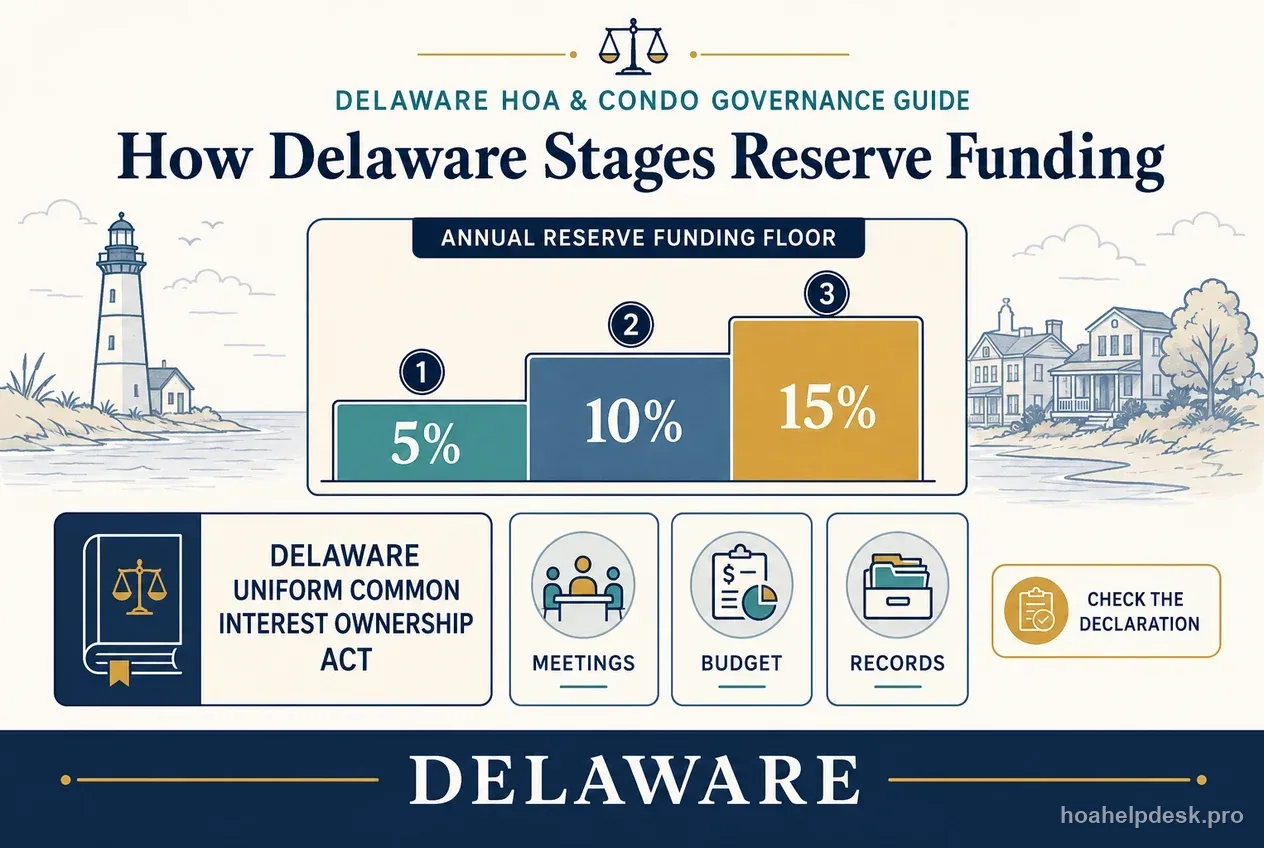
Delaware’s DUCIOA is unusually specific about condominium and cooperative reserves: a reserve study is defined as being performed or updated within 5 years, and minimum annual reserve contributions can be 5%, 10%, or 15% depending on the systems the board maintains. DUCIOA also requires quarterly board meetings, 10-to-60-day meeting notice, fidelity insurance, and five days’ written notice for records inspection.
Which statute governs your association
Delaware uses DUCIOA as the modern umbrella statute for condominiums, cooperatives, and planned communities created after its September 30, 2009 effective date, subject to statutory exceptions. That means a planned-community board and a condominium board often start in the same Chapter 81, but the reserve provisions are not always identical because some requirements expressly apply to condominiums and cooperatives rather than every planned community.
Older condominiums require an applicability check. The Unit Property Act, Chapter 22, still exists, and DUCIOA Section 81-119 determines which newer provisions supersede or apply to preexisting communities. Do not assume the recording date is irrelevant. If the declaration or code of regulations requires stricter notice, voting, or reserve procedures, follow those governing documents unless DUCIOA makes its rule mandatory. Confirm the current statute text and any recent amendment before relying on this guide.
Reserve study and reserve funding
Delaware is one of the states where “reserve study” and “reserve funding” should not be collapsed into a generic best-practice paragraph. DUCIOA defines a reserve study for a condominium or cooperative as an analysis performed or updated within the last 5 years by qualified independent professionals. The study estimates remaining useful life and replacement cost and is meant to inform the amount needed for a fully funded repair and replacement reserve.
The funding rule is also concrete. For condominiums and cooperatives, the annual budget must include a reserve contribution sufficient to achieve or maintain the study’s funding level. If the board maintains four or more listed component groups, the minimum annual budget percentage assigned to reserves is 15%; for three groups it is 10%; for two or fewer it is 5%. The statute also supplies these minimums when the association lacks a current study.
Sources: [1]
Insurance and fidelity bond
DUCIOA requires association property insurance, to the extent reasonably available, on common elements and certain planned-community property. The total amount after deductibles must be at least 80% of the actual cash value of the insured property, excluding the statutory categories such as land and foundations. The association must also maintain liability insurance and fidelity insurance. Unlike the reserve rule, the fidelity subsection does not state a simple dollar formula in the text of Section 81-313.
Insurance allocation can differ in older Unit Property Act condominiums, where the declaration and code of regulations remain important. For a modern DUCIOA community, the board should still reconcile the master insurance policy with the declaration, deductibles, unit boundaries, and maintenance responsibilities. Fidelity coverage protects association money; it is not the same as D&O insurance, property insurance, or a crime endorsement whose limits happen to be convenient for the manager.
Open meetings, notice, and agenda
DUCIOA requires an annual unit-owner meeting and permits special meetings under the statute. Except for emergencies, notice of a unit-owner meeting generally must be given 10 to 60 days before the meeting and must state the time, place, and agenda. Executive-board meetings must be held at least quarterly, and the modern board-meeting statute generally uses a 10-to-60-day notice framework unless a schedule has been properly distributed or an emergency exception applies.
Owners are entitled to the transparency structure in the statute, while executive session is reserved for specified confidential subjects. Older Chapter 22 condominiums have their own meeting-notice provision, including a seven-day posting route or a fourteen-day mailing route. That is why a pre-2009 condominium should not simply copy a DUCIOA notice template. Identify which statute governs first, then keep notice, agenda, meeting minutes, and executive-session basis in the same meeting file.
Quorum and voting thresholds
For a modern DUCIOA community, the declaration-amendment default is at least 67% of allocated association votes unless the declaration sets another lawful percentage. Special amendments involving unit boundaries, allocated interests, or similarly fundamental rights can require different approval. The board should calculate the threshold using total allocated votes and should not describe 67% of members present at a meeting as equivalent to 67% of association votes.
Quorum, proxies, ballots, and board-election procedures should be checked in Chapter 81 and the governing documents. Older Unit Property Act communities may have different code-of-regulations provisions. Before any consequential vote, prepare a voting memo stating the governing statute, declaration section, total eligible votes, quorum, permissible proxy or ballot method, approval threshold, and final tally. That memo is particularly valuable when a lender or title company later asks whether an amendment was validly adopted.
Records access and retention
DUCIOA requires detailed association records, including receipts and expenditures, meeting minutes, member information, governing documents, recent financial statements and tax returns, and—when applicable—the condominium or cooperative’s most recent reserve study. An owner’s inspection right generally may be exercised on five days’ written notice that reasonably identifies the purpose and the specific records requested, subject to statutory exclusions.
Excluded material can include personnel records, privileged attorney communications, pending litigation material, executive-session records, and individual owner files other than the requester’s. The association may charge no more than actual materials and labor costs for permitted production. Boards should maintain a records-retention schedule longer than the minimum where litigation, warranties, capital projects, tax obligations, or insurance claims justify it, and should keep the reserve study and funding history permanently accessible to future boards.
Sources: [1]
Budget and assessment disclosure
DUCIOA requires a board-adopted annual budget and uses owner ratification rather than requiring an affirmative membership vote for every budget. Within 30 days after adoption, the association must provide a budget summary that includes reserves, then set a ratification meeting 14 to 60 days later. Unless the required owner majority rejects the budget, the budget is ratified. Condominium and cooperative budgets must also carry the required repair-and-replacement reserve line item.
That structure makes the budget packet a governance document, not merely an accounting spreadsheet. Show the operating budget, reserve contribution, current reserve-study recommendation, insurance, debt, known capital work, and the assessment effect by unit or allocation class. If the declaration requires a stricter vote or additional disclosure, follow it. For a large capital project, explain whether the annual reserve contribution, a special assessment, or borrowing is being used and why.
Sources: [1]
Limits on assessment and fee increases
Delaware does not impose a simple across-the-board annual percentage cap on regular assessments. For a condominium or cooperative, however, the statutory reserve contribution can create a real budget floor because the association cannot simply set reserves to zero when Chapter 81 requires a minimum contribution. Planned communities should not assume those condominium/cooperative reserve percentages apply to them unless the statute or governing documents make them applicable.
For any special assessment, first identify the common expense being funded and the declaration’s allocation formula. The board should disclose whether the project was anticipated in the reserve study, whether a current reserve shortfall exists, and whether the owners have any ratification or voting right under the statute or declaration. “No percentage cap” is therefore not the same thing as unlimited discretion; valid budgeting, allocation, notice, and governing-document authority still matter.
Sources: [1]
Fines and enforcement due process
DUCIOA authorizes reasonable fines for violations after notice and an opportunity to be heard. A fine should therefore begin with a rule or declaration provision, evidence of the alleged violation, and a clear notice—not with an unexplained ledger entry. The board should give the owner the required opportunity to respond, record the decision, and apply the same enforcement standard to comparable owners.
Chapter 81 also gives the association a statutory lien for assessments and can make certain fines and charges enforceable through that framework, which is precisely why procedural discipline matters. Before collection escalates, confirm the amount, authority, notice, hearing record, and any statutory collection limits. The Ombudsperson can provide general explanations and dispute-resolution services, but it does not replace the board’s duty to follow the declaration and statute in the first instance.
Sources
- Delaware Code — Title 25, Chapter 81, DUCIOAOfficial Delaware Code for modern common interest communities.
- Delaware Code — Title 25, Chapter 22, Unit Property ActOfficial older condominium statute; subject to DUCIOA supersession rules.
- Delaware DOJ — Office of the Ombudsperson for the Common Interest CommunityOfficial state ombudsperson information and dispute-resolution resources.
- Delaware Code — DUCIOA Part 3, Management of the Common Interest CommunityOfficial sections for insurance, reserves, assessments, budgets, records and board powers.
- Delaware Code — DUCIOA Part 1, applicability and definitionsOfficial effective-date, preexisting-community and reserve-study definitions.
Compare nearby state rules
Check one decision against the statute
For a single board decision — a fine, a special assessment, a records request, an election, a CC&R amendment — the State Decision Lookup resolves the verified statutory rule for Delaware and a growing set of other states, and the Board Decision Router lays out the research sequence. Both fail closed when the primary law is unclear rather than guessing.