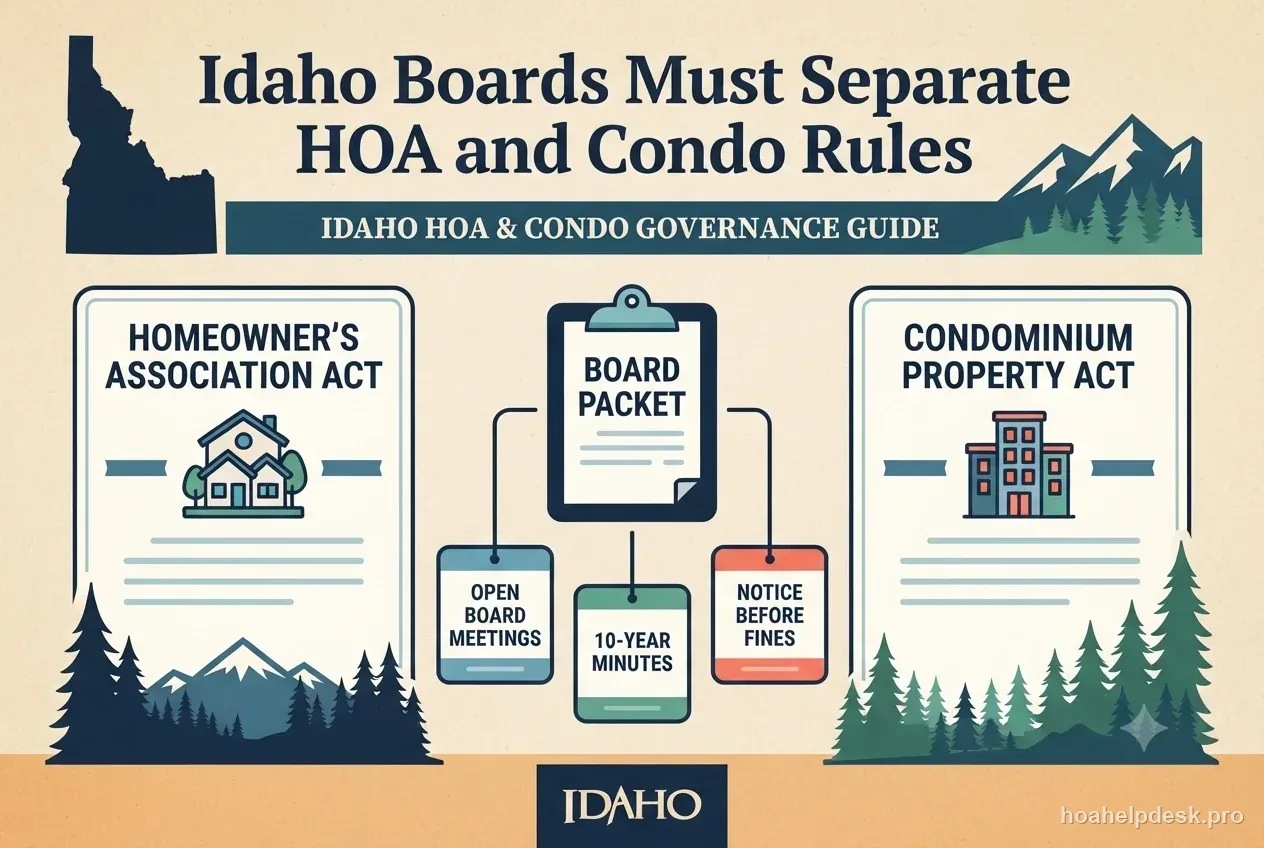
Idaho's HOA Act focuses on meetings, disclosures, records, and fines rather than a broad reserve or insurance code. HOA board meetings are generally open, minutes have a ten-year retention rule, and the fine process includes advance notice and a board vote. Condominium governance sits in a separate older statute, so boards should not apply HOA Act procedures automatically to condos.
Which statute governs your association
Idaho uses separate statutory tracks. Most homeowners associations fall under the Homeowner's Association Act in Idaho Code Title 55, Chapter 32, while condominiums are governed by the Condominium Property Act in Title 55, Chapter 15. The HOA Act is relatively targeted: it regulates meetings, disclosures, fines, and selected governance practices without replacing the declaration and bylaws. Corporate associations may also need to consult Idaho's nonprofit-corporation law for director and organizational rules not displaced by the property statute.
The board should verify that the HOA Act applies to the association and then check any effective-date or formation-date limitation on the specific section being used. Several newer Idaho provisions distinguish newer associations or post-declarant periods. If the CC&Rs or bylaws require a stricter process than the statute, follow the stricter governing-document requirement unless the statute says otherwise. Confirm the current statute text and any recent amendment before relying on this guide.
Reserve study and reserve funding
Idaho's HOA Act does not establish a statewide reserve-study cycle or a general mandatory reserve-funding percentage for ordinary HOAs. The Condominium Property Act likewise does not supply a modern, across-the-board reserve-study schedule comparable to states with dedicated reserve statutes. Boards therefore need to start with the declaration, bylaws, adopted budget policies, lender requirements, and the physical condition of common assets. A reserve study can still be important governance evidence even when the statute does not mandate one on a fixed cycle.
The practical board distinction is between authority and prudence. A statute may be silent on a mandatory study while the governing documents still require reserves, or while the board's fiduciary duty makes long-range capital planning sensible. Directors should avoid saying 'Idaho does not require reserves, so we do not need them.' The more accurate statement is that the researched HOA and condo statutes do not create one universal statewide reserve-study and funding formula for every association.
Insurance and fidelity bond
Idaho's HOA Act does not set a universal fidelity-bond formula or one statewide master-policy limit for all planned communities. Insurance obligations are therefore commonly driven by the declaration, contracts, lender requirements, the type of common property owned, and the board's risk analysis. Condominium boards should separately check Title 55, Chapter 15 and their declaration for property and liability requirements rather than assuming an HOA policy structure will satisfy condominium obligations.
For financial controls, a board should distinguish insurance that protects buildings and common property from D&O insurance and from fidelity bond or crime coverage that responds to theft or misuse of association funds. Even where no statutory dollar formula applies, boards handling substantial operating cash or reserves should document why their limits, deductibles, authorized signers, and management-company coverage are adequate. The board minutes should record the review without publishing sensitive banking details.
Open meetings, notice, and agenda
Idaho Code § 55-3204 requires HOA board meetings to be open to members, subject to authorized executive session topics. The researched text permits closed discussion for subjects such as personnel, contract negotiations or bids, confidential records, attorney advice, litigation or alternative dispute resolution, and certain sensitive member matters. The HOA must also hold an annual membership meeting. These rules make 'informal' board gatherings risky when directors are actually conducting association business.
The HOA Act does not convert every owner conversation into a meeting, and boards should read the statutory definitions and their bylaws before setting a notice policy. Minutes matter: the researched § 55-3204 text requires meeting minutes to be preserved for at least ten years. Condominium boards should not automatically use the HOA Act's open-meeting rules; Title 55, Chapter 15 and the condominium bylaws control the condominium framework.
Quorum and voting thresholds
Idaho voting rules are unusually sensitive to association type and formation status. For an unincorporated HOA, § 55-3204 contains bylaw requirements and ties increases in fees or assessments to a majority vote of all members. That language should not be generalized to every incorporated HOA without checking the statute's scope. The declaration and bylaws ordinarily establish membership quorum, director-election mechanics, and amendment thresholds unless a specific statute overrides them.
Newer Idaho law also changed governance for certain HOAs formed after July 1, 2025. House Bill 361 created post-declarant provisions addressing owner representation, turnover, board composition, and proxy concentration. Because those provisions are formation- and phase-dependent, a mature association should not copy them into its election rules without confirming applicability. For any contested proxy or CC&R amendment, the board should cite the exact governing clause and current statute before counting ballots.
Records access and retention
Idaho's HOA Act provides concrete financial-disclosure and record duties. The researched § 55-3205 text requires an association to provide an assessment-account statement within five business days after a written request, make annual fee disclosures by January 1, provide an updated financial disclosure within ten business days after request, and provide a reconciled fiscal-year financial disclosure within sixty days after the fiscal year closes. Those numbers should be built into the association's records calendar rather than handled ad hoc.
Section 55-3204 also requires HOA meeting minutes to be preserved for at least ten years. Other corporate records may be governed by Idaho nonprofit-corporation law and the association's own retention schedule. Condominium owners should use the condominium statute and bylaws instead of assuming every HOA Act deadline applies. A good records policy labels the legal source for each retention period so a manager can tell statutory rules from board-created convenience rules.
Budget and assessment disclosure
Idaho does not impose a single statewide budget template on every HOA, but § 55-3205 creates annual fee and financial-disclosure obligations that make surprise charges harder to justify. The researched text requires disclosure by January 1 of fees that may be charged during the calendar year and states that the association may not exceed the disclosed amount for that year. Boards should confirm the current wording and any exceptions before treating that provision as a mechanical cap on every type of assessment.
For condominiums, budget authority remains much more document-driven under the older Condominium Property Act. Directors should map each recurring charge, special assessment, reserve contribution, transfer fee, and enforcement fee to a statute or governing-document source. That exercise is especially important when a management contract uses fee labels that do not appear in the declaration. A board cannot create new assessment authority merely by adding a line item to the annual budget.
Limits on assessment and fee increases
Idaho should not be described as having one universal percentage cap on annual HOA assessments. The HOA Act regulates disclosures and contains special voting rules for some associations, including unincorporated HOAs, but those provisions are not a substitute for reading the association's legal form and CC&Rs. A proposed special assessment should be tested against the declaration's purpose, amount, and voting provisions rather than presented as permissible simply because state law contains no broad percentage ceiling.
Directors should also separate a fee disclosed under § 55-3205 from a regular assessment established under the covenants and from a fine imposed for a violation. Those categories can have different authority and procedure. When owners challenge an increase, the treasurer's response should identify the exact budget line, governing-document provision, vote if required, and effective-date notice. That is more defensible than citing the Homeowner's Association Act as though it authorizes every charge.
Fines and enforcement due process
Idaho provides an unusually concrete HOA fine procedure in § 55-3206. The researched text requires clear fine authority in the CC&Rs, a majority board vote, and written notice at least thirty days before the meeting at which the board will vote on the fine. Notice must be personally served or sent by certified mail. If the owner begins resolving the violation before the meeting and continues in good faith, the statute restricts the association's ability to impose the fine.
That procedure should not be diluted into a generic violation letter. The board's file should preserve the covenant cited, proof of service, the scheduled meeting, evidence considered, and the vote. A fine is also different from an unpaid common assessment, so lien and collection rights should be analyzed separately. Because Idaho's HOA statute has been amended repeatedly in recent sessions, the exact current text of § 55-3206 should be checked on the official legislature portal before publication or enforcement.
Sources
- Idaho Code, Title 55, Chapter 32 — Homeowner’s Association ActOfficial Idaho Legislature statute portal; primary HOA act. Portal access should be rechecked during assembly because automated retrieval may be blocked.
- Idaho Code, Title 55, Chapter 15 — Condominium Property ActOfficial Idaho Legislature statute portal for condominiums.
- 2025 Idaho Code § 55-3204 — Meetings and governanceSecondary mirror used to inspect section text; verify against the official Idaho portal before publication.
- 2025 Idaho Code § 55-3205 — Financial disclosures and recordsSecondary mirror used for current-section research; official-text verification required.
- 2025 Idaho Code § 55-3206 — FinesSecondary mirror for fine procedure; recheck current official text and 2026 amendments.
- Idaho House Bill 361 (2025) — HOA governance changesOfficial Idaho Legislature bill page for post-declarant board and proxy changes applying to certain HOAs formed after July 1, 2025.
Compare nearby state rules
Check one decision against the statute
For a single board decision — a fine, a special assessment, a records request, an election, a CC&R amendment — the State Decision Lookup resolves the verified statutory rule for Idaho and a growing set of other states, and the Board Decision Router lays out the research sequence. Both fail closed when the primary law is unclear rather than guessing.