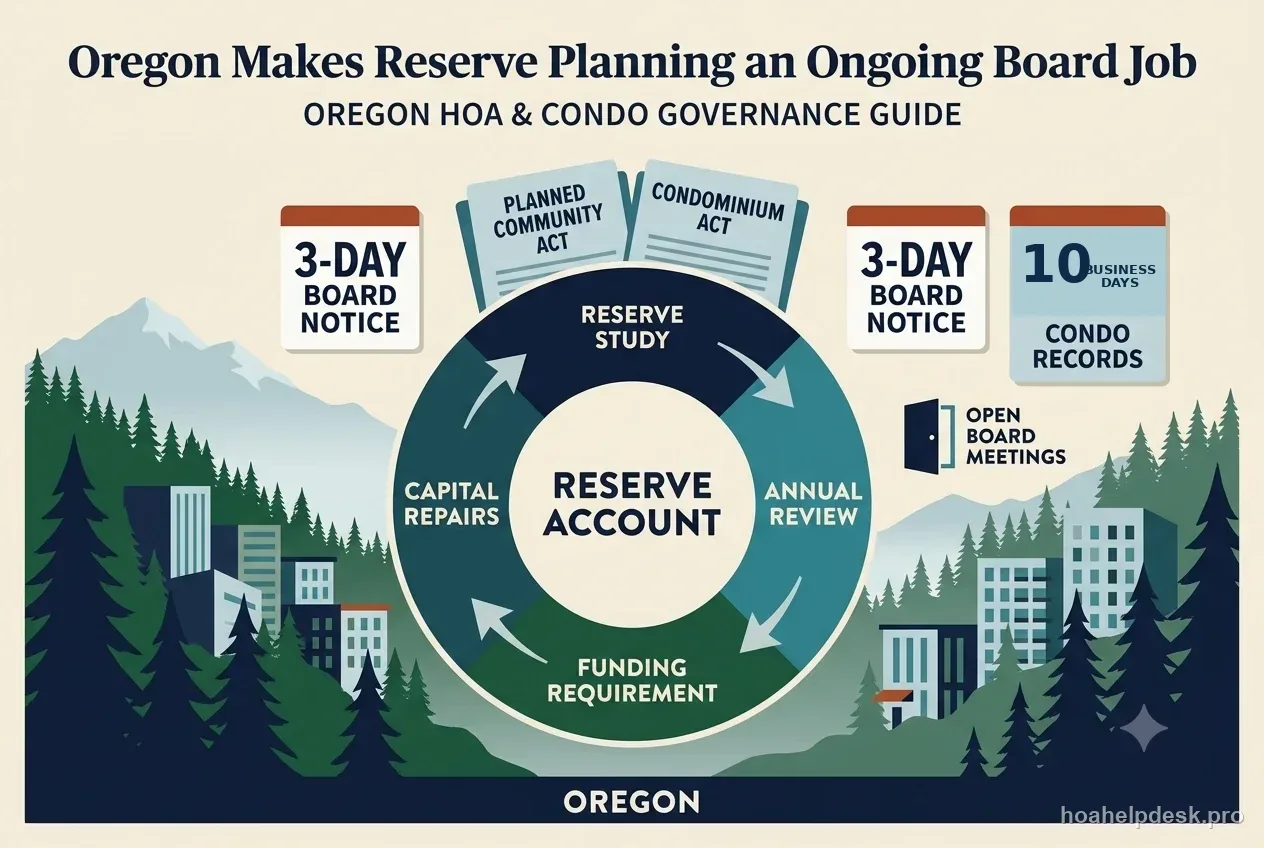
Oregon is unusually prescriptive about reserves. Covered planned communities and residential condominiums generally maintain reserve accounts, and boards annually determine reserve requirements through a reserve study or review/update. Board meetings are open to owners, with a three-day notice rule for many residential planned-community board meetings. Condo owner records requests also have a ten-business-day furnishing rule for specified maintained information.
Which statute governs your association
Oregon uses separate but parallel statutes. Planned communities are governed principally by ORS 94.550 through 94.783, while condominiums use ORS chapter 100. The planned-community act also contains Class I, Class II, and Class III distinctions and special transition rules for communities created before January 1, 2002. A board should identify both the community type and the date of creation before deciding which statutory provisions are mandatory.
The Oregon Condominium Act governs the condominium form of ownership and is administered in part through filings with the Oregon Real Estate Agency. Corporate law can supplement association governance, but the common-interest statutes control where they conflict. Governing documents may impose tighter operational rules, so the board should read the declaration and bylaws alongside the statute. Confirm the current statute text and any recent amendment before relying on this.
Reserve study and reserve funding
ORS 94.595 requires covered planned communities to establish a reserve account for major maintenance, repair, or replacement of qualifying common property and to make periodic payments into that account. The reserve framework generally covers components expected to require major work in more than one and less than thirty years. For Class I planned communities, the statute also requires a reserve study and maintenance plan, while older-community transition rules can change the exact application.
For condominiums, ORS 100.175 requires a reserve account and directs the board to determine reserve requirements annually by conducting a reserve study or reviewing and updating an existing study. The study identifies reserve items, remaining useful life, and estimated maintenance or replacement cost. This is a genuine statutory funding system, not merely a recommendation to obtain a study, so the annual budget should reconcile directly to the reserve analysis.
Insurance and fidelity bond
ORS 94.675 requires a planned-community board to maintain insurance for insurable common-property improvements against specified hazards and, when available at reasonable cost, to cover full replacement cost. The same statutory area addresses fidelity bond coverage, so a treasurer should not rely only on the declaration when setting crime coverage. Exact applicability can depend on the class and age of the planned community.
The condominium act also includes association insurance requirements and should be read together with the declaration’s allocation of maintenance responsibility. A practical annual insurance review should compare insured property, replacement-cost assumptions, deductibles, fidelity or crime coverage, D&O insurance, and any owner-policy obligations. If the governing documents demand broader coverage than the statutory minimum, the board should budget to the stricter standard.
Open meetings, notice, and agenda
Oregon planned-community law states that board meetings are open to owners. In a planned community where a majority of lots are principal residences, notice for a nonemergency board meeting generally must be posted on the property at least three days beforehand or delivered by another method reasonably calculated to inform owners, including qualifying electronic communication. The statute also recognizes executive sessions for limited subjects, so closure should be tied to a statutory purpose rather than convenience.
Condominium law similarly provides owner access to board meetings and supplies meeting procedures in chapter 100. Boards should distinguish member meetings, board meetings, emergency meetings, and executive sessions because their notice mechanics differ. Agenda discipline matters: if a governing document requires more notice or a more detailed agenda than the statute, use the stricter rule. Preserve meeting minutes and the basis for any executive session.
Quorum and voting thresholds
For condominium owner meetings, ORS 100.408 sets a default quorum of twenty percent of voting rights unless the bylaws specify a greater percentage. Planned-community quorum and voting provisions appear in ORS 94.655 and related sections, but older-community transition provisions can alter applicability. Do not assume the condo quorum automatically carries over to every planned community.
Oregon also has specific amendment rules. For certain older Class I or II planned communities that were not originally created under the current act and lack amendment procedures, a conforming amendment to governing documents other than bylaws can require at least seventy-five percent of owners, while a conforming bylaw amendment can use a majority. Because these are transition provisions, the safest board practice is to identify the document’s own amendment clause first.
Records access and retention
Oregon statutes require associations to keep a substantial set of governance and financial records. For condominiums, ORS 100.480 and related provisions require maintained information such as the current operating budget, annual financial statements, and reserve study, and ORS 100.480 provides a ten-business-day response rule for specified information after a written owner request. Planned communities have parallel recordkeeping and examination rules in ORS 94.670.
Boards should maintain a written retention schedule that separates permanent governance records from ordinary operational files. Declarations, amendments, bylaws, minutes, reserve studies, major contracts, insurance history, and capital-project records deserve long retention. Owner ledgers, bids, correspondence, and enforcement files should be retained consistently with statutory and litigation needs. Redact protected information rather than refusing access to an entire mixed record when only part is confidential.
Budget and assessment disclosure
Planned-community boards must adopt a budget at least annually, and ORS 94.645 requires the budget to include money allocated to the reserve account. Within thirty days after adopting the annual budget, the board must provide a budget summary to all owners. That creates a concrete board calendar: reserve analysis first, budget adoption second, owner summary third.
Condominium boards likewise adopt an annual budget, and ORS 100.483 requires reserve allocations required by ORS 100.175 to appear in that budget. The statute should be read with the declaration’s assessment-allocation formula. If owners have additional approval rights under the governing documents, those rights remain operationally important even when the board has statutory power to adopt the annual budget.
Limits on assessment and fee increases
Oregon’s statutes reviewed here do not impose a simple statewide percentage cap on annual assessment increases comparable to California’s well-known twenty-percent rule. Instead, the board’s authority flows from the statute, annual budget, reserve obligations, declaration, and bylaws. Reserve funding cannot simply be ignored when the statute requires it, which can make a budget increase necessary even without a separate fee-cap statute.
Before adopting a special assessment or a large annual increase, identify whether the declaration requires an owner vote, whether the charge is an operating assessment or reserve contribution, and how it must be allocated among lots or units. For older planned communities, transition provisions deserve special attention because some statutory sections apply only when they are consistent with the existing governing documents or after an election into specified provisions.
Fines and enforcement due process
Oregon associations have statutory enforcement powers, but a fine should still be anchored to a valid covenant, bylaw, or rule and imposed through the procedure required by the governing documents and applicable statute. Boards should give clear notice of the alleged violation, identify the rule, state the proposed consequence, and provide any hearing or opportunity to be heard required by law or documents before treating a fine as collectible.
A practical due-process file should contain the complaint or inspection record, photographs if relevant, prior notices, the applicable rule, hearing notice, board decision, and ledger entry. Avoid using a fine as a substitute for a special assessment or collection charge. If the association plans to lien or foreclose, verify the separate assessment-lien statute and notice sequence rather than assuming every enforcement charge receives the same lien treatment.
Sources
- Oregon Revised Statutes Chapter 94 — Planned CommunitiesOfficial Oregon Legislature text; includes reserve, meetings, budget, records, insurance, and transition provisions.
- Oregon Revised Statutes Chapter 100 — CondominiumsOfficial Oregon Legislature text; includes reserve account, quorum, records, budgets, and condominium governance.
- Oregon Real Estate Agency — Condominium Unit Owners AssociationsOfficial agency page explaining condominium association filing responsibilities.
- Oregon Real Estate Agency — Consumer InformationOfficial agency page stating HOA/condo disputes are outside its complaint jurisdiction.
Compare nearby state rules
Check one decision against the statute
For a single board decision — a fine, a special assessment, a records request, an election, a CC&R amendment — the State Decision Lookup resolves the verified statutory rule for Oregon and a growing set of other states, and the Board Decision Router lays out the research sequence. Both fail closed when the primary law is unclear rather than guessing.