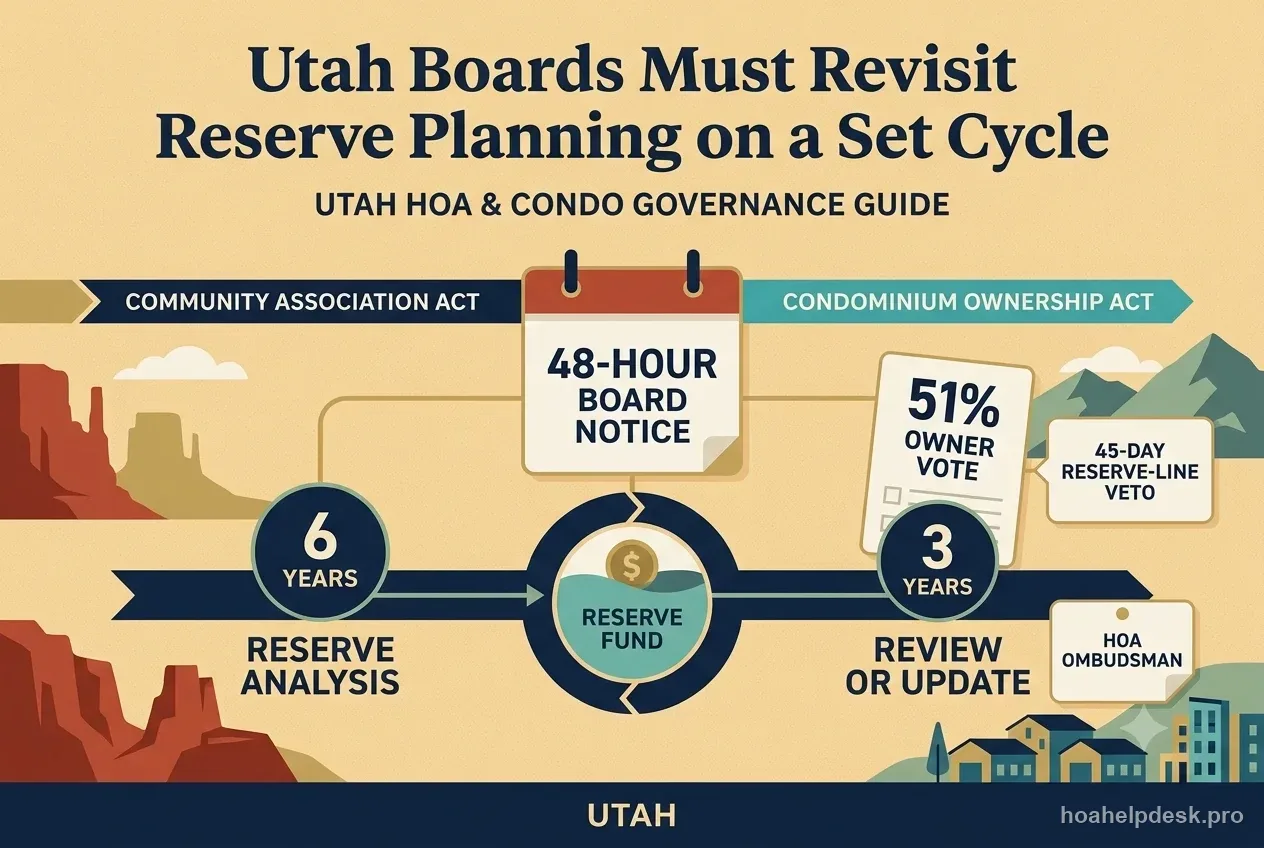
Utah regulates HOAs under Chapter 8a and condominiums under Chapter 8. Both regimes require a reserve analysis at least every six years and review or update at least every three years unless governing documents validly provide otherwise. Board meetings generally use a 48-hour owner-notice rule for owners who request notice. Owners also have a 45-day, 51%-vote mechanism to veto the reserve line item.
Which statute governs your association
Utah uses two parallel association statutes. Planned communities and many subdivision associations fall under the Community Association Act in Title 57, Chapter 8a, while condominiums use the Condominium Ownership Act in Chapter 8. The statutes contain many similar governance concepts but use different terminology—board and lot owner in Chapter 8a, management committee and unit owner in Chapter 8—so boards should cite the statute that actually matches the project.
Utah’s acts also contain applicability provisions that can extend selected requirements to associations created before later amendments. Do not assume a declaration date alone makes a current open-meeting or reserve rule irrelevant. If governing documents impose a stricter valid notice, voting, or funding procedure, follow that stricter requirement unless the statute makes its rule nonwaivable. Confirm the current statute text and any recent amendment before relying on this guide.
Reserve study and reserve funding
Utah’s reserve rule is more specific than many states. Under Section 57-8a-211, an HOA board must cause a reserve analysis to be conducted at least every six years and review and, if necessary, update it at least every three years, unless the governing documents provide otherwise. Condominium Section 57-8-7.5 uses the same six-year analysis and three-year review cycle, subject to its declaration-based exception.
Each regime also requires owners to receive a summary of the most recent reserve analysis or update and to receive the complete analysis on request. The annual budget must address a reserve fund line item under the statutory framework, but Utah does not simply prescribe one universal percent-funded target. Boards should distinguish the reserve study or analysis cycle from the annual funding decision and should document how the adopted line item relates to the current component forecast.
Insurance and fidelity bond
Utah’s association statutes contain property and liability insurance provisions that can require association-level coverage when reasonably available. For covered Chapter 8a associations, the current insurance part includes a full-replacement-cost concept for association-insured property, but exemptions and project configuration matter. Condo boards should use the parallel Chapter 8 insurance provisions rather than assuming every planned-community clause applies word for word.
Utah does not use one simple statewide fidelity bond formula that can be quoted safely for every association without checking the applicable insurance section and governing documents. A board should review crime coverage, employee dishonesty, handling of reserve funds, and D&O insurance with the declaration and current statute in hand. Where the declaration requires broader limits than the statutory baseline, the document requirement should be treated as part of the association’s risk plan.
Open meetings, notice, and agenda
Utah has a concrete open meeting rule for private community-association boards. Chapter 8a requires at least 48 hours’ written email notice of a board meeting to each lot owner who has requested meeting notice, unless the meeting is already on a previously supplied schedule or qualifies for the emergency exception. The notice states the time, date, location, and information needed for available electronic participation.
Board meetings are generally open to owners or their written representatives, with specified subjects permitted in a closed session, including legal advice and litigation, personnel matters, contract negotiations, privacy-sensitive matters, and certain delinquency or fine discussions. The condominium statute has a parallel management-committee open-meeting section. Boards should keep the agenda aligned with the notice and avoid using an executive session to hide final action that the statute requires in an open meeting.
Quorum and voting thresholds
Utah does not supply one universal owner quorum or amendment percentage that overrides every declaration in every HOA and condominium. Voting and quorum therefore require close reading of the declaration, bylaws, corporate statute, and the applicable Chapter 8 or 8a provision. Before a member meeting, the board should state whether quorum is measured by lots, allocated voting interests, persons present, or valid proxies and electronic ballots.
Amendment thresholds deserve the same care. A board should not import a 67% UCIOA rule from another state into Utah simply because the project looks similar. Identify the recorded amendment clause and then check whether Utah law restricts changing the particular provision. If the governing documents require a higher vote to amend the CC&Rs, that threshold controls unless the statute expressly supplies a different mandatory procedure.
Records access and retention
Utah Chapter 8a requires associations to keep and make specified records available to lot owners, including records identified through the nonprofit-corporation framework plus governing documents, recent approved minutes, recent budget and financial information, and the most recent reserve analysis. Protected information may be redacted or withheld under statutory exceptions. Condominium associations have parallel records obligations that should be checked in Chapter 8.
The statute should be the floor for the association’s records retention practice, not the entire filing system. Keep permanent governing documents and a clear archive of board and owner minutes, budgets, reserve analyses, insurance, contracts, tax filings, and owner-account material for the periods required by current law and business need. When an owner requests records, document the request date, any statutory response period, redactions, copying charges, and the exact records produced.
Budget and assessment disclosure
Utah ties reserve planning directly to the annual budget. Chapter 8a requires the association to provide owners with a summary of the most recent reserve analysis and to include a reserve fund line item. Within 45 days after adoption of the annual budget, lot owners may veto that reserve line item by a 51% vote of allocated voting interests at a special meeting. The condominium statute uses a parallel reserve framework.
Boards should make budget disclosure understandable by separating operating expenses, reserve contributions, debt service, and any special assessment. When the governing documents provide an owner vote on the budget or reserve line item, calendar that vote before invoices go out. If the board changes the reserve amount materially from the analysis recommendation, minutes should explain why so owners can distinguish a deliberate funding judgment from a missing or outdated reserve study.
Limits on assessment and fee increases
Utah does not impose a universal annual percentage cap on ordinary association assessment increases. The declaration and bylaws may therefore provide the controlling cap, owner vote, or budget procedure. Utah does, however, regulate certain charges. Current Chapter 8a provisions limit a late fee and interest structure, so boards should verify the exact current statutory formula before publishing a fee schedule or automatically carrying forward an older policy.
A special assessment should be analyzed separately from late charges and the annual budget. Determine whether the governing documents allow the board to levy it, whether owners must vote, how the amount is allocated, and whether the purpose belongs in reserves or ordinary expenses. A board cannot create extra assessment authority merely because there is no statewide annual dues-increase cap; the declaration remains a binding part of the authority analysis.
Sources: [1]
Fines and enforcement due process
Utah allows associations to enforce governing documents and adopt rules within statutory limits, but fines should follow the applicable Chapter 8 or 8a procedure and the association’s own notice requirements. Before imposing a fine, identify the valid rule, the board authority to levy the charge, the fee schedule, the notice delivered to the owner, and any opportunity to contest or cure the violation required by statute or documents.
Closed-session authority for discussions involving delinquent assessments or fines does not eliminate the need for lawful final action and a defensible record. Keep the violation notice, photographs or other evidence, owner response, hearing materials if a hearing is provided, and the board’s final decision. If governing documents offer more due process than state law, use the stricter procedure consistently rather than shortening it for convenience.
Sources: [1]
Sources
- Utah Legislature — Community Association Act, Title 57 Ch. 8aOfficial current chapter compilation; verify the displayed effective-date annotations and 2026 amendments section by section during assembly.
- Utah Legislature — Condominium Ownership Act, Title 57 Ch. 8Official current chapter compilation for condominium associations.
- Utah Code § 57-8a-211 — Reserve analysisOfficial section text showing the six-year reserve analysis and three-year review/update cycle; re-check against the current chapter compilation before publication.
- Utah Code § 57-8-7.5 — Condominium reserve analysisOfficial condominium section text with the parallel six-year/three-year reserve framework; verify no 2026 amendment changed the cycle.
- Utah Legislature — current Chapter 8 open-meeting compilationOfficial current source containing §57-8-57; use the current compilation rather than superseded standalone PDFs when publishing.
- Utah Department of Commerce — HOA Office and RegistryOfficial Office of the Homeowners’ Association Ombudsman portal for registration, education, advisory opinions, and HOA services; current registration system reflects 2025–2026 changes.
Compare nearby state rules
Check one decision against the statute
For a single board decision — a fine, a special assessment, a records request, an election, a CC&R amendment — the State Decision Lookup resolves the verified statutory rule for Utah and a growing set of other states, and the Board Decision Router lays out the research sequence. Both fail closed when the primary law is unclear rather than guessing.