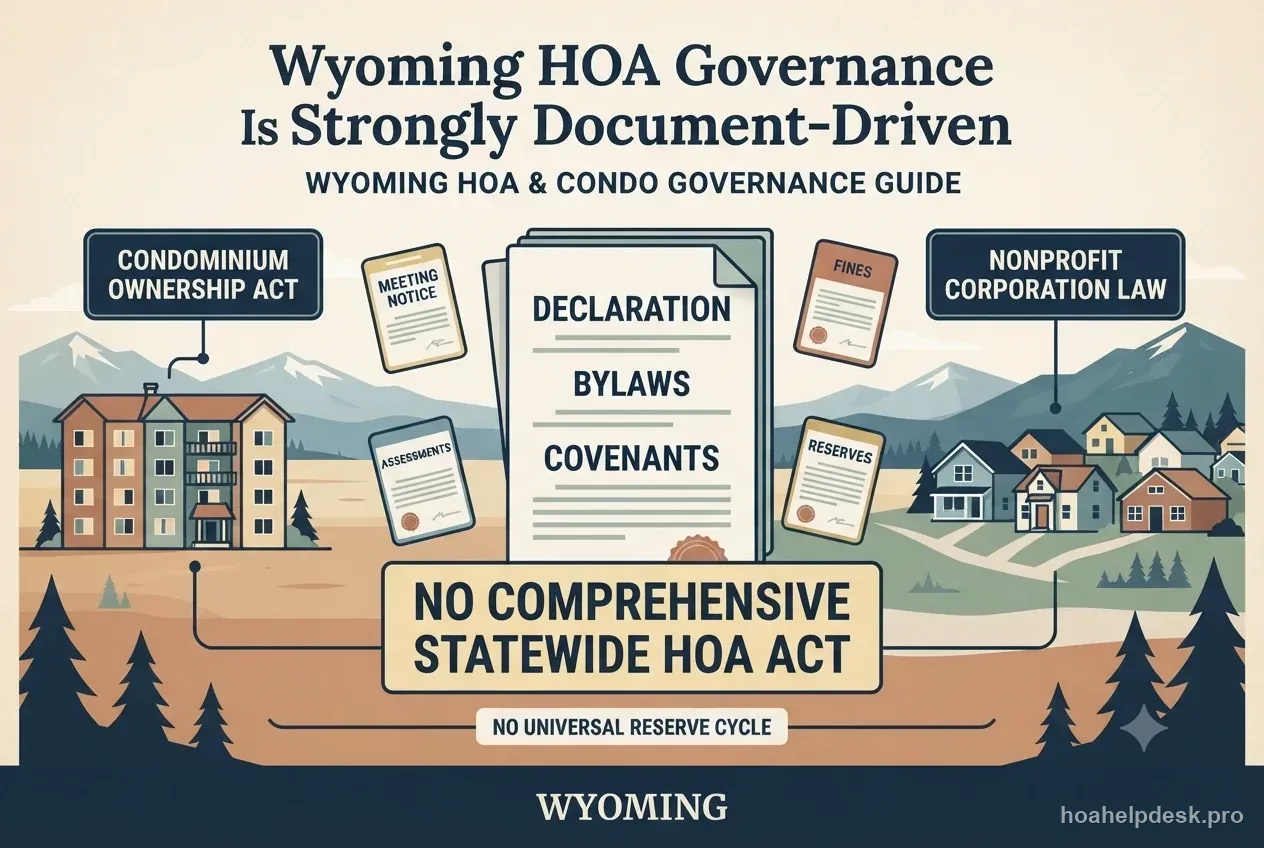
Wyoming is strongly document-driven. Condominiums are created under the Condominium Ownership Act, but ordinary subdivision HOAs do not have a comprehensive statewide governance code comparable to WUCIOA. Meeting notice, assessment limits, fines, and reserve practices often come from declarations and bylaws, with nonprofit-corporation law supplying corporate procedure when applicable. Boards should avoid inventing statewide caps or reserve cycles where the statutes are silent.
Which statute governs your association
Wyoming recognizes condominiums through the Condominium Ownership Act in Title 34, Chapter 20. The act defines units and common elements and depends heavily on the recorded declaration for the structure of ownership and administration. Ordinary subdivision HOAs do not have a single comprehensive Wyoming HOA statute. Their powers usually arise from recorded covenants, bylaws, deeds, and the corporate statute under which the association was formed.
If an HOA is organized as a nonprofit corporation, Title 17 corporate rules may govern meetings, records, director action, and member rights unless the governing documents or a more specific property statute controls. The practical first step is therefore document identification, not searching for an “HOA chapter” that does not exist. If governing documents impose stricter lawful requirements, follow them. Confirm the current statute text and any recent amendment before relying on this guide.
Reserve study and reserve funding
Wyoming does not impose a broadly applicable statewide professional reserve-study cycle on ordinary HOAs or condominiums comparable to Washington’s annual update or Virginia’s five-year study. Boards should therefore not advertise a statutory three-year or five-year schedule unless their declaration, bylaws, lender requirements, or another applicable law creates one. Reserve planning is primarily a governance and document issue.
A prudent board should nevertheless inventory roofs, paving, water systems, structures, amenities, and other major components; estimate remaining useful life and replacement cost; and adopt a contribution plan. Where documents authorize special assessments but do not require reserves, the board should still consider the financial shock of deferring all capital costs. Label a reserve study as a board best practice unless a verified legal source makes it mandatory for that community.
Insurance and fidelity bond
The Wyoming Condominium Ownership Act and declaration should be reviewed together to determine the association’s insurance obligations. Because the statute is older and comparatively compact, the recorded instruments may carry much of the detail about casualty coverage, rebuilding, common-element responsibility, and allocation of insurance proceeds. Non-condominium HOAs should look to their covenants, contracts, lender requirements, and general corporate powers.
Wyoming does not provide a single statewide fidelity-bond formula that should be quoted for every HOA. Associations holding significant cash should still evaluate crime coverage and funds-transfer controls based on exposure. The treasurer should document bank authority, reserve-account access, dual approvals, manager coverage, and cyber-fraud protections. Any numeric coverage statement should be sourced to the current statute, declaration, or policy requirement rather than industry custom.
Sources: [1]
Open meetings, notice, and agenda
Wyoming’s Condominium Ownership Act does not create a detailed open-board-meeting regime comparable to Virginia or Washington. For many associations, meeting notice, owner attendance, agendas, remote participation, and executive sessions are controlled mainly by the declaration, bylaws, and applicable nonprofit-corporation provisions. Boards should not import another state’s four-day or fourteen-day rule simply to fill the gap.
If the association is a nonprofit corporation, its directors should also review Title 17 for corporate meeting procedures and records of action. Good governance remains straightforward: publish regular meeting dates, circulate agendas, keep minutes, identify conflicts, and reserve closed discussion for legitimate confidential matters. When documents provide owners a right to attend or require a longer notice period, that stricter rule should be honored.
Sources: [2]
Quorum and voting thresholds
Wyoming condominium voting rights and common-element interests are rooted in the declaration, while bylaws and corporate rules address meeting mechanics. Ordinary HOAs are similarly document-driven. As a result, there is no responsible universal statement such as “all Wyoming HOAs use a 20% quorum” or “all amendments require 67%.” The controlling percentage must be read from the declaration, bylaws, and any applicable corporate statute.
Boards should distinguish quorum from approval threshold and record the denominator for every significant action. An amendment may require a percentage of all owners even though a much smaller number constitutes a meeting quorum. Proxy voting, written ballots, remote participation, director elections, and recalls should be handled exactly as authorized by the documents and corporate law. If a percentage is unclear, it should be verified before ballots are issued.
Records access and retention
Wyoming nonprofit-corporation law contains corporate recordkeeping provisions, including requirements to preserve minutes and accounting records. An association formed under that statute should maintain those corporate records in addition to property-specific materials required by its declaration. Condominium boards should also preserve declarations, plats, amendments, unit-owner information, budgets, invoices, insurance, assessments, contracts, and minutes needed to administer the common property.
The safest records policy is category-based rather than an unsupported claim that Wyoming requires every HOA record to be kept for a fixed number of years. Privileged legal advice, personnel information, owner account details, and enforcement files need controlled access. The management agreement should specify that the records belong to the association and must be transferred promptly when a manager or board administration changes.
Sources: [2]
Budget and assessment disclosure
Wyoming does not provide a uniform owner-ratification system for every HOA budget. Assessment and budget authority therefore depends heavily on the declaration and bylaws, with corporate procedure layered on top where the association is incorporated. Condominium documents should identify the allocation of common expenses and the association’s authority to collect them. Boards should not approve assessments first and look for authority afterward.
An adopted budget should separate operating costs, insurance, reserves, and expected capital work. If the declaration requires member approval above a threshold or for a special assessment, the board must follow that requirement. Notice should state the amount, purpose, allocation method, due dates, and vote if one is required. This document-driven approach is especially important in Wyoming because the statutes do not supply a comprehensive fallback HOA budget code.
Limits on assessment and fee increases
Wyoming does not impose a simple statewide percentage cap on annual HOA or condominium assessment increases. If a cap exists, it is likely to come from the declaration, bylaws, or a specific contractual restriction. A board should therefore avoid claiming that state law permits an unlimited increase just because no general cap is found; its own recorded documents may impose a meaningful limit or owner-vote requirement.
Before a large dues change or special assessment, the board should identify the covenant authority, confirm the allocation formula, review any reserve information, and comply with notice and voting requirements. Fines, late charges, interest, attorney fees, and ordinary common assessments should not be lumped into one category. Each charge needs a separate source of authority and an accounting trail showing why it was imposed.
Fines and enforcement due process
Wyoming has no comprehensive HOA fine-and-hearing statute that supplies one statewide process for every subdivision association. Enforcement therefore turns heavily on the covenants, bylaws, valid rules, and general contract and corporate principles. A board should confirm that the documents actually authorize fines before placing them on an owner ledger and should follow every required notice, cure, hearing, or appeal step.
Condominium boards should likewise distinguish document enforcement from assessment collection and property remedies under the Condominium Ownership Act. Consistency is important: the board should document the rule, evidence, owner notice, opportunity to respond, and final decision. If the documents are silent on a monetary sanction, the board should not invent one merely because another association uses a fine schedule. Confirm enforceability before collection or lien action.
Sources
- Wyoming Statutes Title 34 — Property, including Condominium Ownership ActPrimary official statute PDF; Chapter 20 contains the Condominium Ownership Act.
- Wyoming Statutes Title 17 — CorporationsOfficial corporate statute PDF; verify the nonprofit chapter applicable to the association entity.
- Wyoming Legislature statutes portalOfficial navigation portal; HTTP-check current path during assembly.
Compare nearby state rules
Check one decision against the statute
For a single board decision — a fine, a special assessment, a records request, an election, a CC&R amendment — the State Decision Lookup resolves the verified statutory rule for Wyoming and a growing set of other states, and the Board Decision Router lays out the research sequence. Both fail closed when the primary law is unclear rather than guessing.