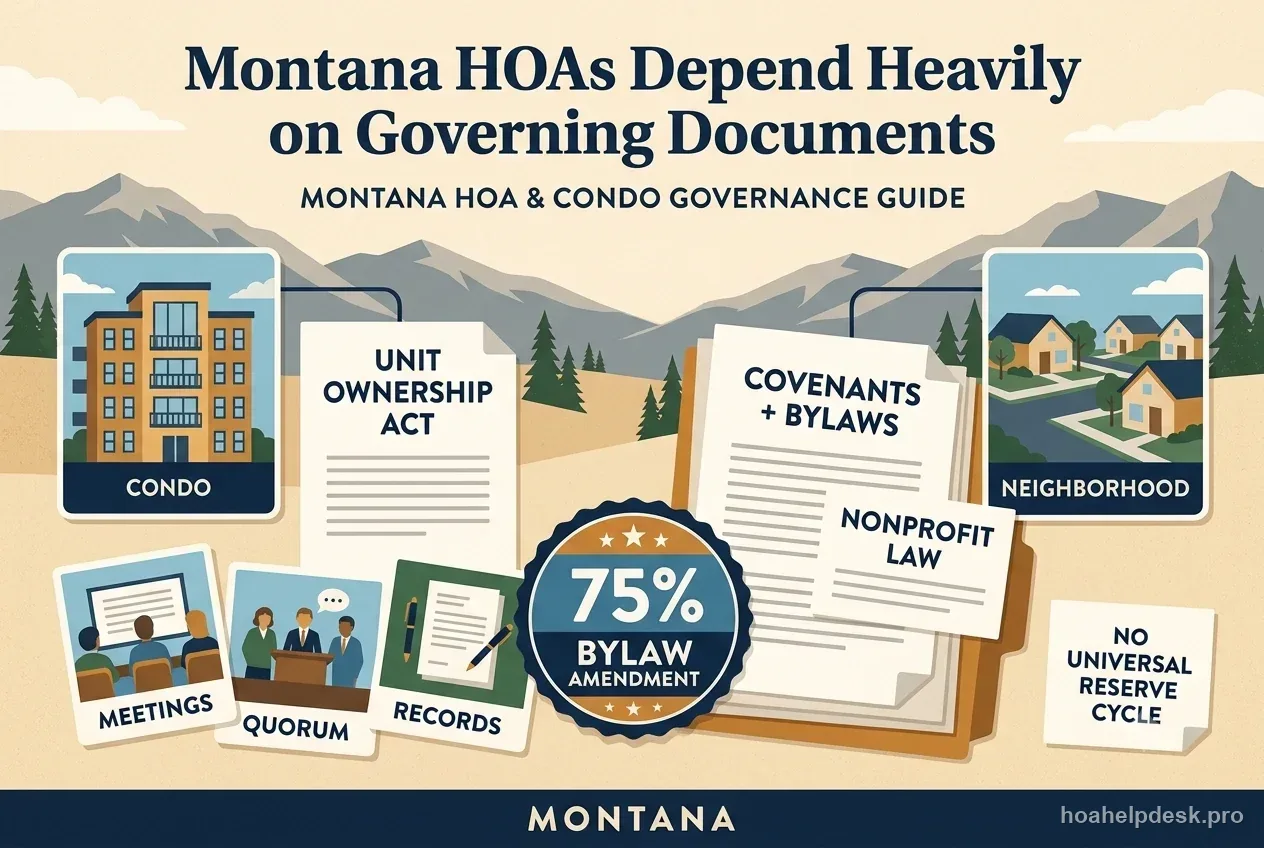
Montana does not use a comprehensive HOA governance act. Condominium boards follow the Unit Ownership Act, while many incorporated HOAs rely on nonprofit-corporation law plus their recorded covenants and bylaws. The condo statute requires bylaws to address meetings and quorum and requires 75% owner approval to amend bylaws. No statewide reserve-study cycle or annual assessment-increase cap applies generally.
Which statute governs your association
Montana boards should begin by classifying the community. A condominium submitted to Title 70, chapter 23 is governed by the Montana Unit Ownership Act, which regulates declarations, bylaws, common elements, association administration, and owner obligations. A conventional subdivision HOA is not automatically governed by that condominium act simply because it owns common property or collects assessments. Many incorporated HOAs instead operate under the Montana Nonprofit Corporation Act together with recorded covenants, articles, and bylaws.
That distinction changes which meeting, voting, and record rules apply. For condominiums, the declaration and recorded bylaws fill many details that the statute intentionally leaves project-specific. For nonprofit HOAs, corporate rules can supply annual-meeting and record-inspection procedures when the governing documents do not validly provide otherwise. If the CC&Rs or bylaws impose a stricter lawful requirement than the statutory floor, follow the documents. Confirm the current statute text and any recent amendment before relying on this summary.
Reserve study and reserve funding
Montana’s Unit Ownership Act does not prescribe a recurring professional reserve study or a statewide minimum reserve-funding percentage for every condominium. The bylaws must address maintenance, upkeep, repair, payment of common expenses, and assessment collection, but the statute does not turn those requirements into a five-year study cycle or a fixed funding formula. A board should therefore avoid describing Montana as a mandatory reserve-study state unless its own documents or another project-specific requirement says so.
Even without a statutory cycle, directors should inventory long-lived common components, estimate remaining useful life, and connect expected replacement costs to the budget. The declaration or bylaws may require reserves, limit use of reserve cash, or set owner-approval rules for major assessments. A reserve study can be a sensible governance tool, but boards should label it as a planning practice or document requirement rather than claiming the Montana statute mandates one statewide.
Insurance and fidelity bond
The Montana Unit Ownership Act does not impose one modern statewide master-policy formula or a universal fidelity bond amount comparable to statutes that tie coverage to several months of assessments plus reserves. The condominium bylaws and declaration therefore remain central to property, liability, deductible, and bonding requirements. Directors should also distinguish insurance protecting the common property from D&O insurance and crime or fidelity protection for association funds.
For a conventional HOA, the recorded documents and the board’s general fiduciary responsibilities usually drive coverage decisions because there is no comprehensive HOA insurance statute. The board should confirm who owns each common asset, which party must insure it, and whether the manager handles association money. If the declaration requires broader coverage than the statutory baseline, the association should follow the stronger requirement rather than assuming statutory silence eliminates the obligation.
Open meetings, notice, and agenda
Montana does not impose a condominium open-board-meeting law with one statewide advance-notice period. The Unit Ownership Act instead requires condominium bylaws to state the method of calling unit-owner meetings and the quorum percentage if it differs from the statutory majority definition. For incorporated HOAs, nonprofit-corporation law requires an annual membership meeting, but ordinary notice and meeting mechanics still depend heavily on the bylaws and applicable corporate provisions.
Montana expressly allows qualifying homeowners associations and associations of unit owners organized under the nonprofit act to conduct meetings remotely unless their articles or bylaws provide otherwise. That authority does not erase notice, quorum, agenda, or voting requirements in the governing documents. A board should separately document owner meetings, board meetings, emergency meetings, and any closed discussions rather than treating remote technology as a substitute for the association’s procedural rules.
Quorum and voting thresholds
For condominiums, the bylaws must state the percentage that constitutes a quorum if the association wants a number other than the majority definition used by the Unit Ownership Act. The same bylaws govern election and removal mechanics for directors. This makes the recorded condominium documents the first place to look before calling an annual meeting or declaring that a particular vote has passed.
A clear statutory threshold does apply to condominium bylaw amendments: an amendment is not effective unless approved by 75% of the unit owners and then recorded in the required form. That 75% rule should not be generalized to every declaration amendment or every HOA covenant change. Conventional HOA amendment thresholds usually come from the recorded CC&Rs and entity documents. Boards should count votes against the correct denominator and preserve proxies, ballots, consents, and recording evidence.
Records access and retention
Montana’s nonprofit-corporation statute supplies useful record rules for incorporated HOAs. A nonprofit must keep permanent minutes of member and board meetings, accounting records, and a membership record. It must also keep specified governance and financial materials available at its principal office or a location from which they can be recovered, including member-meeting minutes and financial statements for the past three years.
A member may inspect and copy specified corporate records after giving at least five business days’ written notice, subject to statutory purpose and confidentiality conditions for certain categories. Condominium boards should also follow any stronger access rights in their declaration or bylaws. A practical retention schedule should keep recorded declarations, amendments, plats, and key governance history permanently even where a shorter statutory production window applies to particular corporate records.
Budget and assessment disclosure
The Unit Ownership Act requires condominium bylaws to address common-element maintenance costs and the manner of collecting each owner’s share of common expenses, but it does not establish a statewide budget-ratification hearing like some UCIOA states. The board should therefore build the annual budget process from the recorded declaration and bylaws, identifying operating expenses, insurance, reserve contributions, and planned capital work separately.
For incorporated HOAs, corporate law may govern approval mechanics while the CC&Rs establish assessment authority and allocation. The board should not assume that authority to adopt a budget automatically authorizes every special assessment. If the documents require owner notice, a vote, or a cap before a special assessment is imposed, those requirements remain controlling. Minutes should show the basis for the assessment and the vote that authorized it.
Limits on assessment and fee increases
Montana does not impose a general statewide percentage cap on annual HOA or condominium assessment increases. For condominiums, assessment authority and collection procedure are largely structured by the declaration and bylaws. For subdivision HOAs, the CC&Rs commonly define regular-assessment increases, special-assessment votes, and any owner-approval threshold. A board should not invent a statutory cap simply because owners ask how much dues may rise.
When an increase is substantial, directors should identify the exact document clause authorizing it, confirm whether the increase is part of the regular budget or a special assessment, and follow every notice or membership-vote requirement. If the documents are stricter than state law, the documents govern unless a mandatory statute overrides them. The association should also document how the increase relates to insurance, maintenance, reserves, or another authorized common expense.
Fines and enforcement due process
Montana’s Unit Ownership Act requires unit owners to comply with the declaration, bylaws, rules, and covenants and allows enforcement actions, but it does not establish one statewide fine schedule with a universal hearing deadline for every condominium. The declaration and bylaws therefore matter when the board decides whether monetary fines are authorized, how notice must be given, and whether an internal hearing or appeal is required.
For a conventional HOA, enforcement is even more document-driven. Before charging a fine, the board should identify the covenant or rule violated, confirm that the governing documents authorize the remedy, provide the notice and hearing promised by those documents, and record the decision. Do not assume a fine automatically becomes an assessment lien. Lien authority and collection remedies should be traced separately to the declaration and applicable Montana law.
Sources: [1]
Sources
- Montana Legislature — Montana Code Annotated statute portalOfficial Montana statute portal; navigate to Title 70, chapter 23 for the Unit Ownership Act.
- MCA 70-23-307 — condominium bylaws; 75% amendment approvalOfficial Montana statute.
- MCA 70-23-308 — required contents of condominium bylawsOfficial Montana statute.
- MCA 35-2-906 — nonprofit corporate recordsOfficial Montana nonprofit-corporation record requirements.
- MCA 35-2-907 — member inspection of recordsOfficial Montana inspection provision.
- MCA 35-2-525 — HOA and unit-owner association remote meetingsOfficial Montana remote-meeting provision.
Compare nearby state rules
Check one decision against the statute
For a single board decision — a fine, a special assessment, a records request, an election, a CC&R amendment — the State Decision Lookup resolves the verified statutory rule for Montana and a growing set of other states, and the Board Decision Router lays out the research sequence. Both fail closed when the primary law is unclear rather than guessing.