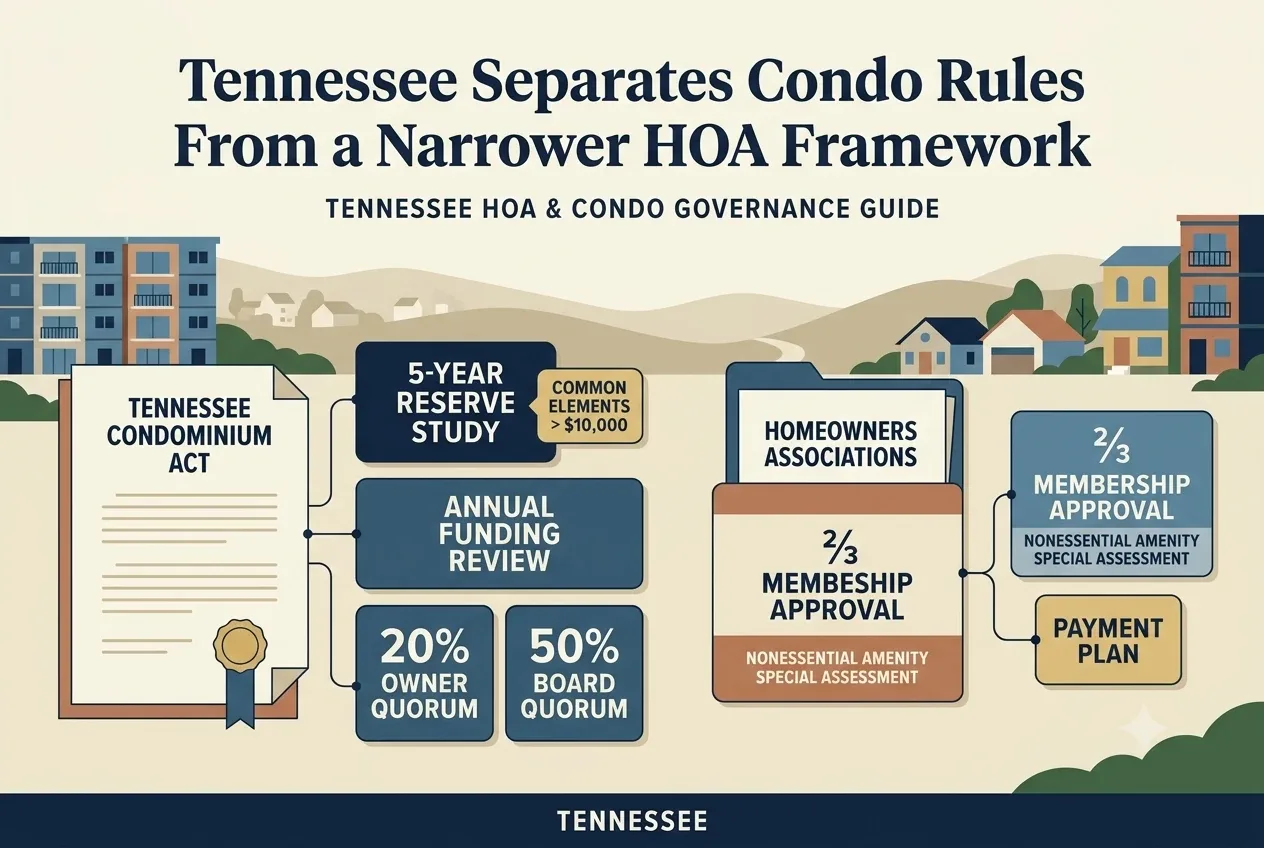
Tennessee separates its 2008 condominium statute from a much narrower HOA part. Condo boards overseeing common elements with aggregate replacement cost above $10,000 generally need a reserve study every five years and an annual funding review. Condo quorum defaults to 20% for owners and 50% for the board. For HOAs, a nonessential-amenity special assessment requires approval from two-thirds of the total membership plus a payment plan.
Which statute governs your association
Tennessee does not give subdivisions and condominiums one interchangeable governance code. Parts 2 through 5 of Title 66, Chapter 27 contain the Tennessee Condominium Act of 2008 and address unit-owner associations in detail. Part 7 contains a smaller group of homeowners-association provisions. A subdivision HOA therefore still depends heavily on its recorded declaration, bylaws, articles, and applicable nonprofit-corporation rules for questions that Part 7 does not answer.
Older projects require extra classification work because Tennessee also retains horizontal-property provisions in Part 1. Before using a condominium rule, verify that the declaration and statutory applicability provisions place the project under the 2008 Act. If the governing documents impose a stricter meeting, budget, insurance, or voting requirement than a statutory minimum, follow the stricter valid requirement. Confirm the current statute text and any recent amendment before relying on this guide.
Reserve study and reserve funding
Tennessee has an unusually concrete condominium reserve rule. Under Tenn. Code Ann. § 66-27-403, a board overseeing common elements with aggregate replacement cost exceeding $10,000 generally must have a reserve study conducted or updated on a five-year cycle. Projects that had no qualifying study since January 1, 2020 were required to obtain one by January 1, 2025, subject to statutory exceptions such as declarant-controlled or single-owner condominiums.
The same section requires the condo board to review reserve funding annually for adequacy and make the reserve study available to owners electronically or on the community website. This is a study-and-review mandate, not a simple statutory command to maintain a fixed percent-funded ratio. The narrower HOA statutes do not impose the same universal five-year reserve study rule on subdivisions, so an HOA board should look to its governing documents before treating the condo standard as its own obligation.
Sources: [2]
Insurance and fidelity bond
The Tennessee Condominium Act addresses association insurance in Tenn. Code Ann. § 66-27-413, while disclosure provisions also require buyers to receive meaningful information about budgets, reserves, and association obligations. A condo board should read the current insurance section together with the declaration because coverage duties can depend on project configuration, insurable common elements, deductibles, and the allocation of repair responsibility between the association and unit owners.
The limited HOA provisions do not create a single statewide fidelity bond formula for every Tennessee subdivision. If the declaration, bylaws, lender requirements, or management agreement calls for crime coverage or a fidelity bond, the board must follow that requirement rather than importing a formula from another state. The same is true for D&O insurance: it may be prudent and document-required even when Part 7 does not state a universal dollar amount.
Open meetings, notice, and agenda
The Tennessee Condominium Act requires unit-owner meetings and supplies association governance mechanics, but boards should not assume the separate HOA provisions create the same owner-attendance regime for every subdivision. Meeting notice, agenda control, electronic participation, and owner-comment rights can turn on the condominium statute, the nonprofit-corporation act, and the project’s bylaws. Read those sources together before scheduling an annual or special meeting.
For board deliberations, the safest operating practice is to distinguish statutory rules from document rules in the meeting notice itself. If bylaws require advance agendas, owner access, or limits on an executive session, those provisions should be followed even where the state HOA part is silent. Condominium owners may participate through the methods permitted by the bylaws, and proxy voting is expressly recognized for owner meetings; HOAs should verify their own instruments before copying that procedure.
Quorum and voting thresholds
For a condominium owner meeting, Tenn. Code Ann. § 66-27-409 sets a default quorum at 20% of votes that may be cast for election of directors, present in person or by proxy, unless the bylaws provide otherwise. For board meetings, the default is 50% of board votes unless the bylaws specify a larger percentage. The statute also permits meeting attendance by telephone or another method specified in the bylaws.
Do not extend those percentages automatically to a subdivision HOA. Part 7 is narrower, and HOA voting often remains controlled by the declaration, bylaws, and corporate law. Amendment rules can also differ from ordinary member votes. When owners are being asked to amend the CC&Rs, remove a director, or approve a special assessment, the board should identify the exact vote denominator—total membership, votes cast, or votes represented at a quorum—before distributing the ballot.
Sources: [2]
Records access and retention
Tenn. Code Ann. § 66-27-417 requires a condominium association to keep financial records detailed enough to support statutory disclosure obligations and to make financial and other association records reasonably available for examination by a unit owner, mortgage holder, or their authorized agents. The section is broad, but it does not create the kind of single fixed response deadline and detailed multi-category records retention schedule found in some other states.
For an HOA, records rights may come from the entity’s nonprofit status, governing documents, and specific disclosure statutes rather than the condo section. Boards should therefore maintain a written records retention policy covering minutes, owner ledgers, contracts, insurance, tax filings, reserve reports, and governing documents. If the governing documents grant broader access or a specific response time, use that stricter process rather than telling owners the condo statute supplies an identical rule.
Sources: [2]
Budget and assessment disclosure
Tennessee’s condominium disclosure structure requires meaningful budget information, including the most recent approved budget and statements about repair-and-replacement reserves and whether a reserve study has been performed. For an operating board, that reinforces the need to keep the budget, reserve analysis, and assessment allocation internally consistent. The board should not describe a reserve contribution as optional if the declaration or adopted budget already makes the contribution part of the association’s obligations.
For subdivision HOAs, annual budget disclosure procedures are more often document-driven because the state HOA part is limited. The board should verify who has authority to adopt the budget, whether owners receive a notice or ratification right, and whether a special assessment requires separate approval. A well-documented budget disclosure should distinguish recurring operating assessments from reserve contributions and one-time project charges so owners can see which authority supports each line.
Sources: [2]
Limits on assessment and fee increases
Tennessee does not impose a general statewide percentage cap on ordinary annual assessment increases for every HOA and condo. A significant targeted rule does apply to a homeowners association seeking a special assessment for a nonessential amenity: Tenn. Code Ann. § 66-27-706 requires approval by at least two-thirds of the total HOA membership and requires the association to provide financing or a payment plan over a defined period.
The same provision bars foreclosure for failure to pay that particular nonessential-amenity special assessment. It should not be generalized into a two-thirds requirement for every repair assessment or a blanket ban on assessment liens. Boards should first classify the expense—ordinary operations, required repair, reserve contribution, or nonessential amenity—then apply the statute and governing documents that actually govern that category. No statutory cap means the declaration’s limits still matter.
Fines and enforcement due process
Tennessee’s HOA provisions do not create a comprehensive statewide fine-hearing timetable equivalent to Texas Chapter 209. Condominium and HOA boards should therefore trace enforcement authority to the declaration, bylaws, rules, and applicable association statutes before imposing a fine. The board should document the violated provision, the notice given, any cure opportunity promised by the governing documents, and the body authorized to make the final enforcement decision.
If the documents provide a hearing or appeal, follow that due process consistently. A board should also separate a violation fine from unpaid assessments because lien and foreclosure rights can differ by charge. The 2024 nonessential-amenity rule is a good example: it specifically prevents foreclosure for nonpayment of that special assessment, but it does not erase every other collection remedy or convert unrelated fines into assessments.
Sources
- Tennessee Courts — Tennessee Code / Lexis Law linkState judiciary portal linking to the current free Tennessee Code; use it as the primary publication-check gateway.
- Tennessee General Assembly — 2025 Tennessee Code Bill, Volume 2Official General Assembly publication containing Title 66 text, including current HOA Part 7 language; section-level text must still be checked against the live Lexis code.
- Tennessee General Assembly — SB 2150 / Public Chapter 691Official enactment history for 2024 HOA changes; effective July 1, 2024.
- 2025 Tennessee Code § 66-27-403 — reserve study (secondary presentation)Useful section-level text for drafting; secondary source and must be verified against the official Tennessee Code portal before publication.
- 2025 Tennessee Code § 66-27-409 — quorum (secondary presentation)Secondary presentation of the current code; verify against official Lexis before publication.
- 2025 Tennessee Code § 66-27-417 — records (secondary presentation)Secondary presentation of the current code; verify against official Lexis before publication.
Compare nearby state rules
Check one decision against the statute
For a single board decision — a fine, a special assessment, a records request, an election, a CC&R amendment — the State Decision Lookup resolves the verified statutory rule for Tennessee and a growing set of other states, and the Board Decision Router lays out the research sequence. Both fail closed when the primary law is unclear rather than guessing.