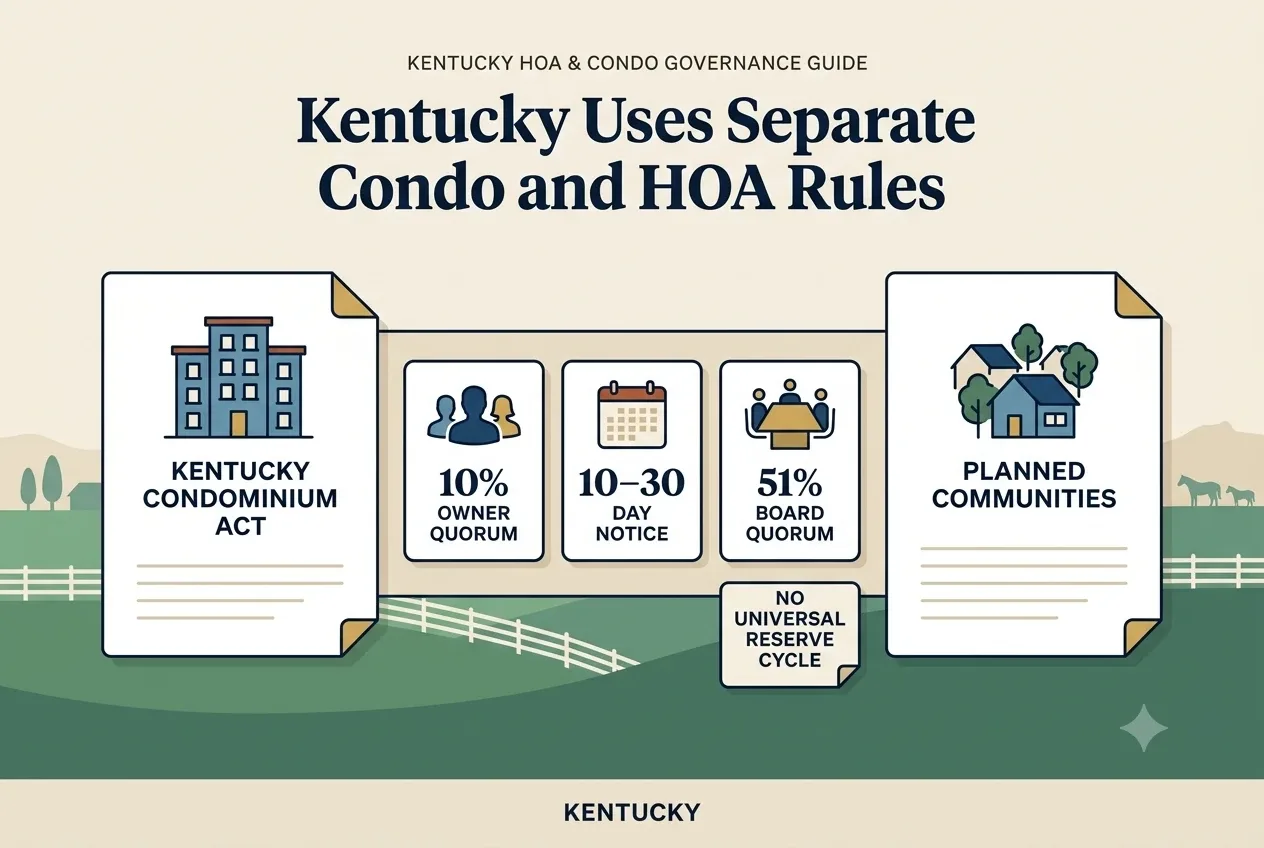
Kentucky separates planned communities from condominiums. HOAs use KRS 381.785–381.801, with a 10% default owner quorum, 10–30 day owner-meeting notice, and open board meetings; condominiums use the Kentucky Condominium Act. Kentucky does not impose a general reserve-study cycle or statewide assessment-increase cap, so declarations and bylaws remain central.
Which statute governs your association
Kentucky now has a true statutory split between planned communities and condominiums. Planned communities are governed by KRS 381.785 through 381.801, enacted in 2023, while condominiums use the Kentucky Condominium Act, KRS 381.9101 through 381.9207. Older condominium regimes also matter because the pre-2011 Horizontal Property Law, KRS 381.805 through 381.910, was not simply erased for every existing project.
The planned-community statute applies broadly to planned communities in the Commonwealth, but it protects pre-June 29, 2023 governing-document provisions from being invalidated unless the statute specifically overrides them. New planned communities formed after that date must record a declaration. For condominiums, the modern Act generally governs projects created after January 1, 2011, while selected provisions also reach older condos for later events. If the declaration, CC&Rs, or bylaws impose a stricter procedural requirement than the statute, the board should follow the governing documents unless the statutory provision is mandatory and does not permit variation. Confirm the current statute text and any recent amendment before relying on this summary.
Reserve study and reserve funding
Kentucky does not impose a general statewide reserve study cycle on planned communities comparable to Maryland or Florida. The 2023 planned-community provisions require budgeting and financial reporting but do not establish a recurring engineering reserve study or a statutory percentage that every HOA must fund. Boards should therefore identify any reserve obligations in the declaration and treat long-range capital planning as a governance practice rather than inventing a state mandate.
The Kentucky Condominium Act permits association budgets to include allocations to reserves and gives the association broad powers over common expenses, but the statewide statute is not a blanket “fully funded reserves” law. Condo boards should review the declaration, budget provisions, lender requirements, and any project-specific commitments before setting a funding target. If a study is commissioned, minutes should distinguish its recommendation from a legally required contribution.
Insurance and fidelity bond
Kentucky planned communities must look first to KRS 381.790 and their governing documents for insurance and budgeting duties. The planned-community law does not supply a universal fidelity bond formula for every association. A board should review coverage for association-owned property, general liability, directors and officers, cyber or crime risk, and any management-company bond separately rather than assuming a condominium rule automatically applies to an HOA.
Condominium insurance is governed within the Kentucky Condominium Act and the declaration. The executive board should confirm what property is insured by the association versus by individual unit owners, the required deductibles, and whether the governing documents impose crime or fidelity coverage. Where mortgage requirements or contracts demand higher limits, those operational requirements may exceed the minimum stated in statute.
Open meetings, notice, and agenda
For planned communities, KRS 381.792 requires owner-meeting notice no less than 10 and no more than 30 days before a meeting. The notice must state the time, place, and agenda items. The statute requires an annual association meeting and permits special meetings called by specified officers, the board, or 20% of owners unless the declaration or bylaws set a lower owner percentage.
KRS 381.793 adds a board-level transparency rule: board meetings are open to owners unless the bylaws provide otherwise for permitted executive-session business. A planned-community board should not assume that a casual director gathering is exempt if association business is actually being conducted. For condominiums, meeting procedure comes from the Kentucky Condominium Act and bylaws, so boards should not import the 10–30 day HOA range without checking the condo provisions. If the declaration, CC&Rs, or bylaws impose a stricter procedural requirement than the statute, the board should follow the governing documents unless the statutory provision is mandatory and does not permit variation.
Quorum and voting thresholds
Kentucky’s planned-community default owner-meeting quorum is 10% of the lots. Owners may vote in person or by proxy, a proxy generally terminates one year after it is signed unless it states a shorter term, and each lot has one vote unless the governing structure lawfully provides otherwise. A majority of votes cast at a properly convened meeting acts for the owners unless the declaration or bylaws require a greater number.
For the board, 51% of directors is the statutory quorum unless the bylaws specify a larger percentage. Those defaults do not rewrite declaration-amendment thresholds. When a board proposes to amend CC&Rs, terminate rights, or approve another matter requiring a supermajority, it must use the percentage in the applicable statute and recorded documents, not the ordinary meeting quorum or ordinary majority-vote rule.
Records access and retention
Kentucky planned-community associations must maintain financial records detailed enough to prepare financial statements and must prepare an annual financial report. KRS 381.794 uses revenue-based reporting tiers, ranging from a cash-receipts-and-disbursements statement for smaller associations to an audit by a certified public accountant for associations with annual revenue of at least $1 million. The report is generally prepared within 180 days after fiscal year end or on the annual date set by the governing documents.
The planned-community chapter separately gives owners rights to examine association records, subject to exclusions and reasonable procedures. Condominium associations have their own financial-reporting and records provisions in the Kentucky Condominium Act. A 2026 bill proposing small-association exemptions did not become law, so boards should not rely on that proposal as an enacted exception. Retention and access should be confirmed against the current Chapter 381 text before denying a request.
Budget and assessment disclosure
Kentucky requires planned-community boards to adopt an annual budget and levy assessments according to the declaration and statutory framework. The budget process should be tied to the association’s actual common-area obligations and anticipated expenses rather than simply rolling forward last year’s assessment. Financial records must be detailed enough to support the required annual report, which makes undocumented “plug” amounts especially risky for volunteer boards.
Condominium budgeting follows the Kentucky Condominium Act, including powers to adopt budgets, collect common-expense assessments, and use emergency-assessment authority where the statutory conditions are met. A board should distinguish an emergency assessment from an ordinary annual assessment and record the legal and documentary basis for each. Owners should receive any budget or financial report in the manner and timing required by the applicable statute and governing documents.
Limits on assessment and fee increases
Kentucky does not impose a single statewide percentage ceiling on annual assessment increases for all planned communities or condominiums. For many associations, the enforceable limit is found in the declaration, bylaws, or an owner-approval clause rather than in a universal statutory cap. Boards should therefore avoid statements such as “Kentucky caps dues at 10%” unless the number comes from the project’s recorded documents.
Assessment increases should be tied to a validly adopted budget and the assessment authority granted by the governing documents and statute. If a declaration sets a ceiling, requires a membership vote, or distinguishes regular from special assessments, those provisions matter even though state law does not supply one statewide number. If the declaration, CC&Rs, or bylaws impose a stricter procedural requirement than the statute, the board should follow the governing documents unless the statutory provision is mandatory and does not permit variation.
Fines and enforcement due process
The planned-community act makes the declaration, bylaws, rules, and board duties central to enforcement, but it does not create a one-size-fits-all statutory fine schedule. Before imposing a monetary sanction, the board should locate the fine authority, notice procedure, hearing right, and appeal or reconsideration process in the association’s documents and any applicable Chapter 381 provision. Rules should be applied consistently and within the board’s stated authority.
Condominium boards likewise should separate collection of assessments from punishment for covenant violations. A lien right for unpaid assessments is not automatically a lien right for every fine. Minutes should identify the violation, the governing provision, notice sent, hearing opportunity, vote, and resulting sanction. Confirm the current statute text and any recent amendment before relying on this summary.
Sources
- Kentucky Revised Statutes, Chapter 381 — Planned Communities and Kentucky Condominium ActOfficial KRS Chapter 381 portal including 2026 Regular Session enactments.
- KRS 381.786 — applicability of Planned Community ActOfficial applicability and June 29, 2023 transition rule.
- KRS 381.792 — owner meetings, notice, quorum, proxyOfficial planned-community meeting procedure.
- KRS 381.793 — open board meetings and board quorumOfficial planned-community board meeting rule.
- KRS 381.794 — financial records and annual financial reportOfficial financial reporting tiers; database checked after the 2026 Regular Session.
- KRS 381.9101 — Kentucky Condominium Act short titleOfficial short-title/effective-date section; use the Chapter 381 index for the Act’s management provisions.
Compare nearby state rules
Check one decision against the statute
For a single board decision — a fine, a special assessment, a records request, an election, a CC&R amendment — the State Decision Lookup resolves the verified statutory rule for Kentucky and a growing set of other states, and the Board Decision Router lays out the research sequence. Both fail closed when the primary law is unclear rather than guessing.