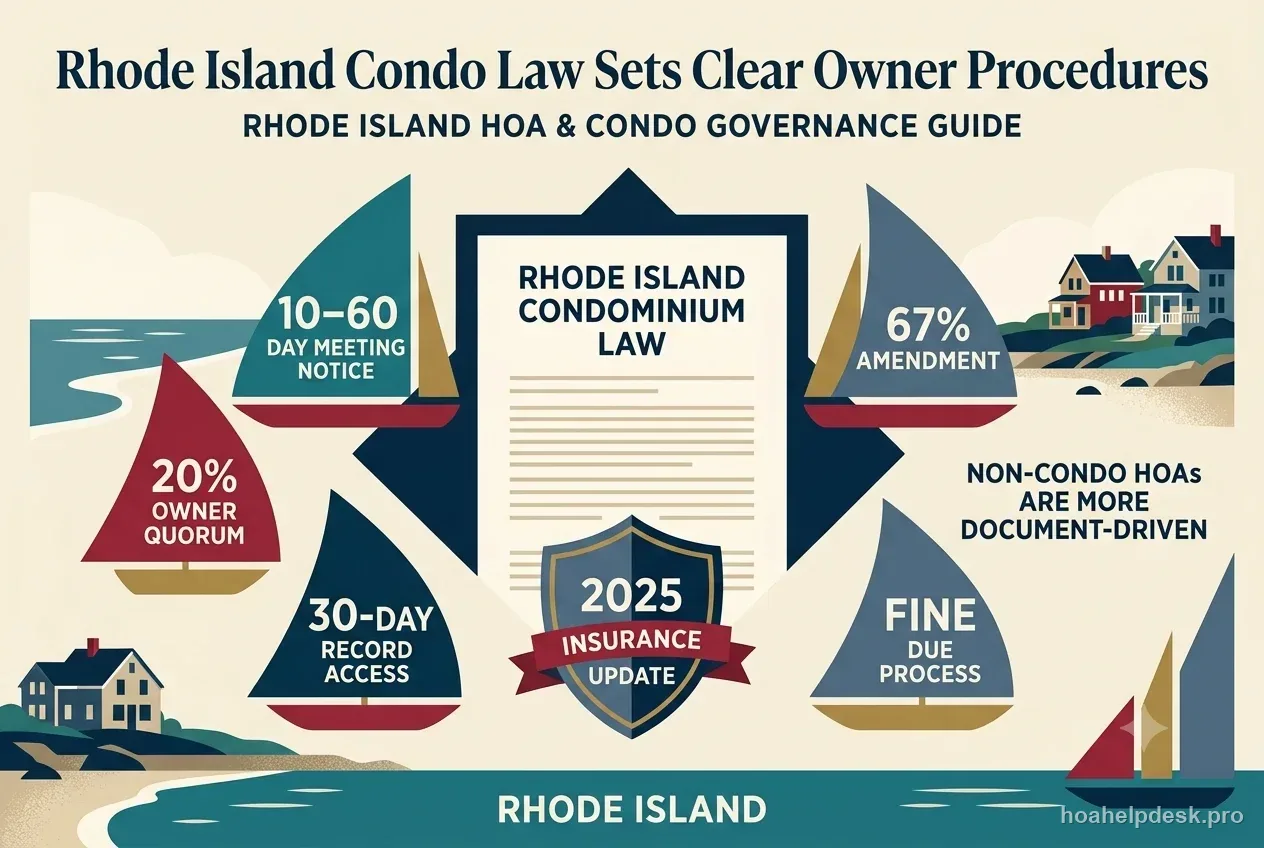
Rhode Island’s detailed statewide rules are concentrated in condominium law, not a comprehensive HOA act. Modern condos generally use Chapter 34-36.1, with owner-meeting notice of ten to sixty days, default owner quorum of twenty percent, a sixty-seven-percent declaration-amendment threshold, records access within thirty days, and statutory fine caps with notice and a hearing. Insurance rules were materially amended in 2025.
Which statute governs your association
Rhode Island’s modern Condominium Law, Chapter 34-36.1, generally governs condominiums created after July 1, 1982. Condominiums created earlier may voluntarily accept the newer chapter, and the statute also applies selected modern provisions to older projects for later events and circumstances. Chapter 34-36 remains relevant to older condominiums that have not fully opted into the newer framework.
Rhode Island did not have a comprehensive enacted HOA governance act identified in the official sources reviewed for this batch as of the guide date, so a non-condominium HOA may depend heavily on its recorded declaration, bylaws, restrictive covenants, and general corporate law. Do not apply condominium percentages automatically to a subdivision HOA. If governing documents require a stricter process, follow them unless inconsistent with mandatory law. Confirm the current statute text and any recent amendment before relying on this.
Sources: [1]
Reserve study and reserve funding
Chapter 34-36.1 does not establish a universal recurring reserve-study cycle comparable to Oregon or Florida. Condominium boards therefore should not describe a three-year, five-year, or ten-year study interval as a Rhode Island statutory requirement unless another applicable rule or the governing documents supply it. The absence of a fixed cycle does not eliminate the board’s need to plan for predictable capital obligations.
A reserve study remains a strong governance tool for roofs, paving, siding, elevators, mechanical systems, drainage, and other common elements with long replacement cycles. The board should connect the reserve schedule to the annual budget and distinguish owner-funded reserves from insurance proceeds. For older condominiums under Chapter 34-36, review the recorded documents carefully because they may carry older budgeting and maintenance structures.
Sources: [1]
Insurance and fidelity bond
Rhode Island condominium insurance rules are detailed and were amended in 2025. Under § 34-36.1-3.13, the association generally must maintain property insurance on common elements, to the extent reasonably available, with coverage after deductibles of at least eighty percent of actual cash value, plus liability insurance. The statute also addresses primary coverage, deductibles, owner obligations, and notice when the association’s deductible changes.
The 2025 amendment requires the association to notify unit owners of a change in the association property-policy deductible within thirty days after the carrier notifies the association, and it places specified insurance obligations on unit owners when the association insures units. The statute does not provide a general fidelity-bond formula for every condominium, so boards should check the declaration, lender requirements, management contracts, and insurer recommendations for crime coverage.
Open meetings, notice, and agenda
For modern condominiums, an association meeting must be held at least annually. Special meetings may be called by the president, a majority of the executive board, or unit owners holding twenty percent of association votes, or a lower percentage set by the bylaws. Notice must be given not less than ten nor more than sixty days before the meeting and must state the time, place, and agenda items, including proposed document amendments and budget changes.
The statute now also allows association and executive-board meetings to be held electronically when participants can communicate simultaneously. Boards should still separate owner meetings from executive-board sessions and follow any additional notice or openness requirements in the declaration and bylaws. Several 2026 bills proposed further open-meeting changes, but this guide does not treat a pending proposal as enacted law.
Quorum and voting thresholds
Unless the bylaws provide otherwise, a quorum at a condominium association meeting exists when persons entitled to cast twenty percent of the votes for election of the executive board are present in person or by proxy at the beginning of the meeting. Board quorum defaults to fifty percent of board votes unless the bylaws require a larger percentage. These statutory defaults make the proxy and attendance rules operationally important.
For declaration amendments, § 34-36.1-2.17 generally requires unit owners holding at least sixty-seven percent of association votes, or a larger majority specified in the declaration. Some amendments affecting unit boundaries, allocated interests, or restricted uses require unanimous consent. A board should identify whether it is amending the declaration, bylaws, or rules before selecting a threshold because those documents do not necessarily use the same vote.
Records access and retention
Rhode Island requires the condominium association to keep financial records sufficiently detailed to support resale disclosure obligations and makes financial and other records reasonably available for examination within thirty days after a request by a unit owner or authorized agent. The rule applies to selected older condominiums as provided in the applicability section, making it more than a purely post-1982 transparency rule.
The statute does not itself supply a complete retention schedule for every record category. Boards should maintain permanent copies of declarations, amendments, bylaws, recorded rules, meeting minutes, major contracts, reserve studies, insurance history, and capital-project documents, while keeping routine financial and enforcement files according to a written schedule. Where a record mixes accessible material with privileged or protected content, use redaction rather than an all-or-nothing response when appropriate.
Budget and assessment disclosure
Rhode Island’s condominium statute gives the association power to adopt budgets and collect common-expense assessments, while meeting notice must identify budget changes presented to owners. The governing documents may impose additional delivery, ratification, or owner-approval requirements. Boards should therefore calendar both the statutory notice window and any separate bylaw deadline before adopting a material budget change.
The annual budget should distinguish operating expenses, insurance deductibles, reserve contributions, and planned capital work. If a special assessment is needed, the board should document the authority, allocation formula, payment schedule, and any owner vote required by the declaration. A reserve contribution should not be disguised as an operating fee merely to avoid a document-based approval process.
Sources: [1]
Limits on assessment and fee increases
Rhode Island condominium law does not impose a simple statewide annual percentage cap on common-expense assessment increases. Authority instead comes from the budget powers in Chapter 34-36.1 and the declaration’s allocation and approval provisions. Boards should not interpret the absence of a cap as unlimited discretion; the assessment must still be authorized, allocated according to the governing documents, and adopted through the required process.
For non-condominium HOAs, the recorded covenants and bylaws are even more important because there is no comprehensive HOA statute setting a general fee-increase formula in the sources reviewed. If the documents cap annual increases or require a member vote for a special assessment, that contractual rule controls the board’s process. Distinguish assessments, transfer charges, late fees, and fines rather than treating them as interchangeable revenue tools.
Sources: [1]
Fines and enforcement due process
Rhode Island’s modern condominium law contains unusually concrete fine rules. Before imposing and assessing a fine, the association must give the alleged violator notice and an opportunity for a hearing. Daily fines for a residential condominium may not exceed one hundred dollars per day, and non-daily residential fines may not exceed five hundred dollars. Commercial-condominium caps are higher.
The statute states that fines are liens on the charged unit and specifies who conducts the hearing. Even with that statutory authority, boards should use written violation notices, identify the rule, record the hearing result, and apply sanctions consistently. Do not apply these condominium fine caps automatically to a non-condominium HOA without confirming the HOA’s separate legal authority. A pending 2026 HOA bill is not a substitute for enacted law.
Sources
- Rhode Island General Laws Chapter 34-36.1 — Condominium LawOfficial Rhode Island statute index for the modern Condominium Law.
- R.I. Gen. Laws § 34-36.1-3.08 — Meetings and noticeOfficial current meeting-notice provision, including electronic meeting language.
- 2025 Public Law Chapter 178 — Condominium insurance amendmentsEnacted June 24, 2025; official amendment text for insurance and deductibles.
- R.I. Gen. Laws § 34-36.1-3.18 — Association recordsOfficial records-access provision with the 30-day rule.
- R.I. Gen. Laws § 34-36.1-3.20 — Enforcement and finesOfficial fine limits and notice/hearing provision.
- R.I. Gen. Laws § 34-36.1-2.17 — Amendment of declarationOfficial 67% declaration-amendment rule and unanimity exceptions.
Compare nearby state rules
Check one decision against the statute
For a single board decision — a fine, a special assessment, a records request, an election, a CC&R amendment — the State Decision Lookup resolves the verified statutory rule for Rhode Island and a growing set of other states, and the Board Decision Router lays out the research sequence. Both fail closed when the primary law is unclear rather than guessing.