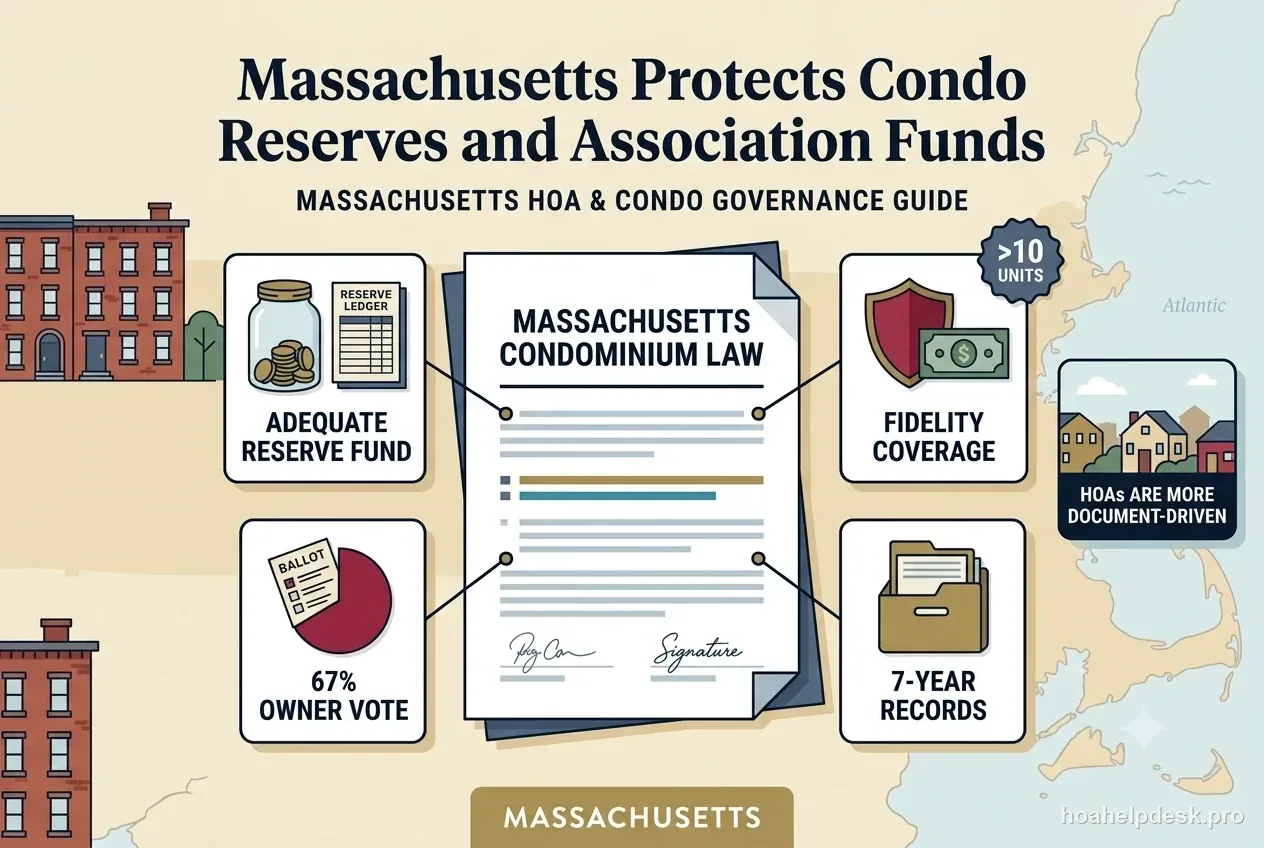
Massachusetts condominium law requires an adequate replacement reserve fund, seven-year records retention, and fidelity insurance for condominiums with more than ten units unless owners validly modify specified requirements after turnover. The statute does not create a general open-board-meeting rule or annual assessment-increase cap. Ordinary HOAs are more document-driven because Massachusetts has no comprehensive HOA governance act.
Which statute governs your association
Massachusetts boards must first identify whether the community is legally a condominium or a conventional deed-restricted HOA. Condominiums are governed by Mass. Gen. Laws ch. 183A, which regulates the master deed, unit-owner organization, common expenses, records, reserves, insurance, and selected voting issues. Massachusetts does not have a single comprehensive HOA act that supplies equivalent governance rules to every planned community. An incorporated HOA may also need to read the corporate statute governing its legal form.
The distinction matters because a rule found in Chapter 183A should not automatically be imported into a subdivision HOA. For a condominium, the master deed, declaration of trust, bylaws, and Chapter 183A operate together. For an HOA, recorded covenants, bylaws, easements, contract principles, and applicable corporate law carry more weight. If the governing documents impose a stricter requirement than the statutory floor, follow the documents unless a mandatory statute overrides them. Confirm the current statute text and any recent amendment before relying on this summary.
Reserve study and reserve funding
Massachusetts does not prescribe a recurring professional reserve study cycle comparable to states that require an engineer or reserve specialist every few years. It does, however, require every condominium to maintain an adequate replacement reserve fund, collected as part of common expenses and held separately from operating funds. That is a real funding obligation, not merely a suggestion to commission a reserve study. A board should therefore connect the annual budget to expected replacement obligations even though the statute does not dictate a single funding formula.
After declarant control ends, owners holding at least 67% of the beneficial interest may, by an annual vote, modify the reserve-fund requirement described in Chapter 183A section 10, and may later rescind that modification by majority vote. A volunteer board should document any such vote carefully and avoid treating it as permission to ignore foreseeable capital costs. Governing documents, lender standards, or a board-adopted reserve study may still require a stronger funding plan than the statutory minimum.
Sources: [2]
Insurance and fidelity bond
Chapter 183A authorizes and structures condominium insurance and imposes a specific fidelity insurance rule when the condominium has more than ten units. The organization must maintain blanket fidelity coverage for people handling association funds in an amount at least equal to one-fourth of annual assessments, excluding special assessments. The policy must cover the manager or managing agent and name the organization as insured. This is separate from the master insurance policy protecting common property and liability exposures.
The fidelity requirement is one of the provisions that may be modified after turnover by the annual 67% beneficial-interest vote described in section 10(m). That does not make crime coverage unimportant; it means the statute permits owner-level modification under defined conditions. Boards should separately evaluate property coverage, liability coverage, D&O insurance, fidelity bond or crime coverage, deductibles, and any mortgage requirements. An HOA outside Chapter 183A should look first to its own documents and insurance contracts rather than borrowing the condominium formula.
Sources: [2]
Open meetings, notice, and agenda
Massachusetts Chapter 183A does not establish a broad open meeting law requiring every condominium board meeting to be open to all unit owners with a fixed notice period. Meeting procedure therefore depends heavily on the declaration of trust and bylaws. A board should not advertise a universal four-day, seven-day, or ten-day board notice rule unless its own governing documents actually provide one. Minutes and owner-meeting procedures should likewise be checked against the recorded documents and the organization’s legal form.
Section 24 now expressly permits condominium governing bodies to meet by telephone, video conference, or another interactive electronic process when participants can communicate simultaneously. It also permits remote annual or special owner meetings, requires owners to be notified and given access information, and permits electronic or mail voting subject to the statute’s quorum language. This electronic-meeting authority is not the same thing as an open meeting mandate. If the bylaws require longer notice or a particular agenda format, the stricter document rule should be followed.
Sources: [4]
Quorum and voting thresholds
Massachusetts condominium law leaves many ordinary quorum and election mechanics to the master deed, trust, and bylaws rather than imposing one statewide owner-meeting quorum percentage. Section 24 recognizes that a governing body may satisfy quorum through permitted electronic participation, but it does not replace the quorum number written into the association documents. For ordinary director elections, proxies, and owner votes, the board should build its election calendar from the recorded documents and any applicable corporate provisions.
Some Chapter 183A actions do have statutory thresholds. For example, after turnover a 67% beneficial-interest annual vote can modify specified financial-control requirements in section 10, while certain changes involving common interests or development rights may require 75%, affected-owner consent, mortgagee consent, or another rule tied to the particular amendment. Do not reduce those specialized rules to a claim that every CC&R amendment requires the same percentage. The exact amendment power must be matched to the provision being changed.
Records access and retention
Condominium records are one of Massachusetts’ clearest governance areas. Section 10 requires the organization or responsible manager to maintain core condominium documents, minutes to the extent kept, and detailed financial records including receipts, expenditures, reserve accounts, audits or reviews, contracts, and current insurance policies. Those records must be kept up to date in Massachusetts and made available for reasonable inspection by unit owners and qualifying first mortgagees during regular business hours, with copying available at the requester’s expense.
The statute sets a minimum records retention period of seven years for the records covered by section 10. Boards should use that as a floor, not a reason to destroy governing documents, master deeds, amendments, or records that should be preserved permanently. A practical retention schedule should distinguish permanent organizational records from seven-year financial files and shorter-lived operational material. The board should also document how electronic requests for meeting minutes are handled so access is consistent rather than dependent on which director receives the email.
Sources: [2]
Budget and assessment disclosure
Chapter 183A requires common expense assessments to be made at least annually based on a budget adopted at least annually in accordance with the master deed, trust, or bylaws. The statute therefore supplies an annual budgeting cadence for condominiums but does not replace the association documents on notice, owner presentation, or approval mechanics. A treasurer should prepare the budget with operating expenses, reserve contributions, insurance, contracted services, and anticipated capital costs separated clearly enough that owners can see what drives the assessment.
Massachusetts also regulates financial review and management reporting in section 10, with some requirements subject to the post-turnover modification vote. Boards should avoid describing every budget increase as a special assessment; recurring common expenses and a true special assessment should be tracked separately. If the governing documents require a budget disclosure meeting, advance mailing, owner ratification, or a tighter timetable, those procedures control unless they conflict with a mandatory statutory rule.
Limits on assessment and fee increases
Massachusetts does not impose a general statewide percentage cap on annual condominium assessment increases comparable to California’s well-known statutory ceiling. Chapter 183A instead requires common expenses to be allocated and assessed under the condominium documents and statutory allocation rules. For a conventional HOA outside the condominium statute, the declaration and bylaws are even more important. A board should not invent a 10%, 15%, or 20% cap simply because another state uses one.
The real constraints may come from the declaration, a required owner vote for a special assessment, mortgage provisions, or the board’s fiduciary and contractual duties. When an unusually large increase is needed, the minutes should identify the cost driver, whether reserve underfunding is involved, and whether the governing documents require member approval. Budget communications should also separate an operating increase from a capital special assessment so owners can understand which approval path applies.
Fines and enforcement due process
Chapter 183A permits the organization of unit owners to levy reasonable fines for violations of the master deed, trust, bylaws, restrictions, rules, or regulations. The statute also permits charges and interest for late payment and allows authorized enforcement costs to become part of the sums assessed against a unit. It does not provide a single detailed hearing script for every fine, so the board must examine its own documents and basic fairness requirements before imposing sanctions.
A defensible enforcement file should identify the violated provision, preserve the complaint or inspection evidence, send the notice required by the governing documents, allow any required hearing or appeal, and record the final board action. Avoid turning a courtesy reminder into a lien-ready fine without confirming authority. Because Chapter 183A lien rules can have serious consequences, boards should distinguish ordinary common-expense collection from fines and enforcement charges and should confirm the current statutory text before escalating a disputed account.
Sources
- Massachusetts General Laws, Chapter 183A — CondominiumsOfficial Legislature chapter portal; primary condominium statute.
- Mass. Gen. Laws ch. 183A, § 10Official text for records, fidelity insurance, reserve fund, management controls, and 67% modification vote.
- Mass. Gen. Laws ch. 183A, § 6Official text for annual budget-based common expenses and condominium liens.
- Mass. Gen. Laws ch. 183A, § 24Official text authorizing electronic condo meetings and voting.
- Massachusetts General Laws, Chapter 180Official nonprofit-corporation chapter; applicability depends on association legal form.
- Mass.gov — CondominiumsState guidance confirming no Commonwealth regulatory oversight over condominiums.
Compare nearby state rules
Check one decision against the statute
For a single board decision — a fine, a special assessment, a records request, an election, a CC&R amendment — the State Decision Lookup resolves the verified statutory rule for Massachusetts and a growing set of other states, and the Board Decision Router lays out the research sequence. Both fail closed when the primary law is unclear rather than guessing.