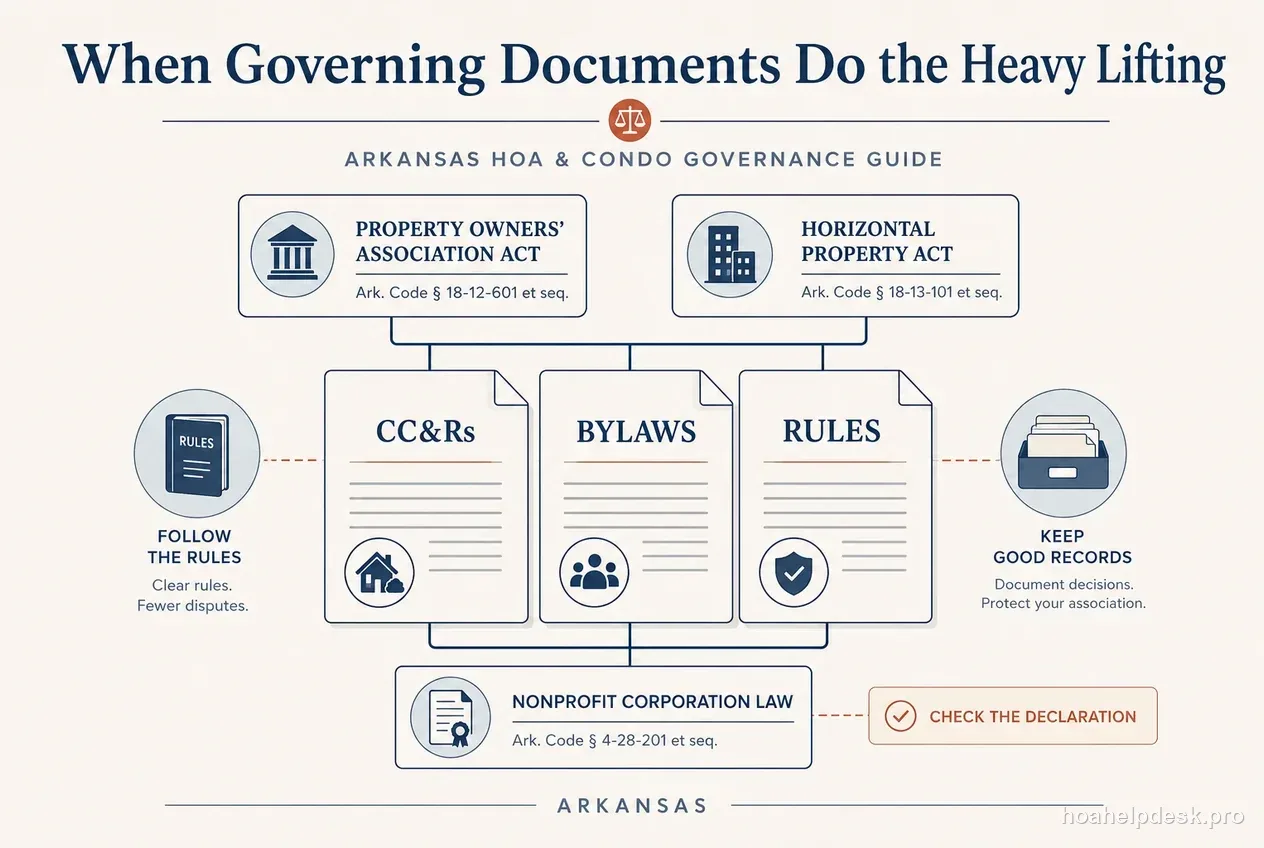
Arkansas is highly governing-document driven. Condominiums organized as horizontal property regimes use the Horizontal Property Act, which was materially updated by Act 516 of 2025. Ordinary subdivision HOAs do not have a comparably comprehensive statewide HOA act and usually depend on recorded covenants, bylaws, and nonprofit-corporation law. There is no general statewide reserve-study cycle, HOA assessment-increase percentage cap, or universal open-board-meeting notice period.
Which statute governs your association
Arkansas boards must first determine whether the property is a condominium-style horizontal property regime or an ordinary deed-restricted subdivision. A horizontal property regime is governed by the Horizontal Property Act in Ark. Code Ann. Title 18, Chapter 13. The General Assembly significantly revised that Act in 2025 through Act 516, updating core definitions, master-deed rules, development rights, common elements, and expense allocation. A condominium board should therefore use the post-2025 text rather than a stale online summary based on earlier wording.
Arkansas does not have a similarly comprehensive statewide HOA governance act for ordinary planned subdivisions. Those associations are typically governed by their recorded declaration or restrictive covenants, bylaws, articles, and — where incorporated — the Arkansas Nonprofit Corporation Act of 1993. That makes the documents unusually important for meetings, voting, assessments, reserves, fines, and owner access. If the CC&Rs, declaration, or bylaws impose a stricter procedure than a statutory default, the board should follow the stricter governing-document requirement unless it conflicts with mandatory law. Confirm the current statute text and any recent amendment before relying on this guide.
Reserve study and reserve funding
Arkansas does not impose a statewide recurring reserve-study schedule on ordinary HOAs, and the Horizontal Property Act does not create a California-style three-year reserve-study mandate for every condominium. The absence of a statutory cycle should not be confused with permission to ignore future common-element costs. The declaration or bylaws may require reserves, and the board’s general financial and maintenance duties still make roofs, paving, elevators, drainage, mechanical systems, and other long-lived assets part of prudent budget planning.
For horizontal property regimes, the 2025 legislation modernized the statute’s treatment of administration, expenses, and common elements. A condo board should use the master deed and bylaws to determine which expenses belong to all owners and which may be tied to limited common elements or a smaller group. A reserve study can provide the factual bridge between those maintenance obligations and the annual assessment, even when state law does not dictate the study interval. If the documents state a reserve contribution formula, that stricter internal requirement controls.
Sources: [1]
Insurance and fidelity bond
Arkansas does not supply one comprehensive statewide master-policy and fidelity-bond formula for all subdivision HOAs. The declaration, bylaws, mortgage requirements, management contracts, and general corporate duties therefore do much of the work. A planned-community board should inventory the property the association actually owns or must maintain, then confirm property, general liability, D&O, crime or fidelity, workers’ compensation, and cyber coverage appropriate to those exposures. Do not describe a voluntary insurance practice as an Arkansas statutory mandate unless the governing document or another statute actually creates it.
For horizontal property regimes, insurance responsibilities can also be shaped by the master deed, bylaws, and the division between units and common elements. After the 2025 amendments, boards should verify the current codified text rather than relying on pre-2025 checklists that may use outdated terminology. A fidelity bond is particularly worth checking in the bylaws when officers or a manager control reserve accounts, but this guide does not identify a universal Arkansas statutory bond amount. If the documents require specific coverage or a higher limit, the board should treat that as binding.
Open meetings, notice, and agenda
Arkansas does not impose a single statewide HOA open-board-meeting statute comparable to Arizona’s 48-hour rule or California’s four-day agenda rule. For an ordinary HOA, the declaration, bylaws, articles, and applicable nonprofit-corporation provisions are therefore the primary source for notice, quorum, remote participation, member attendance, and special meetings. A board should not invent a “standard Arkansas HOA notice period” from another state or from condominium provisions.
Horizontal property regimes are also heavily bylaws-driven. The Horizontal Property Act requires recorded bylaws addressing the form of administration and the method for calling or summoning co-owners, among other administration details. Act 516 of 2025 reinforces the importance of the governing structure rather than replacing it with a broad open-meeting code. As a board practice, publish an agenda consistent with the bylaws, document notice, and state clearly whether a gathering is a board meeting, co-owner meeting, or informal information session. If the bylaws require longer notice or member attendance, follow them.
Sources: [1]
Quorum and voting thresholds
In Arkansas, voting questions are especially document-sensitive. The Horizontal Property Act requires the bylaws to contain the method by which co-owners assemble and adopt decisions, and Act 516 updated the way modifications to the system of administration and bylaws are handled. Older summaries can quote historical percentages without reflecting later amendments, so a condo board should verify the current § 18-13-108 and § 18-13-109 text before announcing a threshold for a bylaw change, master-deed action, or owner decision.
For an ordinary HOA, the declaration and bylaws usually define member voting, board elections, quorum, proxies, and amendment thresholds, supplemented by nonprofit-corporation law if the association is incorporated. Always identify the denominator. A covenant amendment that requires a percentage of all lots is not satisfied merely because a majority of owners who attended a meeting voted yes. Before opening ballots, write down the exact governing-document provision, the total voting interests, any classes of membership, proxy rules, and the approval number required.
Records access and retention
The Horizontal Property Act requires detailed financial recordkeeping. The 2025 legislation states that the administrator, board of administration, or other management form specified in the bylaws must keep a detailed account of receipts and expenditures, submit an annual financial report to co-owners, and make financial records available for examination by co-owners at convenient hours on a business day. That is a meaningful statutory transparency duty for condominium-style regimes even though Arkansas lacks a California- or Arizona-style universal production deadline for every association record.
Ordinary HOA records rights depend more heavily on the bylaws, nonprofit-corporation law, and the type of record requested. Boards should maintain a written retention schedule covering governing documents, amendments, minutes, owner ledgers, bank statements, tax filings, insurance policies and claims, contracts, election materials, architectural decisions, and litigation holds. The absence of one all-purpose state HOA records statute is not a reason to let documents disappear when a manager changes. The board should ensure association records remain under association control and can be produced when corporate law or governing documents require access.
Budget and assessment disclosure
For horizontal property regimes, the 2025 amendments modernized financial administration and expense allocation. The bylaws must address fee structures, expenses, and assessments, and the statute requires annual financial reporting to co-owners. The master deed and current bylaws should therefore be read together before the board sets the next assessment. The board should be able to show how the budget connects to common-element responsibilities and how each owner’s share was calculated under the governing documents and current Act.
For ordinary HOAs, there is no single Arkansas statewide annual budget package with a fixed mailing window. The declaration and bylaws commonly determine who adopts the budget, whether members must receive it before the fiscal year, and whether a special assessment requires a member vote. Even where the documents give broad board authority, a written budget with prior-year actuals, contracts, insurance, reserve contribution, and proposed assessment level is better governance than a bare dues notice. If the documents promise a notice or vote, comply with that stricter procedure.
Sources: [1]
Limits on assessment and fee increases
Arkansas does not impose a general statewide percentage cap on annual assessment increases for ordinary HOAs. The practical ceiling usually comes from the declaration, restrictive covenants, or bylaws. Some documents authorize the board to increase regular assessments within a formula and require owner approval above it; others require a member vote for special assessments. Those provisions are contractual governance rules and should be read exactly rather than replaced by a generic “industry standard.”
Horizontal property regimes must also follow the master deed, bylaws, and statutory expense-allocation rules. Act 516 of 2025 amended § 18-13-116 and related sections, so boards should use current text when allocating administration, maintenance, repair, and other common expenses. No board should assume that a cost can be shifted to one unit merely because that unit benefits more unless the master deed, bylaws, or statute authorizes the allocation. Before raising fees, document both the authority to levy and the formula used.
Sources: [1]
Fines and enforcement due process
Arkansas lacks one comprehensive statewide HOA fine-hearing statute for ordinary subdivisions. Enforcement power therefore usually comes from the declaration, restrictive covenants, bylaws, and rules. A board should identify the exact covenant or rule, give the notice and hearing opportunity promised by the documents, and apply the policy consistently. If the documents do not authorize monetary fines, the board should not assume that general nonprofit status creates a free-standing power to invent them.
For horizontal property regimes, the board should likewise trace enforcement authority to the master deed, bylaws, and current Horizontal Property Act rather than importing an HOA fine schedule. Liens for unpaid assessments and remedies for covenant violations are not automatically the same remedy. Keep violation notices, hearing materials, board decisions, assessment ledgers, and lien documents separate. When enforcement could affect title or result in litigation, confirm the current statute and recorded instruments before escalating. A document-driven state rewards boards that can show exactly where each enforcement power comes from.
Sources
- Arkansas Horizontal Property Act — Act 516 of 2025 (official)Primary official 2025 amendment to Ark. Code Ann. Title 18, Chapter 13.
- SB 323 / Act 516 bill history — Arkansas LegislatureOfficial bill history confirming Act 516 and enactment date.
- Arkansas Nonprofit Corporation Act of 1993 — Act 1147 archiveOfficial Legislature archive identifying Act 1147; current codified sections should be checked in Title 4 before publication.
- Ark. Code § 18-13-116 amendment history — Act 434 of 1993 archiveOfficial legislative history for expense-allocation provision; verify current codified wording.
Compare nearby state rules
Check one decision against the statute
For a single board decision — a fine, a special assessment, a records request, an election, a CC&R amendment — the State Decision Lookup resolves the verified statutory rule for Arkansas and a growing set of other states, and the Board Decision Router lays out the research sequence. Both fail closed when the primary law is unclear rather than guessing.