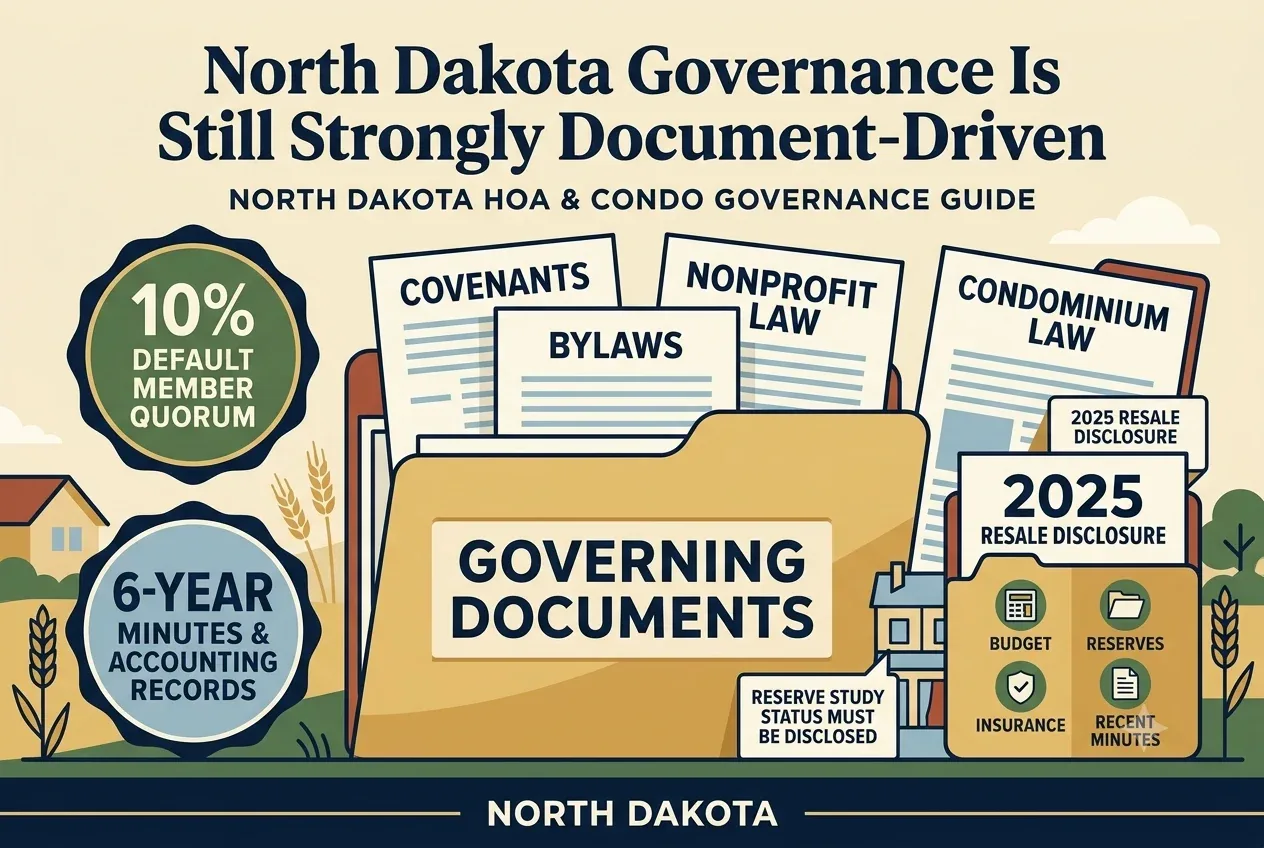
North Dakota remains largely document-driven. Condominiums use Chapter 47-04.1, while many incorporated HOAs also use nonprofit-corporation law. For qualifying nonprofits, default member quorum is 10% and records must include six years of minutes and accounting material. A 2025 law now requires robust HOA/condo resale disclosures, including budgets, reserves, insurance, recent minutes, and whether the community uses a reserve study.
Which statute governs your association
North Dakota does not have a comprehensive planned-community governance act. A condominium is governed by Chapter 47-04.1, which requires a recorded declaration and written bylaws and rules for administration. A conventional subdivision HOA instead depends heavily on recorded covenants, bylaws, and its entity form. When the HOA is a nonprofit corporation, Chapter 10-33 supplies important default rules for member meetings, quorum, proxies, director duties, and corporate records.
That split means the nonprofit statute should not be treated as a substitute condominium code, and Chapter 47-04.1 should not be applied to a subdivision merely because it has common property. The 2025 resale-disclosure statute applies to both defined HOAs and condominium projects but does not erase their different governance sources. If governing documents impose a stricter lawful process, follow them. Confirm the current statute text and any recent amendment before relying on this summary.
Reserve study and reserve funding
North Dakota does not impose a recurring statewide reserve study cycle or fixed reserve-funding percentage on every HOA or condominium. Chapter 47-04.1 leaves maintenance, repair, common-expense assessment, and related administration largely to the recorded declaration and bylaws. For an incorporated HOA, nonprofit-corporation law governs the entity but does not create a reserve-study schedule for shared roofs, roads, or other capital components.
The 2025 resale-disclosure law is still important because it forces financial transparency at a transaction. The disclosure package must identify reserve and capital funds, current operating and reserve budgets, and whether the association or condominium project uses a reserve study. That requirement does not itself mandate a study, but it makes an empty or undocumented reserve program visible to purchasers and gives boards a practical reason to maintain clear capital-planning records.
Insurance and fidelity bond
Chapter 47-04.1 does not contain a modern universal master-policy percentage or fidelity bond formula for every North Dakota condominium. Its administrative framework instead makes the declaration and bylaws central to common expenses and treatment of insurance proceeds. A board should therefore inspect the recorded documents, loan requirements, and actual ownership of common property before deciding what the association must insure.
North Dakota’s 2025 resale disclosure adds an accountability layer: the seller’s package includes insurance documents indicating coverage provided by the HOA or condominium project. That disclosure should match current policies rather than an outdated certificate. Boards should separately consider property, liability, D&O insurance, and crime or fidelity coverage for anyone controlling funds. A stricter requirement in the declaration or bylaws should be followed even where the statewide statute is otherwise silent.
Open meetings, notice, and agenda
North Dakota condominium law does not establish a comprehensive open-board-meeting statute with one statewide owner-notice period. The written condominium bylaws and rules therefore control much of the meeting process. For an HOA organized under Chapter 10-33, the nonprofit statute supplies member-meeting notice rules: unless another applicable provision controls, notice is generally at least five days and not more than 50 days before the meeting, subject to the articles and bylaws.
A board should not assume those nonprofit member-notice rules automatically govern every condominium board meeting. Identify whether the gathering is a member meeting, director meeting, committee meeting, or action by written or remote method, then apply the correct corporate and document rules. Agendas, meeting minutes, and notice evidence should be retained together so later boards can demonstrate that the association followed the process it actually adopted.
Quorum and voting thresholds
For a North Dakota nonprofit corporation, the default member quorum is 10% of members entitled to vote unless the articles or bylaws provide otherwise. Proxy voting exists only if the articles or bylaws permit it. When permitted, a proxy normally lasts 11 months unless a different period is stated, and no proxy can remain valid for more than three years. Those are corporate defaults, not a universal condominium amendment formula.
Chapter 47-04.1 requires condominium administration through written bylaws and makes recorded amendments important, but it leaves many project voting thresholds to those instruments. Before amending condominium bylaws, changing assessments, or electing directors, the board should identify the exact document threshold and recording requirement. For an HOA, the covenants may require a much higher membership percentage than the nonprofit default quorum, so quorum and approval threshold must be tracked separately.
Records access and retention
An incorporated association under Chapter 10-33 has a concrete recordkeeping obligation. The corporation must keep its articles and bylaws, accounting records, voting agreements, and minutes of member, board, and qualifying committee meetings for the last six years at its principal executive office. Members or directors may inspect those materials for a proper purpose at a reasonable time, and the corporation may charge a reasonable copying fee.
North Dakota’s 2025 resale rule adds a separate transaction-production duty. Within 10 days after a seller or authorized representative requests the required package, the HOA or condominium project must furnish specified documents, including recent meeting minutes, budgets, reserves, insurance, assessment information, pending litigation disclosures, and the assessment-collection policy. This resale deadline does not replace ordinary corporate inspection rights, so boards should maintain files capable of serving both purposes.
Budget and assessment disclosure
North Dakota leaves ordinary budget approval largely to the declaration, bylaws, and entity rules rather than creating one statewide budget-ratification model. Condominium bylaws should address common expenses and assessments, while HOA covenants define the board’s power to levy regular and special assessments. A board should document the annual operating budget, reserve contribution, insurance cost, and capital projects separately so the source of any increase is understandable.
The 2025 resale statute now requires disclosure of the periodic assessment, approved special assessments, current operating and reserve budgets, year-to-date financial statements, and reserve or capital funds. This does not give buyers a vote on the budget, but it raises the quality bar for board accounting. Minutes should show the authority for a special assessment and the vote required by the governing documents before the amount is billed.
Limits on assessment and fee increases
North Dakota does not impose a general statewide percentage cap on annual HOA or condominium assessment increases. The enforceable limit usually comes from the declaration, bylaws, assessment formula, and any membership-vote provision for special assessments. Boards should not present a percentage cap from another state or a resale custom as North Dakota law. The 2025 disclosure statute requires transparency about assessments and transaction-related fees but does not create a general dues ceiling.
Before increasing assessments, the board should identify whether the charge is a regular common expense, a special assessment, a transfer-related fee, or an enforcement charge. Those categories can have different authority. If the governing documents require owner approval, advance notice, or a maximum increase, the board must follow that stricter lawful procedure. The resale package should then accurately reflect the approved amount and any unpaid balance.
Fines and enforcement due process
North Dakota does not provide one comprehensive HOA or condominium fine statute with a universal dollar cap and hearing timetable. The recorded covenants, condominium bylaws, and association rules therefore determine whether the board has authority to impose a monetary fine and what internal process applies. Corporate authority alone should not be assumed to create a property lien for a penalty that the declaration does not authorize.
A careful enforcement file should identify the covenant or rule violated, notice to the owner, any opportunity to respond, the decision, and the collection authority. The 2025 resale statute requires disclosure of uncured violations pertaining to the property and the association’s remedies for nonpayment, which makes accurate enforcement records especially important. If the governing documents promise a hearing or appeal, follow that stricter process even though state law does not provide a universal fine schedule.
Sources
- North Dakota Legislative Branch — Chapter 47-04.1 condominium lawOfficial North Dakota Century Code chapter listing for Condominium Ownership of Real Property.
- North Dakota Legislative Branch — Chapter 10-33 nonprofit corporationsOfficial current nonprofit-corporation statute used by qualifying incorporated associations.
- N.D.C.C. Chapter 10-33 PDF — meetings, quorum, proxies, recordsOfficial current PDF; includes §§ 10-33-68, 10-33-76, 10-33-77, and 10-33-80.
- N.D.C.C. Chapter 47-04.1 PDF — condominium administrationOfficial current condominium chapter text.
- N.D.C.C. § 47-10-02.3 — HOA/condo resale disclosuresOfficial current Chapter 47-10 PDF containing the 2025 resale disclosure section.
- 2025 SB 2229 — enrolled resale-disclosure lawOfficial enrolled act creating the disclosure duty, including association production within 10 days of seller request.
Compare nearby state rules
Check one decision against the statute
For a single board decision — a fine, a special assessment, a records request, an election, a CC&R amendment — the State Decision Lookup resolves the verified statutory rule for North Dakota and a growing set of other states, and the Board Decision Router lays out the research sequence. Both fail closed when the primary law is unclear rather than guessing.