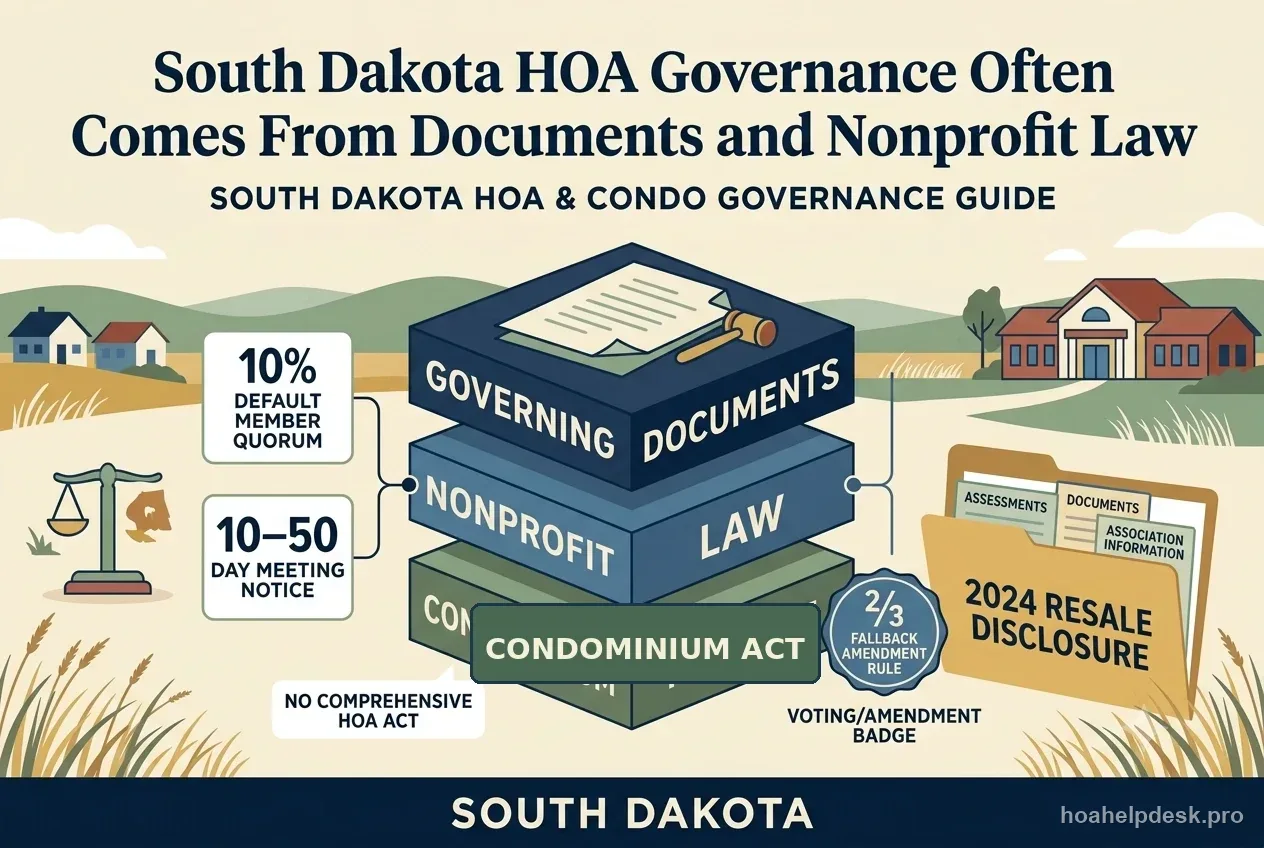
South Dakota has no modern comprehensive HOA governance act. Condominium projects use SDCL Chapter 43-15A, while many incorporated associations rely heavily on their declarations, bylaws, and nonprofit-corporation rules. If bylaws are silent, nonprofit law supplies a 10% member quorum and 10-to-50-day member-meeting notice. A 2024 statute also added HOA resale disclosures and a two-thirds fallback amendment rule for certain restrictive contracts.
Which statute governs your association
South Dakota boards should start by identifying the legal form of the community instead of assuming one statewide HOA code supplies every answer. Condominium projects are created under SDCL Chapter 43-15A through a recorded master deed or lease. A subdivision HOA may instead be governed chiefly by recorded covenants, articles, bylaws, and, if incorporated as a nonprofit, the nonprofit-corporation statutes that govern members, directors, meetings, and records.
The condominium chapter is comparatively narrow and still reflects a developer-registration structure. It defines the council of co-owners and requires the master instrument to address core project matters, but it does not create the detailed board-governance code found in some UCIOA states. If the governing documents impose a stricter notice, approval, or procedural requirement than a statutory default, follow the stricter document rule. Confirm the current statute text and any recent amendment before relying on this guide.
Reserve study and reserve funding
South Dakota’s condominium chapter does not establish a recurring statewide reserve study cycle or a statutory reserve-funding percentage for ordinary owner-controlled associations. The practical reserve framework therefore usually comes from the declaration, bylaws, adopted budgets, lender requirements, and the board’s general corporate duties. A board should distinguish a capital-replacement forecast from a legal mandate: a sensible reserve schedule is not automatically a statute-required reserve study.
For a document-driven HOA, the same caution applies. The absence of a statewide reserve-study mandate does not authorize the board to ignore a reserve covenant or a budget provision already written into the declaration. Treasurers should inventory roofs, roads, private utilities, and other long-lived common assets, then compare the expected replacement schedule with the governing documents before choosing contributions. Do not describe a board-adopted target as a South Dakota funding floor unless the recorded documents actually make it one.
Insurance and fidelity bond
SDCL Chapter 43-15A requires a condominium master deed or lease to contain provisions requiring the council of co-owners to maintain insurance on the condominium. The chapter, however, does not supply the detailed replacement-cost and fidelity bond formulas common in newer uniform acts. The declaration and insurance provisions therefore matter greatly when the board sets property, liability, crime, or directors and officers coverage.
For a non-condominium HOA, South Dakota statutes are likewise largely silent on a universal master insurance policy formula or statewide fidelity bond amount. Boards should read the declaration’s insurance clauses and any lender or management-contract requirements rather than importing a formula from another state. If governing documents require broader property limits, crime coverage, or D&O insurance, those requirements control the board’s purchasing decision even when state association statutes do not state a separate numerical floor.
Open meetings, notice, and agenda
South Dakota does not impose a California-style HOA open meeting code on all private associations. For an incorporated nonprofit, SDCL 47-23-7 supplies a default rule for member meetings: unless articles or bylaws provide otherwise, written notice stating place, day, and hour must be delivered not less than 10 nor more than 50 days before the meeting, and special-meeting notices must identify the purposes for which the meeting is called.
Board-meeting notice is more document-driven. Nonprofit law permits board meetings on the notice the bylaws prescribe and does not by itself create a universal owner-attendance right for every HOA board session. That makes the bylaws and declaration the first checklist for an open meeting, owner comment, agenda limits, or executive session practice. A board should not label a meeting “closed” merely because another state permits closed sessions for the same topic.
Sources: [2]
Quorum and voting thresholds
If a South Dakota nonprofit association’s bylaws do not set a different member quorum, SDCL 47-23-12 uses one-tenth of the votes entitled to be cast on the matter, represented in person or by proxy. With a quorum present, a majority of votes entitled to be cast by the members present or represented generally adopts the matter unless law, articles, or bylaws demand a greater proportion. Board quorum defaults to a majority of directors and may not be set below one-third.
South Dakota also added a useful fallback for restrictive contracts: if a declaration or restrictive contract fails to specify how it may be amended, SDCL Chapter 11 uses approval from two-thirds of the owners for the modification. That is not a universal substitute for every amendment clause. When documents already state how to amend the CC&Rs, use their threshold and any statute that specifically overrides it. Proxy and electronic-ballot procedures should also be checked against the association’s corporate documents.
Records access and retention
An incorporated nonprofit association must keep complete books and account records, minutes of member and board proceedings, and a record of members entitled to vote with their names and addresses. SDCL Chapter 47-24 also allows those records to be maintained electronically. The statute gives a member, or the member’s agent or attorney, a right to examine the corporation’s books and records at a reasonable time for a proper purpose.
South Dakota does not give every HOA a single association-specific records retention schedule comparable to Texas or Nevada. Boards should therefore combine the nonprofit statute with tax, insurance, contract, litigation-hold, and governing-document requirements when building a records retention policy. The fact that a statute says a document may be kept electronically does not mean it may immediately be destroyed; minutes, owner ledgers, governing documents, and major contracts should be mapped to a written retention schedule.
Sources: [3]
Budget and assessment disclosure
The condominium statute does not prescribe a modern statewide owner budget-ratification procedure for ordinary owner-controlled projects. In most communities, the declaration and bylaws determine who adopts the annual budget, when assessments are due, and what information owners receive. Nonprofit corporate rules can govern the mechanics of member voting, but they do not replace a project-specific assessment allocation written into the condominium master deed or HOA covenants.
South Dakota’s 2024 residential-transfer disclosure law adds an important transparency point at resale. When property is governed by a homeowners association, the disclosure must identify that fact and provide governing documents along with assessment information, including amount, frequency, purpose, and specified recent special assessments. That resale duty is different from annual budget disclosure by the board, so a treasurer should not assume compliance with one process satisfies the other.
Sources: [5]
Limits on assessment and fee increases
South Dakota does not impose a general statewide percentage cap on ordinary annual HOA or condominium assessment increases. The operative limit is commonly the declaration, bylaws, adopted budget procedure, or a specific contract provision. Boards should therefore avoid telling owners that state law authorizes an unlimited increase; the absence of a statutory percentage cap still leaves the association bound by its own allocation formula, voting thresholds, purpose restrictions, and contractual procedures.
For a special assessment, first read the recorded documents for owner-approval thresholds and purpose limits. If a board is funding a discretionary improvement rather than maintaining an existing common asset, the governing documents may require a vote even though the state association statutes do not create a generic special assessment percentage. Clearly separate a board’s ordinary budget authority from an owner vote required to amend covenants or authorize a capital project.
Fines and enforcement due process
South Dakota’s condominium and nonprofit statutes do not create a detailed statewide HOA fine-hearing code comparable to Texas Chapter 209. The association’s declaration, bylaws, and adopted rules therefore carry much of the procedural burden. Before a fine is imposed, the board should identify the recorded authority for the rule, the notice required by the documents, any opportunity to contest the charge, and whether the documents permit the amount or continuing schedule proposed.
A document-driven system makes consistency especially important. Use the same violation definitions and hearing steps for similarly situated owners, keep minutes showing the board’s decision, and separate an assessment lien from a penalty that the governing documents may treat differently. If the governing documents promise notice or a hearing, the board should follow that due process even when no separate South Dakota HOA statute states a universal number of days.
Sources
- South Dakota Legislature — Title 43, Property; Ch. 43-15A CondominiumsOfficial statute portal; Ch. 43-15A is the condominium chapter and Ch. 43-15 is listed as repealed.
- South Dakota Legislature — SDCL Ch. 47-23, nonprofit members and directorsOfficial source for member notice, default quorum, proxy voting, and board quorum rules.
- South Dakota Legislature — SDCL Ch. 47-24, nonprofit recordsOfficial source for books, minutes, membership records, and inspection rights.
- South Dakota Legislature — SDCL Ch. 11-5Official source; includes electronic voting authority and the fallback two-thirds amendment rule when restrictive documents lack an amendment provision.
- South Dakota Legislature — SDCL Ch. 43-4Official source for residential transfer disclosures, including HOA documents and assessment information added in 2024.
Compare nearby state rules
Check one decision against the statute
For a single board decision — a fine, a special assessment, a records request, an election, a CC&R amendment — the State Decision Lookup resolves the verified statutory rule for South Dakota and a growing set of other states, and the Board Decision Router lays out the research sequence. Both fail closed when the primary law is unclear rather than guessing.