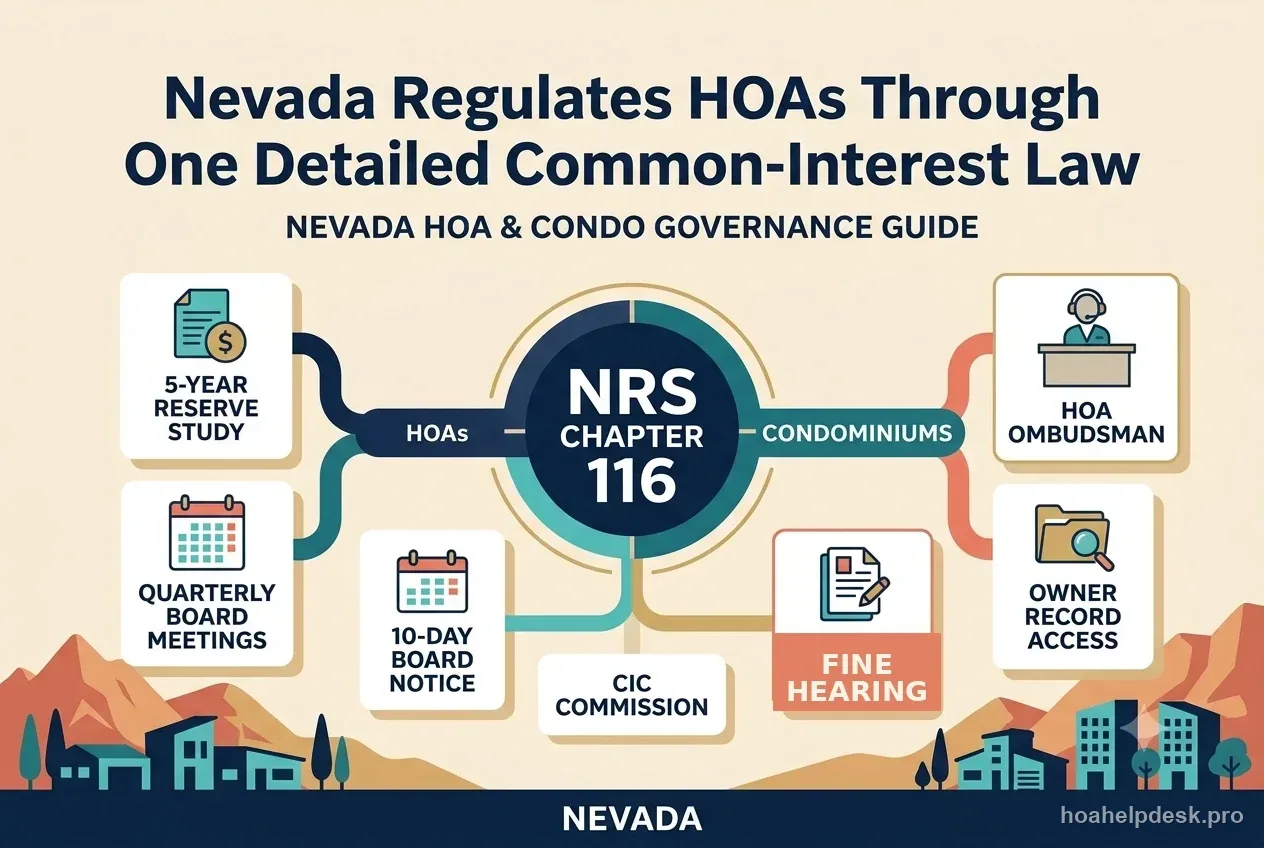
Nevada regulates most HOAs and condominiums under NRS Chapter 116. Boards generally need a reserve study at least every five years, quarterly board meetings with at least 10 days’ notice, formal owner-record access, and detailed budget procedures. Nevada also has a real state Ombudsman and CIC Commission. Governing documents may be stricter, but cannot override mandatory Chapter 116 protections.
Which statute governs your association
Nevada uses a unified common-interest-community statute. NRS Chapter 116 governs qualifying condominiums, planned communities, and other common-interest communities rather than forcing boards to switch between separate HOA and condominium governance acts. Exemptions and partial-applicability provisions exist, so a small or older community should verify that the specific section applies before copying a rule from a large master-planned association.
Nevada also has administrative regulations in NAC Chapter 116 and an active Real Estate Division, Office of the Ombudsman, and CIC Commission. That regulatory structure makes Nevada more statute-driven than most states in this project. Governing documents still matter, especially where Chapter 116 allows customization, but a declaration cannot contract around mandatory protections. Confirm the current statute text, regulations, and any recent amendment before relying on this summary.
Reserve study and reserve funding
Nevada requires the executive board to cause a study of reserves for major common components at least once every five years. The study must address components the association is obligated to maintain, repair, replace, or restore and include estimates supporting a funding plan. The executive board must also review the reserve study at least annually to evaluate whether reserve funding remains sufficient for the association’s obligations.
After the board adopts the reserve study, a summary must be submitted to the Division within the statutory deadline. Nevada regulations add process requirements for conducting, adopting, and disclosing reserve studies. This is not merely a “study only” state: the budget and annual review process must respond to reserve needs. Boards should still verify whether an exemption applies and should not raid reserves for ordinary operations simply because short-term cash flow is tight.
Insurance and fidelity bond
NRS 116.3113 requires qualifying associations to maintain property insurance on common elements and, for planned communities, property that must become common elements, subject to availability and statutory exclusions. The property coverage floor is tied to at least 80% of actual cash value after deductibles under the current text. Associations also maintain commercial general liability insurance and crime insurance covering dishonest acts by specified people who handle or control association affairs.
Nevada’s insurance rules were amended in recent sessions, so boards should verify the exact 2026 crime-coverage amount and scope before publishing a numerical formula or renewing a policy. D&O insurance remains distinct from property and crime coverage. The declaration may demand more coverage than the statute, and lenders may impose additional requirements. The board should document annual review of deductibles, insured property, manager coverage, and reserve-funded deductible exposure.
Sources: [1]
Open meetings, notice, and agenda
Nevada requires an executive-board meeting at least once every quarter and not less than once every 100 days. At least two board meetings each year must be held outside standard business hours. Unless an emergency or another statutory exception applies, owners must receive at least 10 days’ notice, and the notice must include the meeting agenda and follow Chapter 116 posting or delivery requirements.
Owners generally may attend board meetings and make audio recordings, while closed executive session is limited to statutory topics such as certain legal, personnel, and violation matters. Boards should not take final action on routine association business in closed session. Nevada’s meeting rules are detailed enough that a generic bylaw checklist is not sufficient; the secretary should use the current NRS section when preparing the notice, agenda, owner-comment period, and minutes.
Sources: [1]
Quorum and voting thresholds
Nevada Chapter 116 supplies election, quorum, ballot, and proxy rules that may differ from older association bylaws. Owner-meeting quorum can be affected by the declaration and statutory defaults, while executive-board action requires compliance with Chapter 116 and the association’s governing documents. Because Nevada election law has been amended repeatedly, the board should verify the current election and secret-ballot provisions before every annual election cycle.
Declaration amendment thresholds also depend on the provision being changed and the statutory section involved; there is no safe one-percentage answer for every amendment. Before trying to amend the CC&Rs, the board should identify whether owner approval, mortgagee approval, or affected-owner consent is required and then follow the current ballot and notice rules. Where the governing documents impose a larger lawful threshold, use the stricter requirement.
Sources: [1]
Records access and retention
NRS 116.31175 requires the executive board, after a written owner request, to make association books, records, and papers available for review at the association’s business office or a designated location within the statutory geographic limit and during regular working hours. The statute identifies financial statements, budgets, reserve information, contracts, minutes, and other categories, while also protecting specified confidential records.
Nevada also limits what an association may charge for review or copies and gives the Ombudsman an enforcement role in records disputes. The board should maintain a written records retention schedule rather than waiting for a request to expose missing files. Governing documents, adopted minutes, reserve studies, financial statements, insurance policies, contracts, election material, and enforcement records should be retained according to the current statutory and regulatory framework.
Budget and assessment disclosure
Nevada requires the executive board to prepare annual operating and reserve budgets and distribute required budget information to unit owners. After adoption of a proposed budget, the board follows a statutory owner-ratification process rather than treating the budget as final solely because directors voted for it. The current notice and ratification timelines should be checked directly in NRS 116.31151 before the annual budget calendar is set.
Reserve contributions must be tied to the reserve-study process, and the board should explain operating assessments separately from reserve funding and special assessments. Chapter 116 contains additional disclosure and collection provisions, so a board should not rely only on the declaration when state law is more protective. If the governing documents require longer notice or a higher owner vote than the statute, follow the stricter valid rule.
Sources: [1]
Limits on assessment and fee increases
Nevada does not use a simple statewide annual percentage cap that lets every association increase regular assessments by the same amount. The board’s power is shaped by the adopted and ratified budget, the declaration, reserve obligations, and Chapter 116’s collection rules. A large increase may still be lawful when supported by common expenses, but the association must follow the statutory budget process and any stricter declaration requirements.
Special assessments and charges should be separately authorized and documented. Boards should not label a fine, collection fee, reserve assessment, and ordinary annual assessment as interchangeable simply because all appear on an owner ledger. If the governing documents impose an owner vote for a special assessment or cap a particular charge, the board must honor it unless Chapter 116 provides a mandatory contrary rule.
Sources: [1]
Fines and enforcement due process
Nevada has detailed statutory due-process requirements for enforcement. Before imposing many fines for governing-document violations, the association must provide written notice describing the alleged violation and offer the owner an opportunity for a hearing before the appropriate body. Chapter 116 also regulates fine amounts, continuing violations, collection, and circumstances in which a fine may or may not support a lien.
The board should use the current statutory text rather than an old fine schedule because Nevada has amended enforcement rules over time. The hearing record should show the cited rule, evidence, notice, owner response, decision, and any continuing-violation calculation. The Office of the Ombudsman can assist owners and board members in understanding Chapter 116 and receives complaints or intervention requests within its statutory role.
Sources
- Nevada Legislature — NRS Chapter 116, Common-Interest Ownership (Uniform Act)Official Nevada statutory chapter; primary source for meetings, reserves, records, insurance, budgets, elections, and enforcement.
- Nevada Legislature — NAC Chapter 116Official administrative regulations, including reserve-study procedures.
- Nevada Real Estate Division — Office of the Ombudsman for CICCH/HOAsOfficial regulator/ombudsman role and association-registration information.
Compare nearby state rules
Check one decision against the statute
For a single board decision — a fine, a special assessment, a records request, an election, a CC&R amendment — the State Decision Lookup resolves the verified statutory rule for Nevada and a growing set of other states, and the Board Decision Router lays out the research sequence. Both fail closed when the primary law is unclear rather than guessing.