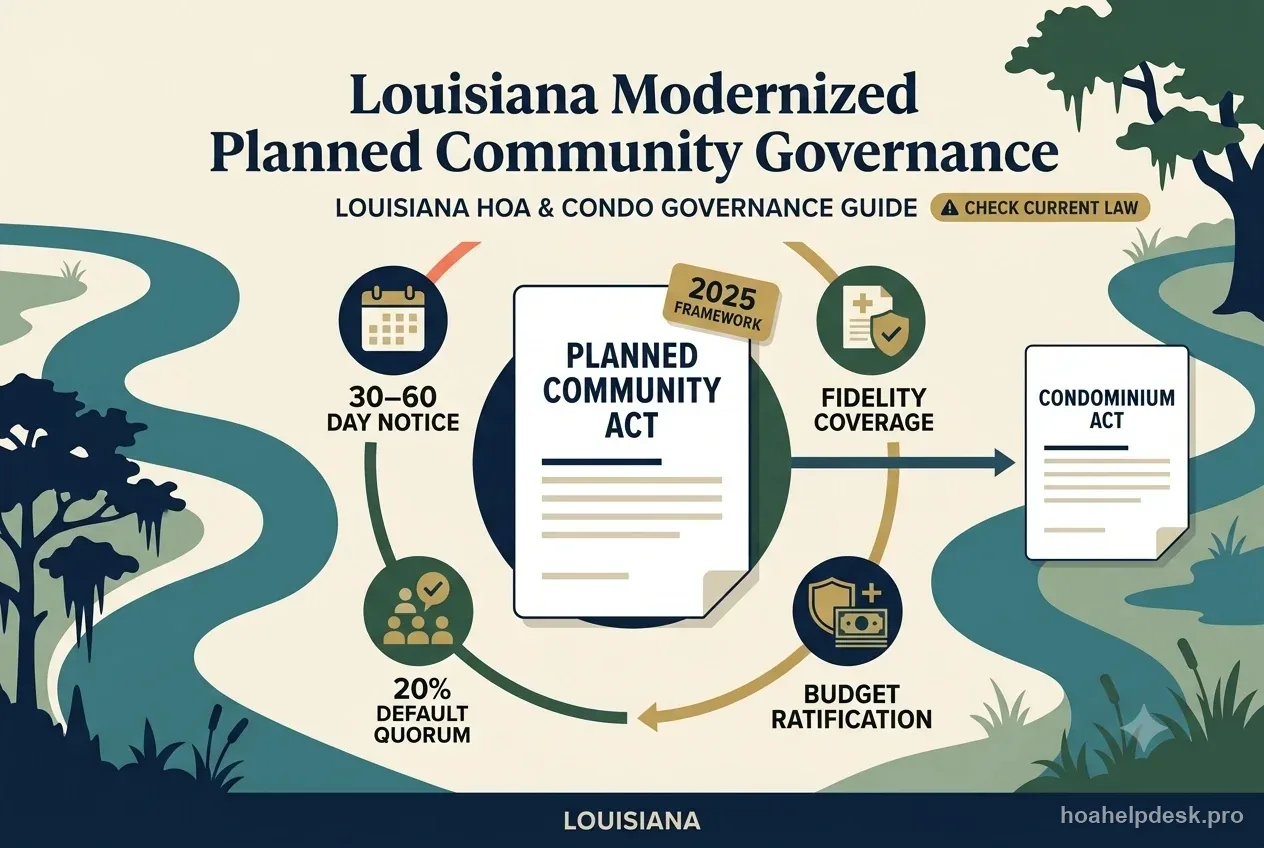
Louisiana’s Planned Community Act was substantially modernized effective January 1, 2025. Planned-community owner meetings generally use 30–60 day notice and a 20% default quorum; larger communities have a formal owner budget-ratification process. Condominiums follow a separate act with specific master-insurance and fidelity-bond requirements, so boards should not transfer HOA rules to condos or vice versa.
Which statute governs your association
Louisiana now has a modern statutory framework for planned communities as well as a separate condominium law. HOAs and subdivision associations that meet the planned-community definition use the Louisiana Planned Community Act, La. R.S. 9:1141.1 et seq. Condominiums remain governed by the Louisiana Condominium Act, La. R.S. 9:1121.101 et seq. The two regimes should not be blended when a board is researching notice, insurance, voting, or records.
Act 158 of 2024 substantially rewrote the Planned Community Act, with the new management provisions effective January 1, 2025. That timing matters because older forms, management handbooks, and blog posts may describe the pre-2025 law. The declaration remains the central contract for project-specific obligations, and Louisiana law expressly gives the declaration priority when it conflicts with another community document. Confirm the current statute text and any recent amendment before relying on this summary.
Sources: [1]
Reserve study and reserve funding
Louisiana’s Planned Community Act does not create a statewide recurring reserve study cycle comparable to Maryland’s five-year requirement. It does, however, force more transparency into the budget process. For planned communities with more than 25 lots, the annual budget summary must identify reserves and state the basis on which the reserves are calculated and funded. That is a disclosure and budgeting requirement, not a statutory engineering-study mandate.
The Condominium Act permits bylaws to establish reserves for maintenance, improvements, replacements, working capital, bad debts, obsolescence, and other appropriate purposes. It does not turn that permission into a universal reserve-study schedule. Boards should document their reserve assumptions, check lender and declaration requirements, and avoid saying Louisiana “requires full funding” unless a specific provision applicable to the project actually does.
Insurance and fidelity bond
Louisiana condominiums have unusually specific insurance rules. The association must maintain property insurance to the extent reasonably available, and the statutory property limit is not less than 80% of the actual cash value of the insured property after deductibles, excluding specified items such as land and foundations. The Condominium Act also requires comprehensive general liability insurance subject to the declaration and board-determined limits.
Condominium associations collecting common-expense assessments must also maintain a fidelity bond or equivalent insurance. The statutory amount is the lesser of $1 million or the association’s reserve balances plus one-fourth of aggregate annual assessments, with a $10,000 minimum. The planned-community statute is different: it requires commercial general liability coverage for the common areas but does not impose this same condo fidelity formula on every HOA. Boards must identify which act governs before calculating coverage.
Open meetings, notice, and agenda
For planned communities, annual and special owner meetings require notice no more than 60 days and no fewer than 30 days before the meeting. The notice must state the time, date, place, and agenda, including the general nature and text of a proposed community-document amendment, budget changes, and a proposal to remove a director or officer elected by the association. Owners must receive a reasonable opportunity to comment.
The Planned Community Act separately governs board meetings and executive-session subjects. Boards should use the statute’s authorized notice methods and keep emergency shortcuts limited to genuine emergencies. Condominium meeting procedure comes from the Condominium Act and the bylaws rather than from the new HOA meeting range, so a condo board should not automatically use the 30–60 day planned-community rule. If the declaration, CC&Rs, or bylaws impose a stricter procedural requirement than the statute, the board should follow the governing documents unless the statutory provision is mandatory and does not permit variation.
Quorum and voting thresholds
Unless the bylaws provide otherwise, the planned-community owner-meeting quorum is 20% of the voting interest, counted through owners present in person or by proxy, qualifying absentee ballots, or a permitted combination. The board quorum is a majority of board votes unless the statute or community documents require more. In a declared emergency, the statute has a special reduced owner-quorum rule that should be used only when the statutory emergency conditions are satisfied.
The planned-community voting statute recognizes proxies and ballots and requires ballot materials to disclose the number of responses needed for quorum and the voting interest necessary to approve the matter. Amendment thresholds still depend on the declaration and the specific statutory section governing the action. A board should never substitute the 20% quorum figure for the percentage required to amend recorded covenants.
Records access and retention
The revised Planned Community Act gives boards a detailed retention checklist. It includes accounting records; open-session minutes and records of action without a meeting; owner lists; governing documents and current rules; the past three years of financial statements and tax returns; current contracts; architectural decisions; and voting records. Ballots, proxies, and related voting materials must be kept for one year after the election, action, or vote to which they relate.
Upon a request for specific records, the association must make covered records available for examination and copying, subject to statutory exclusions and procedures. Condominium law is shorter but still requires financial and other records to be reasonably available to unit owners and their authorized agents. A board should maintain a written records retention schedule that distinguishes the new planned-community list from the condominium rule rather than assuming they are identical.
Budget and assessment disclosure
For planned communities with more than 25 lots, the board must submit a proposed budget at least annually for owner consideration at a duly called association meeting. Within 30 days after adopting a proposed budget, the board must give all owners a budget summary, including reserves and the basis for calculating and funding them, and schedule a ratification meeting no fewer than 10 and no more than 60 days after the summary is provided.
The budget is ratified by majority vote unless the declaration requires a greater vote. If owners do not ratify the proposal, the last ratified budget continues until a later budget is ratified. Special assessments have their own procedure under the same statute. This is a meaningful owner-ratification structure, so a Louisiana planned-community board should not treat the annual budget as an internal board document that becomes effective without the required owner process.
Sources: [3]
Limits on assessment and fee increases
Louisiana does not impose a single statewide percentage cap on annual HOA or condominium assessment increases. In planned communities, the controlling constraints are the declaration, the annual budget-ratification procedure, and any specific special-assessment provisions. The absence of a statewide percentage ceiling does not mean the board may ignore a declaration that caps dues or requires an owner vote above a stated threshold.
Condominium assessments follow the Condominium Act and declaration. Boards should distinguish the authority to adopt a budget from the authority to change allocated common-expense shares or other recorded property rights. A treasurer explaining an increase should identify whether the change is a regular assessment, a reserve contribution, or a special assessment and cite the actual provision authorizing it. If the declaration, CC&Rs, or bylaws impose a stricter procedural requirement than the statute, the board should follow the governing documents unless the statutory provision is mandatory and does not permit variation.
Fines and enforcement due process
The revised Planned Community Act requires reasonable rules and provides a notice-and-comment process before the board adopts, amends, or repeals a rule. It also directs associations to establish reasonable procedures for receiving and resolving written owner complaints. Those procedural protections are important when the same rule later becomes the basis for an enforcement action.
Louisiana does not set one universal dollar cap for every HOA or condo fine in the statutes cited here. The board should confirm the declaration’s sanction authority, provide the notice and hearing process required by the governing documents and applicable law, and distinguish fines from unpaid assessments before asserting a lien. Consistent enforcement and a written record of the board’s decision are especially important when a sanction could later be challenged in court.
Sources: [1]
Sources
- Louisiana Planned Community Act, La. R.S. 9:1141.1 et seq.Official Louisiana Legislature table of contents for the Planned Community Act, substantially revised by Act 158 of 2024 effective January 1, 2025.
- La. R.S. 9:1141.26 — planned-community owner and board meetingsOfficial annual/special meeting notice rule; adjacent sections cover quorum and voting.
- La. R.S. 9:1141.34 — budgets and special assessmentsOfficial budget-ratification and special-assessment provisions for planned communities.
- La. R.S. 9:1141.36 — association recordsOfficial planned-community retention and inspection requirements.
- La. R.S. 9:1123.112 — condominium property and liability insuranceOfficial condominium master-insurance section; fidelity coverage is in the immediately following statute.
- La. R.S. 9:1123.113 — condominium fidelity bond or equivalent insuranceOfficial condominium fidelity rule; includes the lesser-of $1 million/reserves-plus-one-fourth-assessments formula and $10,000 minimum.
Compare nearby state rules
Check one decision against the statute
For a single board decision — a fine, a special assessment, a records request, an election, a CC&R amendment — the State Decision Lookup resolves the verified statutory rule for Louisiana and a growing set of other states, and the Board Decision Router lays out the research sequence. Both fail closed when the primary law is unclear rather than guessing.