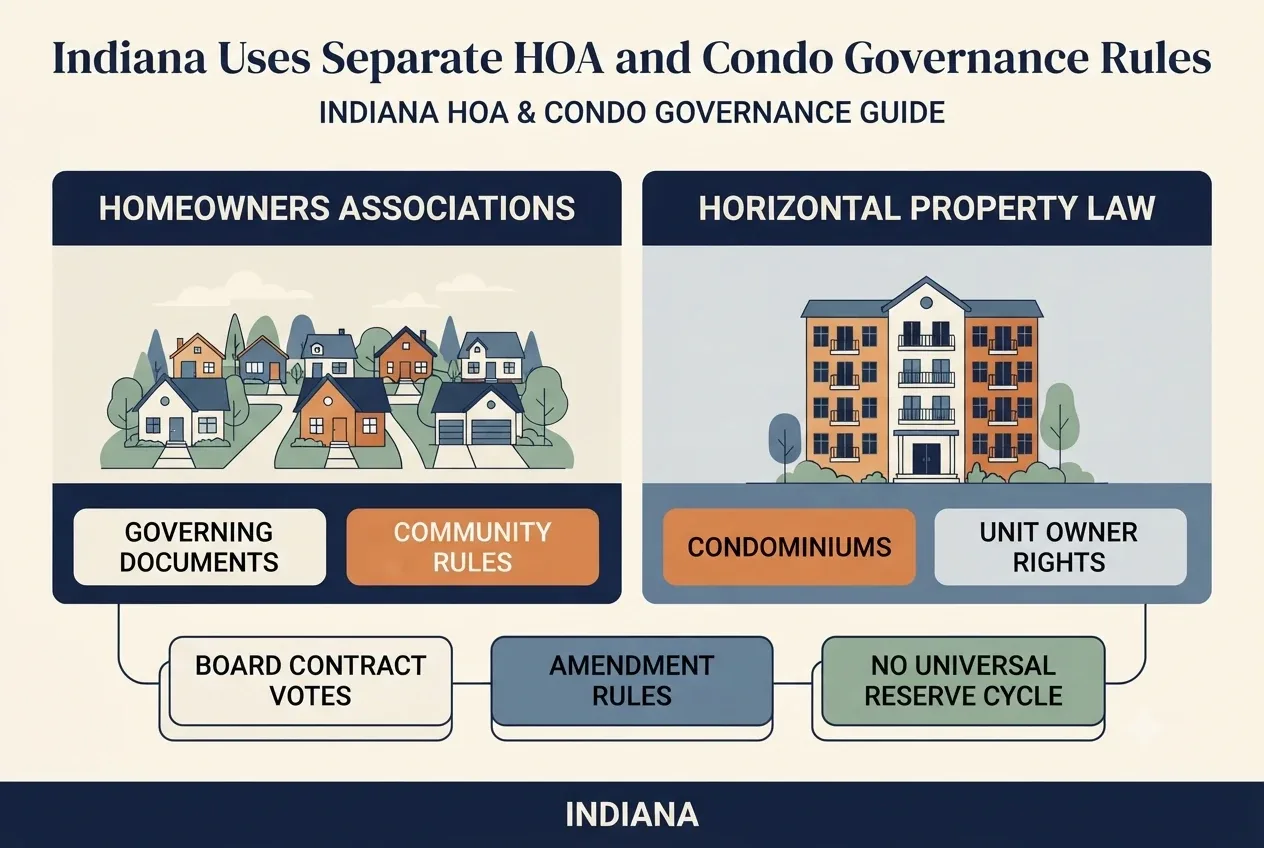
Indiana separates condominiums under Article 32-25 from HOAs under Article 32-25.5, and some HOA duties depend on the association's formation date. The state has targeted owner-vote rules for certain high-impact contracts and statutory limits on some amendment thresholds, but no universal reserve-study cycle or general annual-dues cap. Recheck 2026 amendments before using a precise voting rule.
Which statute governs your association
Indiana separates condominium law from the homeowners-association statute. Condominiums are governed under Indiana Code Article 32-25, while homeowners associations are addressed in Article 32-25.5. The HOA article was enacted much later and has applicability rules that matter, especially for associations established before July 1, 2009. Some provisions apply broadly, while other budget requirements depend on when the association was established or whether an older association opted into the statutory regime.
That applicability split is a reason to avoid generic statements such as 'Indiana HOAs must do X' without checking the section. The declaration, covenants, bylaws, and corporate law can fill gaps or impose stricter valid procedures. If the governing documents require more notice or a higher approval threshold than the statute allows, the board must analyze both sources before acting. Confirm the current statute text and any recent amendment before relying on this guide.
Reserve study and reserve funding
Indiana does not impose one broad statewide reserve-study cycle or mandatory reserve-funding percentage on every HOA and condominium. The researched HOA and condominium articles focus more heavily on association powers, meetings, records, budgets, insurance, and voting than on a periodic reserve-study mandate. That statutory silence does not eliminate the board's capital-planning duty when the declaration, lender documents, contracts, or condition of common assets makes reserve planning necessary.
Boards should therefore separate a voluntary reserve study from a legally required reserve contribution. A study can be a strong governance tool for roofs, paving, drainage, private roads, elevators, or other long-life components even when Indiana law does not dictate a fixed update interval. If the declaration requires a reserve account or limits use of reserve money, those provisions should be copied into the board's annual funding resolution rather than summarized from memory.
Insurance and fidelity bond
Indiana condominium law includes master casualty and liability insurance concepts, while the HOA article does not create one universal property-policy or fidelity-bond formula for all planned communities. A condominium board should review Article 32-25 together with the declaration to determine what property the association insures and what unit owners insure. An HOA with private roads, a clubhouse, ponds, or other common property will usually rely much more on its covenants and insurance contracts to define the required coverage.
A board should treat D&O insurance, fidelity bond or crime coverage, and the master insurance policy as three separate risk controls. The absence of a statewide fidelity formula does not answer whether the declaration, lender, or management agreement requires coverage. The treasurer should verify who is insured, who is an authorized signer, whether reserve funds are included in the crime limit, and whether a management company's policy actually extends protection to the association.
Open meetings, notice, and agenda
Indiana's HOA article contains meeting and owner-participation provisions, but the exact requirements depend on the association and the current text of Article 32-25.5. Boards should not assume that every conversation among directors is exempt simply because it occurs by email or outside a scheduled meeting. The safest procedure is to use the bylaws and statute to define board meetings, give the required notice, keep minutes, and reserve any closed discussion for a legally supportable purpose.
Condominium governance is controlled separately under Article 32-25 and the condominium bylaws. Indiana's condominium statute requires bylaws to address administration, meetings, quorum, and related governance mechanics, so the governing documents do substantial work. Because 2026 legislation amended parts of Indiana HOA law, any board relying on a precise meeting notice period or newly added owner right should recheck the current code and effective date rather than use a prior-year checklist.
Quorum and voting thresholds
Indiana HOA law contains several subject-specific voting rules that should not be confused with ordinary meeting quorum. One notable rule limits governing documents from requiring more than seventy-five percent of owners to approve many amendments, while allowing a higher threshold for particular subjects such as conveyance of common areas or dissolution. That section was amended in 2026, so a board should verify the current wording before using the percentage in an amendment notice or legal opinion.
The HOA article also regulates proxies, including required information, methods of delivery, and an outside expiration period. Condominium bylaws must address quorum and owner voting, and the condominium statute also constrains certain amendment thresholds. For any CC&R amendment, the board should build a vote worksheet that states the statutory ceiling or floor, the declaration threshold, the voting denominator, proxy rules, and any declarant or mortgage-holder rights before ballots are distributed.
Records access and retention
Indiana's HOA article contains financial-record and owner-access provisions, including rules that apply even to some older associations that are not fully subject to the annual-budget subsection. That makes formation date important: a board cannot assume that an older HOA is outside every records duty simply because it predates the 2009 statute. The association should maintain a written retention schedule, identify the statutory provision for owner inspection, and keep financial records in a form that can be produced without exposing protected owner information.
Condominium law separately requires books showing receipts and expenditures to be available for examination at reasonable times under the statutory framework. The condominium bylaws and management agreement may impose additional recordkeeping. Directors should keep board minutes, budgets, contracts, insurance records, election materials, and owner ledgers in distinct categories. A records request is much easier to answer when the association can identify which materials are owner-accessible, which are privileged, and which have a document-specific retention rule.
Budget and assessment disclosure
Indiana's HOA annual-budget rule is not universally identical for every association. Article 32-25.5's budget provisions apply to associations established after June 30, 2009 and to certain older associations that opted into the statutory framework, while some records provisions reach more broadly. A board should therefore document the association's formation date and statutory status before telling owners that a particular budget procedure is mandatory. The declaration may impose its own budget-notice or member-approval requirements regardless of statutory coverage.
Indiana also has a targeted owner-approval rule for certain HOA contracts. Under the researched § 32-25.5-3-4 framework, a contract that would cause a new or increased assessment of more than $500 per year for an affected member requires two association meetings and approval by two-thirds of affected members, with at least seven days' notice before the first meeting. This is a contract-trigger rule, not a universal annual-assessment cap.
Limits on assessment and fee increases
Indiana should not be described as having a general statewide percentage cap on ordinary HOA dues. The $500 contract-trigger provision regulates a particular pathway by which a contract produces a new or increased assessment; it does not mean every annual increase above $500 is automatically unlawful. The governing documents may create additional limits or member-vote requirements. A special assessment should therefore be analyzed by purpose, authority, voting threshold, notice, and any contract involved.
For condominium associations, assessment authority and allocation also depend on Article 32-25 and the recorded condominium instruments. Directors should not copy HOA Article 32-25.5 limits into a condominium budget. When the board proposes a major increase, the treasurer should show owners which part is operating expense, which is reserve funding, and which is tied to a specific contract or capital project. That transparency helps prevent a statutory voting trigger from being overlooked.
Fines and enforcement due process
Indiana's HOA statute and governing documents should be read together before the board imposes a fine. The declaration must authorize the rule being enforced, and the association should follow any statutory or bylaw grievance process that applies. The board's enforcement file should include the operative covenant or rule, dated evidence of the violation, notice, the owner's response, any hearing or grievance step, and the final decision. A management company's software workflow does not replace authority in the declaration or statute.
The board should also distinguish fines from unpaid assessments. Lien and collection rights may attach differently, and the fact that an owner owes a fine does not automatically answer whether the association can foreclose or recover attorney fees. Because Indiana adopted additional HOA legislation in 2026, boards should recheck the current version of Article 32-25.5 before relying on an older enforcement form. If the documents require stricter due process, that stricter procedure should be followed.
Sources
- Indiana Code — Title 32, Property (2026 current code portal)Official Indiana General Assembly current-code portal; use Article 25 for condominiums and Article 25.5 for homeowners associations.
- Indiana Code, Article 32-25.5 — Homeowners AssociationsOfficial current-code location for the Homeowners Associations article; exact deep-link behavior should be verified during assembly.
- Indiana Code, Article 32-25 — CondominiumsOfficial current-code location for the Horizontal Property Law / condominium provisions.
- Indiana General Assembly — 2026 Acts / Code update informationOfficial legislature source for current Indiana Code and recent public laws; use to verify 2026 amendments and effective dates.
- Indiana HB 1150 (2026)Official bill page for 2026 HOA legislation; verify enacted public-law number and current codification before citing a changed section.
Compare nearby state rules
Check one decision against the statute
For a single board decision — a fine, a special assessment, a records request, an election, a CC&R amendment — the State Decision Lookup resolves the verified statutory rule for Indiana and a growing set of other states, and the Board Decision Router lays out the research sequence. Both fail closed when the primary law is unclear rather than guessing.