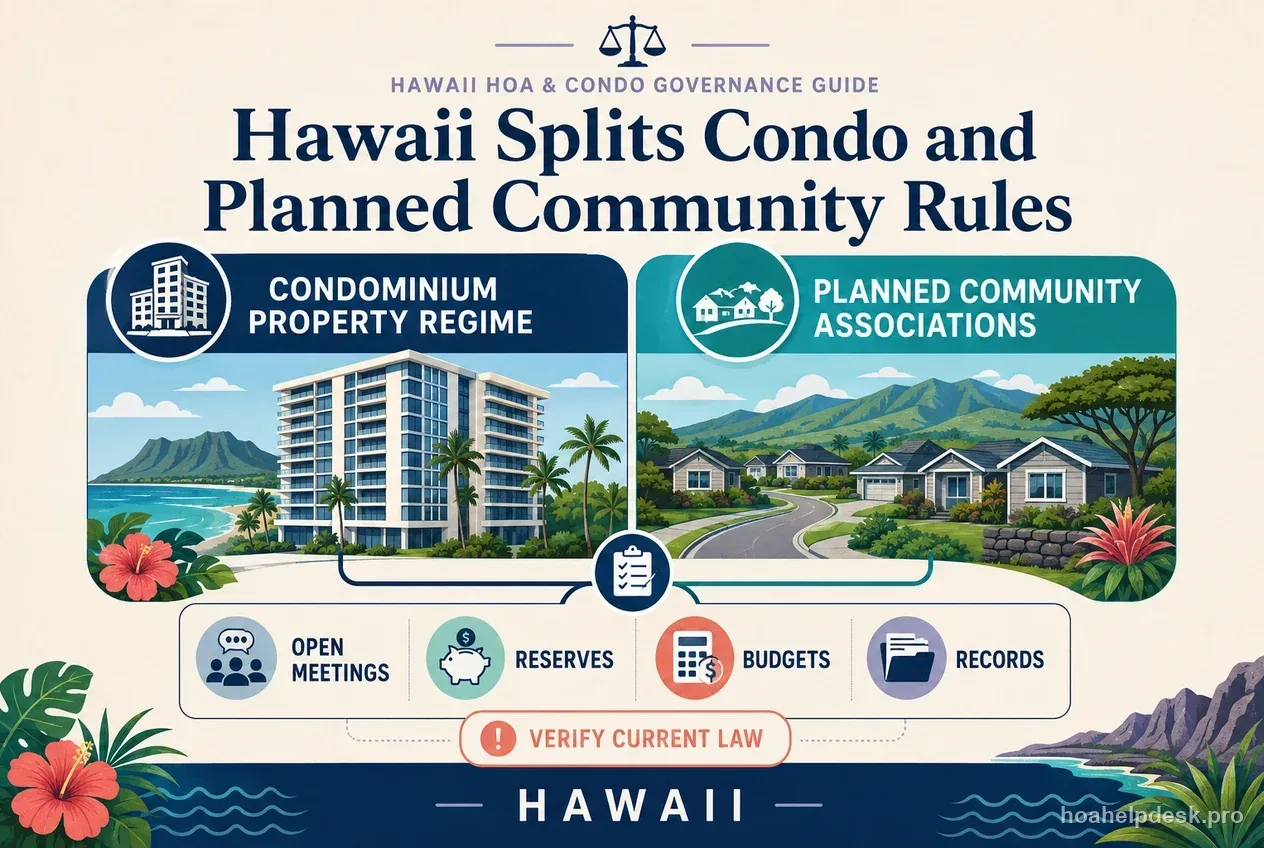
Hawaii separates planned-community HOAs under HRS Chapter 421J from condominiums under Chapter 514B. Condo boards face detailed reserve, insurance, and meeting rules, including a 72-hour board-meeting notice framework and statutory fidelity coverage. Planned-community boards have open-meeting and 14-day member-meeting notice rules but fewer statewide reserve mandates. Governing documents still control many voting and assessment questions.
Which statute governs your association
Hawaii boards must first identify whether the project is a planned community or a condominium. Planned-community associations are principally governed by HRS Chapter 421J, while condominium associations are governed by HRS Chapter 514B. A corporate association may also be subject to Hawaii's nonprofit-corporation statute, Chapter 414D. Those layers do different jobs: the property statute supplies association-specific rules, while corporation law can fill governance gaps involving directors, meetings, and organizational procedure.
For condominiums, Chapter 514A was repealed effective July 1, 2020, and Chapter 514B now carries the operative condominium-governance framework, subject to its applicability provisions. A board should still read the declaration, bylaws, and recorded amendments beside the statute. If the governing documents impose a stricter procedure than the statute permits, the board should follow that stricter requirement unless the statute makes the rule exclusive. Confirm the current statute text and any recent amendment before relying on this guide.
Reserve study and reserve funding
Hawaii's condominium reserve regime is materially more prescriptive than the planned-community HOA regime. Chapter 514B requires condominium budgeting to address replacement reserves and ties annual reserve collections to the association's reserve plan. DCCA guidance also explains that when the reserve study is not prepared by an independent preparer, an independent review is required at least every three years. That makes reserve planning an ongoing board process rather than an occasional capital-project exercise.
Chapter 421J does not create a comparable statewide reserve-study cycle for ordinary planned-community HOAs. For those associations, the declaration, bylaws, board-adopted financial policies, loan covenants, and the board's general fiduciary duties carry much more of the load. Directors should not import the condominium rules into an HOA simply because both communities collect assessments. The correct question is whether the association is legally a condominium under Chapter 514B or a planned community under Chapter 421J.
Insurance and fidelity bond
Condominium boards have specific statutory insurance duties. HRS § 514B-143 requires property coverage for common elements at specified replacement-cost standards, commercial general liability coverage of at least $1 million, and fidelity coverage for associations with more than five units. The fidelity formula is $500 per unit, subject to a $20,000 minimum and a $200,000 maximum, and the statute also addresses directors and officers insurance. These are statutory floors, not a substitute for reviewing actual policy exclusions and deductibles.
Chapter 421J is far less detailed for planned-community HOA insurance. The governing documents, contracts, lender requirements, and prudent risk management therefore become central. An HOA board should distinguish a master insurance policy protecting association property from D&O insurance protecting directors and officers, and from fidelity bond or crime coverage protecting association funds. A management contract should never be treated as proof that the association itself carries the coverage required by its declaration or risk profile.
Sources: [5]
Open meetings, notice, and agenda
Hawaii planned-community boards operate under an open-board-meeting rule in HRS § 421J-5. Except for permitted executive session subjects, board meetings are open to members, and the board must meet at least once each year. The statute permits executive session for personnel matters, litigation, and attorney-client communications. It also bars board-member proxy voting. Separate member-meeting rules require at least 14 days' notice for regular, annual, and special association meetings, with the notice identifying the meeting and agenda.
Condominium boards have a different notice framework. DCCA guidance applying Chapter 514B states that association meetings generally require 14 days' notice, while notice of a condominium board meeting must be posted at least 72 hours in advance, or at the same time notice is given to directors if that occurs later, and must include the agenda. The board should not use the HOA timetable for a condominium or the condominium timetable for a Chapter 421J planned community.
Quorum and voting thresholds
Hawaii does not give every association one universal quorum or amendment percentage. Chapter 421J and Chapter 514B contain specific voting rules for certain subjects, but the declaration and bylaws remain critical for ordinary membership quorum, director elections, and many amendment questions. A board preparing a ballot should identify the exact voting denominator: votes cast, votes present at a quorum, or the entire membership. Treating those denominators as interchangeable is a common way to invalidate an otherwise well-run vote.
Planned-community directors should also remember that HRS § 421J-5 prohibits a board member from voting by proxy at a board meeting. Owner proxies are a different subject and must be checked against the association documents and any applicable statutory restrictions. For condominiums, Chapter 514B contains its own election and proxy provisions. Before a major CC&R amendment or removal vote, the secretary should create a written threshold memo showing the governing section, denominator, proxy treatment, and record-retention plan.
Records access and retention
Both statutory systems give owners meaningful access rights, but the lists, procedures, and exceptions are not identical. Condominium associations have detailed records obligations under Chapter 514B, including financial and governance materials, while Chapter 421J addresses planned-community association documents and member access more narrowly. The safest board workflow is to classify each request by document type, identify any privacy or privilege exception, and answer under the statute that actually governs the project rather than using a generic 'HOA records policy.'
Budget and assessment disclosure
Condominium budgeting is closely connected to the statutory reserve framework. Chapter 514B requires an annual budget and reserve planning, and owners should be able to see how operating expenses, replacement reserves, and anticipated projects fit together. Planned-community HOAs do not have the same statewide reserve-budget architecture under Chapter 421J, so their bylaws and declaration may do more work. In both settings, the board should separate the operating budget from a reserve schedule and from any one-time capital assessment.
For planned communities, HRS § 421J-9 requires written notice of an increase in the regular assessment at least 30 days before the increase takes effect. That is a notice rule, not a statewide percentage cap. Directors should avoid telling owners that Hawaii law limits the amount of every HOA increase merely because it regulates when notice must be given. Any substantive ceiling may instead come from the declaration, bylaws, or a member-approval provision in the governing documents.
Limits on assessment and fee increases
Hawaii does not impose one simple statewide percentage cap that applies alike to every condominium and planned-community assessment increase. Chapter 421J's 30-day notice rule for regular-assessment increases should not be converted into an invented dollar or percentage ceiling. Condominium assessment authority is structured through Chapter 514B, the approved budget, allocated common interests, and the declaration. When a proposed increase is controversial, the board should identify whether owner approval is required by the governing documents before announcing the amount or effective date.
Fines and enforcement due process
Enforcement authority in Hawaii depends heavily on the applicable statute and the association's governing documents. A board should be able to point to the covenant or rule allegedly violated, the source of its authority to impose a fine or other sanction, the notice given to the owner, and the procedure used to consider the response. Condominium and planned-community rules are not interchangeable, and a collection lien for unpaid common expenses should not automatically be assumed to cover every fine without checking the controlling statute and declaration.
Sources
- Hawaii Revised Statutes, Chapter 514B — CondominiumsOfficial Hawaii State Legislature current-statutes chapter page; primary condominium statute.
- Hawaii Revised Statutes, Chapter 421J — Planned Community AssociationsOfficial Hawaii State Legislature chapter page for planned-community HOAs.
- Hawaii DCCA Real Estate Branch — Hawaii Revised StatutesDCCA index linking the official condominium and planned-community statutes and explaining agency jurisdiction.
- Hawaii DCCA — Condominium Governance FAQsState agency guidance on Chapter 514B meeting notice, board procedure, reserves, records, and related governance topics.
- Hawaii Revised Statutes, § 514B-143 — InsuranceOfficial section for condominium property, liability, fidelity, and directors-and-officers insurance requirements.
Compare nearby state rules
Check one decision against the statute
For a single board decision — a fine, a special assessment, a records request, an election, a CC&R amendment — the State Decision Lookup resolves the verified statutory rule for Hawaii and a growing set of other states, and the Board Decision Router lays out the research sequence. Both fail closed when the primary law is unclear rather than guessing.