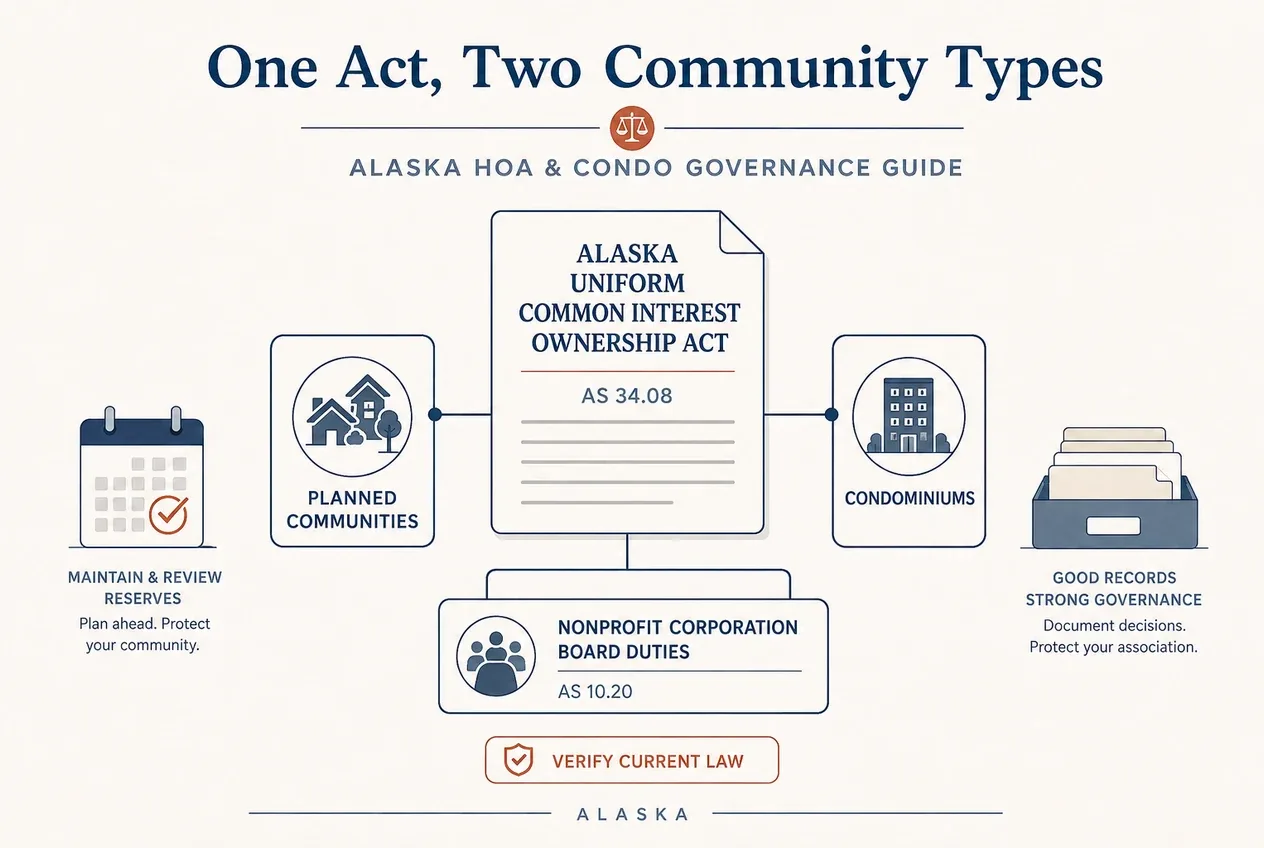
Alaska largely uses one UCIOA-based statute, AS 34.08, for post-1985 condos, cooperatives, and planned communities. Association meetings require 10–60 days’ notice, declaration amendments generally require at least 67% of allocated interests, and the association must maintain specified property and liability insurance. The statute authorizes reserve budgeting but does not impose a universal recurring reserve-study schedule or reserve-funding percentage.
Which statute governs your association
Alaska is different from states that maintain one HOA act and a separate condominium act. For common-interest communities created after January 1, 1986, AS 34.08 — Alaska’s Uniform Common Interest Ownership Act — is the central governance statute for condominiums, cooperatives, and planned communities. That unified structure means many rules on meetings, budgets, insurance, voting, records, assessments, and enforcement apply across property forms, although particular sections still distinguish between condominiums, cooperatives, and planned communities where the ownership structure requires it.
Creation date still matters. Older condominium regimes can fall under AS 34.07, and transition provisions determine when later AS 34.08 rules reach pre-1986 communities. Small or limited-expense planned communities may also have narrower statutory coverage unless the declaration opts into the full chapter. A volunteer board should therefore begin with the recorded declaration and date of creation, not merely the word “HOA” on a bank account. If the declaration or bylaws impose a stricter governance rule than the statutory minimum, follow that stricter requirement. Confirm the current statute text and any recent amendment before relying on this guide.
Reserve study and reserve funding
AS 34.08 expressly allows the association to adopt budgets for revenues, expenditures, and reserves, and common expenses include allocations to reserves. That makes reserve planning part of the statutory financial framework. However, the Act does not establish a universal rule that every Alaska association must commission a professional reserve study every three, five, or ten years, nor does it impose one statewide “percent funded” target. A board should not convert the statute’s authority to budget for reserves into a fictional recurring study mandate.
The practical reserve obligation is driven by the declaration, the association’s maintenance responsibilities, the age and condition of common components, lender or insurer requirements, and the annual budget. New-development disclosures can include assumptions about reserves, which is useful context when the board inherits a developer budget. For mature communities, document why the board’s reserve contribution is reasonable and revisit component costs periodically even when no statutory study cycle applies. If governing documents require a reserve study or minimum contribution, that stricter requirement controls the board’s internal process.
Insurance and fidelity bond
AS 34.08.440 requires the association, beginning no later than the first conveyance to a non-declarant purchaser and to the extent reasonably available, to maintain property insurance on common elements and liability insurance. The property coverage formula is unusually concrete: after deductibles, the required amount is tied to 100% of the actual cash value of the insured property, excluding land, excavations, foundations, and normally excluded items. Liability coverage must cover customary bodily-injury and property-damage occurrences associated with common elements and cannot be lower than a declaration-specified amount.
The statute also permits an association to indemnify directors and officers and maintain D&O insurance. It does not provide the same statewide fidelity-bond formula found in California. Accordingly, a treasurer should separate three questions: what AS 34.08.440 requires for property and liability coverage, what the declaration requires for crime or fidelity coverage, and what the association’s bank, lender, manager contract, or insurer requires operationally. If the declaration sets higher limits or additional coverage, the governing document is the board’s stricter internal standard.
Open meetings, notice, and agenda
Alaska’s UCIOA-based meeting rule is specific for association meetings. AS 34.08.390 requires at least one association meeting each year. A special meeting may be called by the president, a majority of the executive board, or unit owners holding 20% of the votes, unless the bylaws set a lower owner percentage. Notice must be delivered not less than 10 nor more than 60 days before the meeting and must state the time, place, and agenda items, including the general nature of proposed declaration or bylaw amendments, budget changes, and removal proposals.
That section should not be overstated as a complete open-board-meeting code. Alaska does not mirror Arizona’s detailed owner-speaking and recording statute or California’s four-day board-meeting agenda rule. Boards should therefore examine their declaration and bylaws for board-meeting notice, remote participation, owner attendance, executive session, and agenda procedures. If those documents create an open meeting promise or a longer notice period, the board should comply. Good minutes should distinguish the statutory member meeting from routine executive-board action so owners can see which rule the board used.
Quorum and voting thresholds
AS 34.08 contains separate sections for quorums and voting, and the declaration can modify some default mechanics. One important statewide floor is the declaration-amendment rule: except for specified statutory exceptions, an amendment generally requires the vote or agreement of unit owners holding at least 67% of the allocated interests, or a larger percentage stated in the declaration. A board should calculate that percentage against the allocated interests required by the statute and declaration, not merely against ballots returned at a meeting.
Proxy and multiple-owner voting issues should be handled under the UCIOA voting provisions and the bylaws rather than improvised at the meeting. Boards also need to distinguish ordinary board action, member elections, declaration amendments, termination votes, and conveyance of common elements, because the approval thresholds can differ materially. When the declaration requires a supermajority above the statute’s default, the stricter declaration controls. Keep the tabulation record with the meeting minutes so a future board can reconstruct the denominator and approval threshold.
Records access and retention
AS 34.08.490 requires sufficiently detailed financial records and makes financial and other association records reasonably available for examination by a unit owner and an authorized agent. It also imposes a practical handoff rule: a professional manager, managing agent, accountant, or other contracted service provider must return association records within five days after the contract terminates. That is an important board-control provision when changing managers because the records belong to the association, not to the departing vendor.
The statute does not create one comprehensive retention period for every category of record. A board should therefore adopt a records retention schedule that accounts for governing documents, approved minutes, tax records, insurance claims, contracts, owner ledgers, reserve documentation, election records, and litigation holds. “Reasonably available” access does not mean every file is automatically public without regard to privilege, privacy, or other law. Use the governing documents and counsel where needed to separate inspectable association records from protected material.
Budget and assessment disclosure
Alaska associations may adopt and amend budgets for revenues, expenditures, and reserves. Common-expense assessments are made under AS 34.08.460 and are based on a budget adopted by the association. The declaration determines allocated interests and can materially affect which units bear particular costs. For a board, the compliance task is therefore more than setting a total dues number: each expense needs to be classified consistently with the declaration and the common-expense allocation rules before the assessment is spread across units.
The statute’s meeting provision specifically requires association-meeting notices to identify budget changes on the agenda, but Alaska does not use California’s 30-to-90-day annual budget-report package. Check the bylaws for any additional delivery or ratification process. A clean board record should include the proposed budget, reserve contribution, allocation method, meeting or board action adopting it, and the effective assessment schedule. If the governing documents require a membership vote or longer notice, that stricter procedure governs.
Limits on assessment and fee increases
AS 34.08 does not impose a general statewide percentage cap on annual common-expense assessment increases for ordinary associations. Instead, assessments arise from the budget and the allocation of common-expense liability. Small or limited-expense planned communities can have special statutory treatment, and the declaration may cap assessments or require owner approval. A board should therefore avoid statements such as “Alaska allows unlimited increases.” The absence of a general statutory percentage cap does not displace the declaration, budget requirements, allocation rules, or fiduciary standards.
Special assessments should be traced to the association’s authority under the declaration and AS 34.08 and should be allocated using the correct common-expense formula. If the governing documents require owner approval above a certain amount, that rule is the operative internal limit. Boards should also separate regular assessments from usage fees, late charges, fines, and reimbursement charges because each has a different legal basis and accounting treatment. A transparent budget explanation is the strongest way to show why an increase is tied to actual community obligations.
Fines and enforcement due process
The Alaska Act authorizes an association, after notice and an opportunity to be heard, to levy a reasonable fine for a violation of the declaration, bylaws, or rules. That phrase establishes a due-process floor: the board should identify the alleged violation, give the owner meaningful notice, provide the hearing opportunity contemplated by the statute and governing documents, and record the final decision. An enforcement policy should not bypass those steps merely because the violation appears obvious to the board.
Fines, late charges, assessments, and liens should remain distinct in the association ledger and in board communications. AS 34.08 contains assessment-lien provisions, but whether a particular charge can be enforced as an assessment depends on the statute and declaration. Before turning a fine into a collection or lien matter, verify the exact subsection in effect and any governing-document restrictions. Consistent enforcement also matters: apply the same published rule and hearing process to similarly situated owners unless there is a documented reason for different treatment.
Sources
- Alaska Statutes Title 34 — official current PDFPrimary official source; AS 34.08 is the Uniform Common Interest Ownership Act.
- Laws of Alaska 1985, Chapter 95 — UCIOA enactmentOfficial session law useful for insurance, records, meeting, and assessment text.
- Alaska Legislature HB 477 text — later AS 34.08 amendmentsOfficial legislative text showing applicability and later amendments to AS 34.08.
Compare nearby state rules
Check one decision against the statute
For a single board decision — a fine, a special assessment, a records request, an election, a CC&R amendment — the State Decision Lookup resolves the verified statutory rule for Alaska and a growing set of other states, and the Board Decision Router lays out the research sequence. Both fail closed when the primary law is unclear rather than guessing.