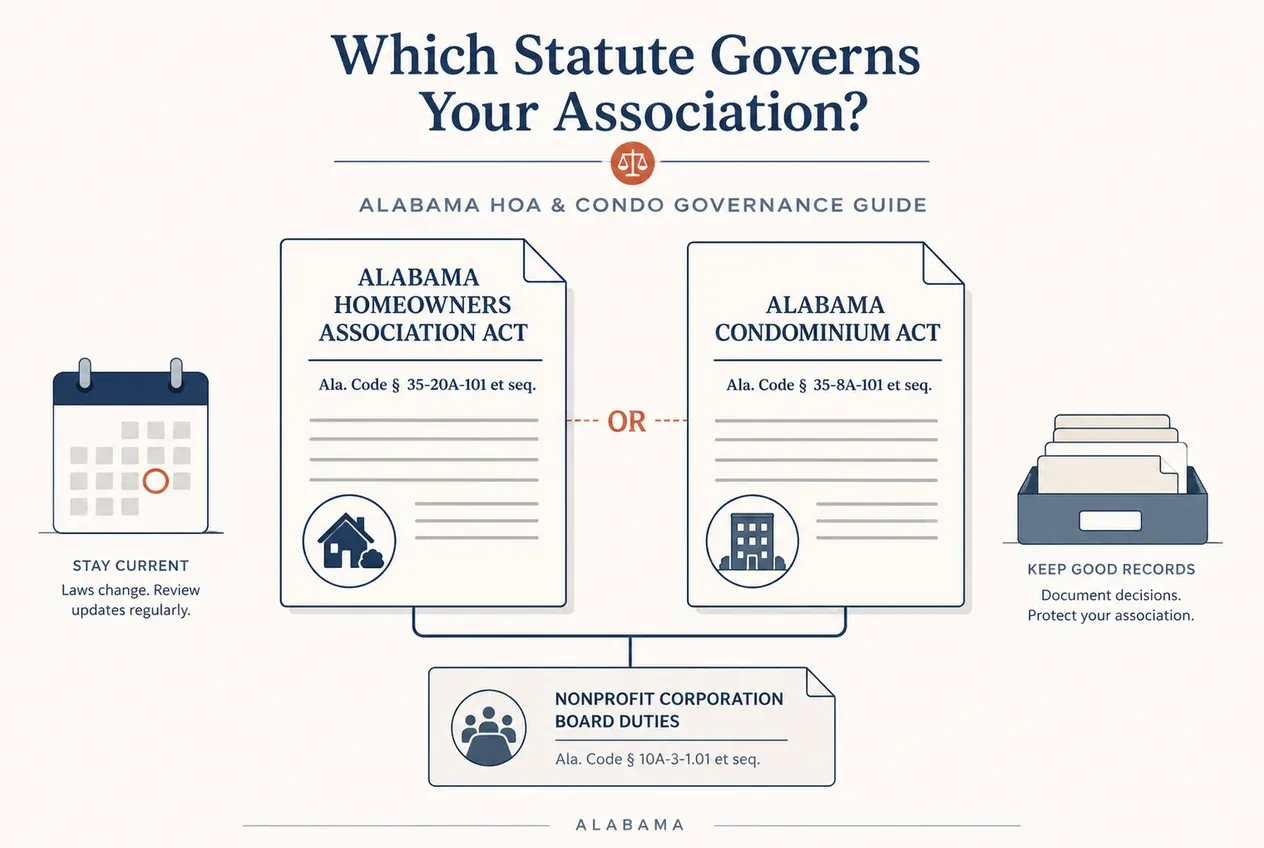
Alabama separates planned-community HOAs from condominiums. HOAs formed under a declaration on or after January 1, 2016 must operate as nonprofit corporations, while newer condos fall under the Alabama Uniform Condominium Act. Condo member meetings require 10–60 days’ notice; HOA records requested in writing must be produced within no more than 30 days. State law does not impose a general HOA reserve-study cycle or annual assessment cap.
Which statute governs your association
Start by identifying the property form, creation date, and declaration. A subdivision HOA is primarily governed by the Alabama Homeowners’ Association Act in Title 35, Chapter 20. The Act expressly ties covered HOAs to Alabama nonprofit-corporation law. Condominiums created after January 1, 1991 are instead governed principally by the Alabama Uniform Condominium Act in Chapter 8A; older condominiums may remain under Chapter 8. That distinction matters because meeting, insurance, voting, and assessment provisions are much more detailed for Chapter 8A condominiums than for Chapter 20 HOAs.
The board should then read the declaration, bylaws, and recorded amendments alongside the statute. Alabama’s HOA Act makes the declaration superior to conflicting HOA governing documents unless the declaration itself conflicts with the Act. In practice, many governance details are left to those documents and nonprofit-corporation law. If the CC&Rs, declaration, or bylaws impose a stricter notice period, approval threshold, audit rule, or procedural protection than the statutory floor, the board should follow the stricter governing-document requirement. Confirm the current statute text and any recent amendment before relying on this guide.
Reserve study and reserve funding
Alabama does not impose a general statewide reserve study cycle on ordinary planned-community HOAs. The HOA Act requires organizational documents to address annual budgets and requires associations to maintain financial records, but it does not create a California-style three-year reserve-study mandate or a Florida-style structural reserve funding regime. The statute also refers to reserve funds, if any, in the records that must be disclosed. For an HOA board, reserve planning is therefore largely a governing-document and fiduciary-budgeting question rather than a fixed statutory timetable.
The Uniform Condominium Act authorizes condominium associations to adopt budgets for revenues, expenditures, and reserves, and the maintenance allocation rules make the association responsible for common elements unless the declaration shifts responsibility. That authority is not the same as a statutory command to conduct a reserve study on a stated cycle or to fund reserves to a prescribed percentage. A condo board should therefore check the declaration, lender requirements, insurance conditions, and its long-term component schedule before assuming that “no statutory cycle” means “no reserve obligation.”
Insurance and fidelity bond
For Chapter 8A condominiums, the insurance article is a real statutory floor rather than an optional policy choice. The association must maintain the property and liability coverage required by Ala. Code § 35-8A-313 to the extent the coverage is reasonably available, subject to the declaration and the Act’s detailed treatment of condominium property. Boards should verify the current wording of § 35-8A-313 when renewing coverage because the allocation between unit interiors, common elements, deductibles, and reconstruction obligations can affect both claims handling and the annual budget.
The HOA Act is different. It says the organizational documents may provide for indemnification and insurance and may provide for fidelity bonds for people or entities having custody or control of association funds. That wording does not create a universal statutory fidelity-bond formula for every Alabama HOA. If your declaration or bylaws require a fidelity bond, crime coverage, D&O insurance, or a specified limit, that stricter document controls the board’s internal obligation. Treat “permitted by statute” and “required by your governing documents” as separate questions.
Open meetings, notice, and agenda
Alabama’s condo statute sets a clear member-meeting notice rule. A condominium association must meet at least annually, and notice of an association meeting must be delivered not less than 10 nor more than 60 days before the meeting. The notice must state the time and place and identify agenda items, including the general nature of proposed declaration or bylaw amendments, budget changes, and proposals to remove a director or officer. Those numbers apply to association meetings under § 35-8A-308; do not automatically treat them as a universal board-meeting notice rule for every HOA.
The HOA Act is more document-driven. It requires the organizational documents to provide rules and regulations for association meetings and methods of communication with members, but it does not create a single statewide open-board-meeting framework comparable to Arizona or California. A planned-community board should therefore read its bylaws, declaration, and nonprofit-corporation provisions before setting notice or attendance rules. If those documents promise owner attendance, advance agendas, longer notice, or special procedures, the board should honor them even where Chapter 20 itself is silent.
Quorum and voting thresholds
For condominiums, Chapter 8A contains specific quorum and voting provisions in §§ 35-8A-309 and 35-8A-310, while the declaration and bylaws can be critical to the final calculation. Proxy voting is addressed by the condo statute, but a board should not copy a threshold from a planned-community HOA or from another state. For declaration amendments, removal votes, elections, and special meetings, first identify the statutory section that applies and then compare it with any larger percentage or procedural protection in the declaration.
For planned-community HOAs under Chapter 20, much of the practical election machinery is left to the declaration, bylaws, and nonprofit-corporation framework. The HOA Act expressly allows a declaration or governing documents to define a period of declarant control and modification rights. That makes document review especially important when a community is transitioning from developer control. A board should distinguish a majority of votes cast, a majority of a quorum, and a percentage of all membership interests; those are not interchangeable concepts, and the declaration often determines which one applies.
Records access and retention
Alabama gives planned-community HOA members a concrete disclosure right. Under Ala. Code § 35-20-13, a covered HOA must make specified records and information available to a member or potential purchaser after a written request within a reasonable time that may not exceed 30 days, subject to reasonable associated costs. The listed material includes current and pending assessments, the operating budget and reserve funds if any, insurance documents including any fidelity bond, governing documents, association loans, contact information, transfer fees, common areas, and specified public-record litigation information.
The condo statute also requires association records to be reasonably available, but boards should use the condominium-specific records provision rather than importing the HOA Act’s 30-day list. Retention periods are not comprehensively standardized across every category in the two property regimes, so the board should combine the governing documents with nonprofit-corporation record duties, tax and accounting rules, insurance requirements, and litigation-hold practices. A written records retention schedule is useful precisely because Alabama statutes do not replace all of those sources with one uniform retention table.
Budget and assessment disclosure
The HOA Act requires the organizational documents to provide for preparation and submission of annual budgets to members. It also requires records that disclose the most recent assessments, pending board-approved assessments not yet in effect, and the current operating budget and reserve funds, if any, when a proper records request is made. The Act does not create a universal owner-ratification procedure for every annual HOA budget. Boards therefore need to check their declaration and bylaws for notice, delivery, hearing, or membership-approval requirements before adopting the next fiscal-year budget.
For condominiums, the Uniform Condominium Act authorizes annual common-expense assessments based on association budgets and contains separate assessment-allocation rules. The safest workflow is to document the budget assumptions, identify which expenses are common expenses under the declaration, and record the vote adopting the budget. If the governing documents promise a budget mailing, owner meeting, ratification opportunity, or financial review beyond the statute, use that stricter process rather than relying on the statute as a ceiling.
Limits on assessment and fee increases
Alabama does not impose a general statewide percentage cap on annual HOA assessment increases comparable to California’s 20-percent board threshold or Arizona’s planned-community rule. For a Chapter 20 HOA, the declaration and bylaws are therefore the first place to look for limits on regular assessments, special assessments, member votes, or formulas tied to budget increases. A board should not describe the absence of a statewide cap as unlimited power: the declaration, contract principles, nonprofit duties, and the requirement of good-faith performance still matter.
Condominium assessments are governed by Chapter 8A’s common-expense provisions and the allocation stated in the declaration. Special charges, fines, late charges, and assessment liens are separate concepts and should be coded separately in the ledger. Before raising dues, the board should confirm both its power to adopt the budget and the method for allocating the resulting common expenses. When a declaration imposes a lower increase ceiling or a member-vote requirement, that stricter restriction should be treated as the operative internal rule.
Fines and enforcement due process
Alabama’s HOA Act allows organizational documents to include reasonable rules for common areas and penalties for violations, but it does not supply one detailed statewide fine-hearing script for every planned community. That means the board should read the declaration, bylaws, rules, and nonprofit procedures before issuing a monetary penalty. At minimum, enforcement should be consistent, tied to an identified rule, documented in the minutes or enforcement file, and carried out in good faith. Avoid creating an informal penalty schedule that conflicts with the recorded documents.
The condominium statute expressly authorizes reasonable fines after notice and an opportunity to be heard, and assessment-lien rules address when fines and other charges can be treated as amounts due to the association. Because lien enforcement can affect title and foreclosure rights, boards should not collapse “a valid rule violation,” “a properly imposed fine,” and “a lien-enforceable charge” into one step. Use the fine hearing due process described by the statute and governing documents, then separately verify any collection or lien remedy before proceeding.
Sources
- Alabama Homeowners’ Association Act — official Code of Alabama portalPrimary HOA statute; Chapter 20 runs from §§ 35-20-1 to 35-20-14.
- Alabama Uniform Condominium Act — official Code of Alabama portalPrimary condominium act and applicability/transition section.
- Ala. Code § 35-20-13 — HOA recordsOfficial records-access section; includes the 30-day outside limit.
- Ala. Code § 35-8A-308 — condominium meetingsOfficial annual/special meeting and 10–60 day notice rule.
- Ala. Code § 35-8A-313 — condominium insuranceOfficial insurance section; verify current subsection wording before publication.
Compare nearby state rules
Check one decision against the statute
For a single board decision — a fine, a special assessment, a records request, an election, a CC&R amendment — the State Decision Lookup resolves the verified statutory rule for Alabama and a growing set of other states, and the Board Decision Router lays out the research sequence. Both fail closed when the primary law is unclear rather than guessing.