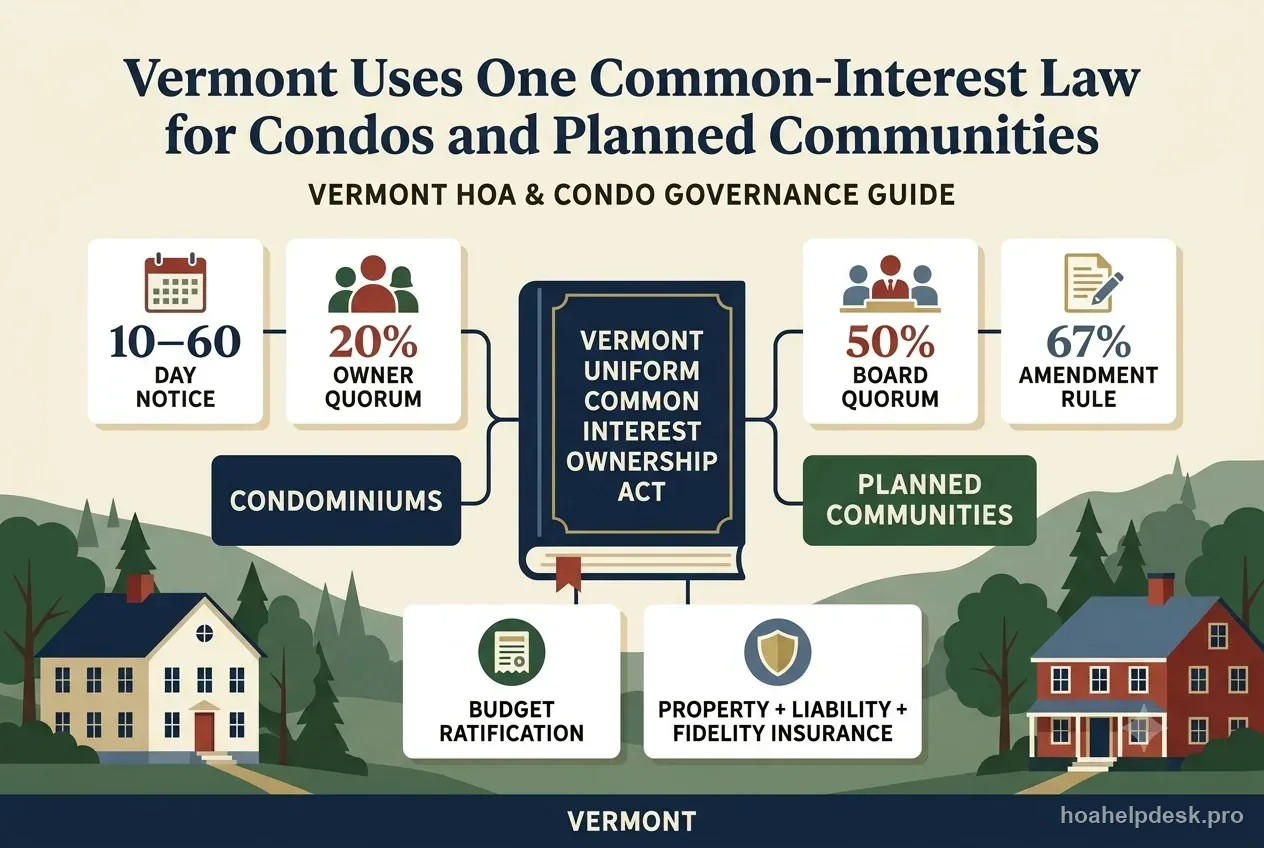
Vermont uses one UCIOA-based statute for condominiums and planned communities. Owner-meeting notice is generally 10 to 60 days, default owner quorum is 20%, and board quorum is 50%. The ordinary declaration-amendment threshold is generally 67% unless a different lawful rule applies. Associations must carry specified property, liability, and fidelity insurance, while budgets are subject to a statutory owner-ratification process.
Which statute governs your association
Vermont is simpler than states with separate HOA and condo acts because Title 27A adopts the Uniform Common Interest Ownership Act for condominiums, cooperatives, and planned communities within its scope. The same management article therefore supplies many board, owner-meeting, insurance, records, budget, and assessment rules. Boards should still identify the community type because some provisions vary by condominium, cooperative, planned community, residential use, or declaration terms.
Older communities need an applicability check. Vermont’s preexisting-community provisions determine which parts of Title 27A apply to projects created before January 1, 1999, so age can matter even though the state now has one common-interest framework. If a declaration or bylaws impose a stricter valid requirement than the statutory minimum, follow the stricter rule unless Title 27A makes its provision mandatory. Confirm the current statute text and any recent amendment before relying on this guide.
Sources: [1]
Reserve study and reserve funding
Vermont UCIOA does not establish a statewide recurring professional reserve study cycle comparable to Utah’s six-year analysis or Tennessee’s five-year condo rule. Instead, the budget provisions require the board to disclose reserve information as part of the proposed annual budget and provide the basis on which reserves are calculated. That makes reserve planning a recurring governance responsibility without prescribing one fixed professional-study interval for every community.
A board should therefore avoid stating that Vermont law requires a reserve study every three, five, or ten years unless a project document independently creates that schedule. Build the capital plan from common-element responsibilities, useful lives, insurance deductibles, and the declaration, then show the reserve basis in budget disclosure. If the governing documents require a formal study or minimum contribution, that stricter requirement controls the board’s funding process.
Sources: [1]
Insurance and fidelity bond
Vermont has concrete insurance requirements. Under 27A V.S.A. § 3-113, an association must maintain specified property insurance, to the extent reasonably available, on common elements and certain planned-community property. The property coverage must be at least 80% of actual cash value after application of deductibles, excluding items normally excluded from property policies. The statute also requires general liability coverage and fidelity insurance.
Those statutory categories are a floor, not a substitute for reading the declaration. The project documents may require broader limits, replacement-cost treatment, deductible allocation, or D&O insurance. Boards should review coverage at renewal against current construction costs and common-element responsibilities rather than treating the 80% actual-cash-value floor as an ideal target. Fidelity bond or crime coverage should also reflect the amount and access controls for operating and reserve funds.
Open meetings, notice, and agenda
Vermont’s meeting statute is detailed. An association must hold an annual unit-owner meeting and must call a special meeting when authorized officials or owners holding at least 20% of votes, or a lower percentage stated in the bylaws, properly request one. Notice for annual and special owner meetings must generally be given not less than 10 nor more than 60 days before the meeting and must state the time, date, place, and agenda information required by statute.
Board meetings are generally open to unit owners under Title 27A, and owners must receive a reasonable opportunity to comment, subject to statutory procedures and permitted executive session topics. The board should avoid using an executive session as a substitute for public final action. For amendments, budget changes, or director removal, make sure the notice identifies the general nature of the proposed action so owners are not asked to vote on a materially different issue.
Sources: [2]
Quorum and voting thresholds
Unless the bylaws provide a larger percentage, Vermont’s default unit-owner quorum is 20% of votes in the association, represented by persons present, proxy, or permitted absentee ballot. Board quorum is generally 50% of the votes on the executive board unless the bylaws specify a larger percentage. Proxy voting is expressly part of the UCIOA framework, but boards should still verify form, duration, and any election-specific rules in the bylaws.
Declaration amendment is separately governed by Article 2. The ordinary default is at least 67% of votes in the association unless the declaration specifies a different lawful percentage, while certain amendments require greater or unanimous consent and some use restrictions have special thresholds. Before asking owners to amend the CC&Rs, identify which category the amendment falls into instead of assuming every change uses the same 67% denominator.
Sources: [1]
Records access and retention
Vermont’s association-records statute requires records sufficient to document receipts and expenditures, minutes of owner and executive-board meetings except permitted executive sessions, owner information, governing materials, and other association business. The statute also provides owner inspection rights and identifies records that may be withheld or redacted. A board should use the current Section 3-118 text when responding rather than relying on a generic nonprofit records policy.
Title 27A does not reduce records retention to one single number for every category. Build a schedule that tracks statutory minimums and keeps governing documents, recorded amendments, owner and board minutes, budgets, tax and audit records, insurance, contracts, and reserve support for appropriate periods. When an owner asks to inspect records, log the request, the statutory purpose and limits, any redaction basis, copying cost, and the records actually produced.
Budget and assessment disclosure
Vermont has an owner-ratification process rather than a simple board-only budget rule. After the executive board adopts a proposed budget, the association must provide a summary to owners within 30 days, including reserves and the basis for them, and set a meeting to consider ratification not less than 10 nor more than 60 days after the summary is provided. Unless the required owner majority rejects it, the budget is ratified without a quorum requirement.
Special assessments generally use a similar ratification framework. An emergency exception allows a special assessment to become effective with a two-thirds executive-board vote when necessary to meet an emergency, followed by prompt owner notice and use of funds only for the stated emergency purpose. These procedures make budget disclosure a board-control function: notices, reserve assumptions, vote denominator, and meeting date should all be documented before assessments are billed.
Sources: [5]
Limits on assessment and fee increases
Vermont does not impose a simple annual percentage cap on ordinary common-expense assessment increases. Instead, the budget-ratification process gives owners a statutory rejection mechanism, while the declaration allocates common expenses and may impose additional limits. A board should therefore avoid describing assessment authority as unlimited merely because Title 27A lacks a California-style 20% dues cap. The budget procedure and declaration remain real constraints.
For a special assessment, Section 3-123 should be read before billing owners because the same ratification concept generally applies, subject to the emergency rule. Boards should state whether the charge is part of the annual budget, a separate special assessment, or an emergency assessment, and should identify the owner-vote procedure that follows. If governing documents require a higher approval threshold, the board should use that stricter valid requirement.
Fines and enforcement due process
Vermont UCIOA authorizes associations to enforce the declaration, bylaws, and rules, but a board should trace each fine to valid authority and follow statutory and document-based notice procedures. Title 27A’s meeting, record, rule, and due-process structure matters when an owner contests an enforcement action. Before a fine is imposed, document the violated provision, evidence, owner notice, any cure or hearing opportunity, and the board authority making the decision.
Do not treat an enforcement fine as interchangeable with a common-expense assessment. Lien and collection consequences can differ, and the declaration may grant additional process. If the governing documents promise a hearing, appeal, or longer notice period, follow that procedure even when the statute could permit a shorter path. Consistent treatment and a clear written record are especially important where the board later seeks to collect or defend the charge.
Sources: [1]
Sources
- Vermont Legislature — Title 27A, Article 3, ManagementState legislature statute portal for UCIOA management provisions; site notes the online text is an unofficial convenience copy and currently includes 2025 session actions.
- Vermont Legislature — 27A V.S.A. § 3-108 MeetingsOfficial legislature-hosted online statute for owner and board meeting requirements.
- Vermont Legislature — 27A V.S.A. § 3-113 InsuranceLegislature-hosted statute text for property, liability, and fidelity insurance.
- Vermont Legislature — Article 3 index including § 3-118 RecordsLegislature-hosted chapter index and full-text access for association records and other management provisions.
- Vermont Legislature — 27A V.S.A. § 3-123 budgets and special assessmentsLegislature-hosted text containing budget summary, ratification, and emergency special-assessment rules.
- Vermont Legislature — 27A V.S.A. § 2-117 amendment of declarationLegislature-hosted Article 2 source; verify §2-117 amendment thresholds and preexisting-community applicability before publication.
Compare nearby state rules
Check one decision against the statute
For a single board decision — a fine, a special assessment, a records request, an election, a CC&R amendment — the State Decision Lookup resolves the verified statutory rule for Vermont and a growing set of other states, and the Board Decision Router lays out the research sequence. Both fail closed when the primary law is unclear rather than guessing.